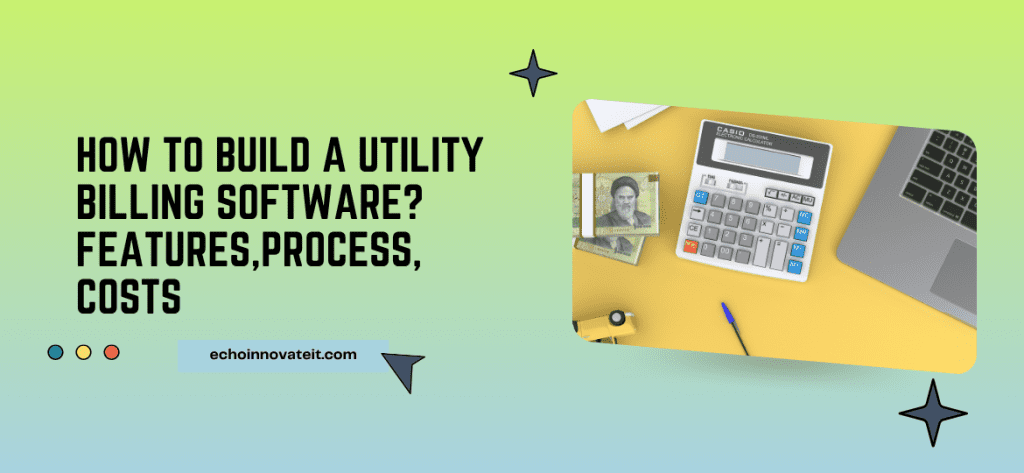
Building custom utility billing software in 2026 typically varies widely in cost, depending on how many utility types you bill, how complex your rate structures are, and how deeply the system integrates with metering and payment infrastructure. A focused MVP that handles accounts, meter readings, a straightforward rate plan, and invoicing sits at the entry level, while a full platform serving multiple utilities with tiered rates, a customer portal, and payment processing sits at the top of the range. Timelines run from roughly 3 months for an MVP to a year or more for a complete system.
Utility billing is deceptively hard. It sits at the intersection of accurate consumption data, complex rate calculations, strict billing cycles, payments, and regulatory reporting — and an error in any of them shows up directly on a customer’s bill. That is why the rating engine and data accuracy matter more here than flashy features. This guide covers what utility billing software does, realistic 2026 costs, the features that matter, the integrations that drive complexity, and how long a build actually takes — written for utility operators, municipalities, and SaaS founders entering the space.
Key takeaways
- Custom utility billing software cost varies widely by scope; rate complexity and integrations drive the number.
- The rating engine and data accuracy are the heart of the system — get them right before adding anything else.
- Start with an MVP for one utility type and a simple rate plan, then add utilities, tiered rates, and a customer portal.
- The biggest cost drivers are complex rate structures, meter-data integration, payment processing, and regulatory reporting.
- A short scoping call produces a transparent, fixed quote and a clear phase plan.
What utility billing software does
Utility billing software turns consumption into an accurate, collectible bill, and manages everything around that process. Whether you bill water, electricity, gas, waste, internet, or a mix, the core job is the same: capture how much each customer used, apply the correct rates, produce a bill, take payment, and keep the books and regulators straight. It is essentially specialized accounting software with a consumption-metering front end and a rating engine at its core.
A complete system handles several connected jobs. It maintains customer and account records tied to service locations and meters. It ingests meter data — manual readings, imported files, or automated meter infrastructure (AMI/AMR) feeds. It runs a rating engine that applies tariffs, tiers, seasonal rates, taxes, and fees to that usage. It manages billing cycles, generating invoices on schedule and handling prorations, adjustments, and corrections. It processes payments and tracks arrears, late fees, and collections. And it produces the reporting that finance teams and regulators require.
The reason this is a custom-software problem rather than an off-the-shelf purchase for many operators is that rate structures and local regulations vary enormously. A municipal water utility, a private energy reseller, and a sub-metering company for apartment buildings each need different rating logic, different reporting, and different integrations. When a generic package forces your tariffs to bend to its model — or cannot represent them at all — a custom build becomes the sensible path. Our custom software development team scopes exactly these rate and integration requirements before any code is written.
How much does it cost to build utility billing software?
Utility billing cost scales with rate complexity, the number of utilities and integrations, and the depth of the customer-facing and reporting layers. The tiers below are 2026 market ranges for custom software builds of this kind, not fixed EchoInnovate IT prices — we provide a transparent quote after a short scoping call, because rate structures and meter-data integration move the figure significantly.
| Tier | Investment level | What it includes | Timeline |
|---|---|---|---|
| MVP | Entry-level | Accounts, meters, manual/imported readings, one rate plan, invoicing, basic payments and reporting | 3–5 months |
| Growth | Mid-range | Tiered/seasonal rates, multiple utility types, customer portal, online payments, arrears and collections, richer reporting | 5–8 months |
| Scale | Enterprise-scale | AMI/AMR meter integration, complex multi-tariff rating, regulatory reporting, accounting integration, high-volume batch billing | 9–14 months |
Two factors push a project up the tiers fastest: rate complexity (every additional tariff type, tier, and seasonal or time-of-use rule adds logic and testing) and meter-data integration (connecting to automated metering infrastructure is a substantial engineering effort). For broader build economics, see our custom software development cost guide, and if you plan to offer the product as a subscription service, our SaaS development cost guide.
Must-have features
Utility billing rewards correctness over polish. These are the features that a serious system needs, and the ones best added in later phases.
Customer and account management. Records linking customers, service addresses, and meters, with the ability to handle moves, transfers, and multiple accounts per customer. This is the foundation the rating engine reads from.
Meter and consumption data. Capturing readings by manual entry, file import, or automated feeds, with validation to catch impossible or missing reads before they become wrong bills. Data quality control here prevents the most common billing disputes.
The rating engine. The core of the system: applying tariffs, tiered and seasonal rates, time-of-use pricing, taxes, connection fees, and discounts to each account’s usage. This is where most of the real engineering and testing goes, because it must be exactly right.
Billing cycles and invoicing. Scheduled bill runs, prorations for partial periods, adjustments and corrections, and clear, accurate invoices in print and digital formats. Batch billing at volume needs to be reliable and repeatable.
Payments and accounts receivable. Recording payments, tracking balances and arrears, applying late fees, and managing collections and payment plans. Integration with payment processors makes this smooth for customers.
Customer self-service portal. A web (and often mobile) portal where customers view usage and bills, pay online, and manage their accounts. This reduces call-center load and is increasingly expected.
Reporting and reconciliation. Financial, operational, and regulatory reports, plus reconciliation between billed, collected, and outstanding amounts. Finance and compliance teams live in this layer.
Features usually deferred: advanced analytics and demand forecasting, prepaid billing, complex multi-entity consolidation, and AI-driven consumption insights. Each is valuable and each is easier to justify once the core billing engine is proven accurate.
Tech stack and integrations
Utility billing is a data-integrity and calculation problem, so the stack is chosen for reliability, auditability, and correct handling of money and large batch jobs. The backend typically runs on Java, C#/.NET, Python, or Node.js, paired with a strong relational database — PostgreSQL or a comparable engine — because billing data is highly relational and must support precise financial calculations and a complete audit trail. Money is handled with exact decimal types, never floating point, and every rate change and adjustment is logged for accountability.
The frontend for staff and the customer portal usually uses React or Vue, giving operators fast account and billing screens and customers a clean self-service experience. Hosting sits on AWS, Google Cloud, or Azure, with a background job system for scheduled bill runs and a reporting layer for finance and compliance. High-volume operators need the batch-billing pipeline designed for scale from the start.
The integrations that most affect cost and complexity are:
- Metering infrastructure (AMI/AMR systems, meter-data management platforms) for automated consumption feeds — usually the largest integration effort
- Payment processing (card, ACH/bank transfer, and local payment methods) for online and recurring payments
- Accounting and ERP systems (QuickBooks, SAP, and others) so billing flows into the general ledger
- Communications (email, SMS, and print/mail providers) for bill delivery and reminders
- Regulatory and tax services where jurisdictions require specific reporting or tax calculation
Each integration adds development, testing, and ongoing maintenance, and metering and payment integrations in particular demand rigorous handling of edge cases, because errors translate directly into wrong bills or failed collections. A disciplined build connects the one meter source and the one payment method that matter most first, then expands. Adding specialist integration engineers through IT staff augmentation is a common way to handle a heavy metering or ERP phase without permanent headcount.
How long it takes
A utility billing timeline runs from about three months for a lean MVP to a year or more for a full multi-utility platform. The phases are predictable, and the rating engine plus data migration deserve extra attention because they carry the most risk.
Discovery and rate modeling (2–4 weeks). Mapping your utilities, tariff structures, billing cycles, meter sources, and reporting requirements. Rate modeling is the make-or-break phase; capturing every tier, season, and fee correctly here prevents expensive rework and produces the fixed quote.
Design and data architecture (2–4 weeks). Screens for operators and customers, plus the data model for accounts, meters, rates, and transactions. A clean, auditable financial data model is essential.
Core build (8–16 weeks). Account management, meter data, the rating engine, billing cycles, and invoicing. The rating engine is tested exhaustively against real scenarios. An MVP often launches at the end of this phase for one utility and one rate plan.
Payments, portal, and integrations (6–16 weeks). Payment processing, the customer self-service portal, meter-data integration, and accounting connections. This is where timelines stretch most, especially with automated metering infrastructure.
Data migration, testing, and go-live (3–8 weeks). Migrating existing customer, meter, and balance data; parallel-running old and new billing to verify accuracy; and phased cutover. In billing, parallel runs are not optional — you confirm the new system produces identical bills before switching.
Scope discipline and correctness are the biggest levers. Launching for one utility type and one rate plan, proving accuracy against real bills, then expanding is far safer than a big-bang cutover. Building with a dedicated offshore team can compress the calendar while keeping cost predictable; see our guide on how to hire offshore developers.
What drives the cost
Five drivers explain most of the difference between a lean billing MVP and a large-scale platform. Control these and you control the budget.
1. Rate and tariff complexity. This is the largest single driver. A single flat rate is simple; tiered, seasonal, time-of-use, and multi-tariff structures each multiply the rating logic and the test cases needed to prove every bill is correct.
2. Meter-data integration. Manual and imported readings are inexpensive to support. Integrating with automated metering infrastructure (AMI/AMR) or a meter-data management platform is a substantial engineering effort and a defining cost of a large system.
3. Number of utility types. Billing one utility is far simpler than billing water, electricity, gas, and waste on one platform, each with its own rates, units, and rules. Every additional utility adds rating logic and reporting.
4. Payments, portal, and collections. A basic payment record is cheap. Online and recurring payments, a full customer self-service portal, and arrears and collections workflows each add meaningful build and compliance work.
5. Regulatory reporting and accounting integration. Jurisdiction-specific reporting, tax handling, and integration with an ERP or general ledger add real engineering, and they are non-negotiable where they apply.
The practical takeaway: get the rating engine and data model right for one utility and one rate plan first, prove it against real bills, then expand utilities, tariffs, and integrations from a solid base. That sequencing controls both cost and risk. Our software development company scopes exactly this path before any code is written.
How EchoInnovate IT builds your billing software
EchoInnovate IT is an India-based custom and white-label software development company with 12 years of experience and a team of 50+ employees. We have delivered 500+ products, most under our clients’ own brands, and hold a 5.0 rating across 6 verified reviews on Clutch. A large share of that work is data-heavy business systems — billing, accounting, and operations platforms — where correctness and auditability matter as much as the interface.
For a utility billing build we start with a discovery and rate-modeling session that captures every tariff, tier, seasonal rule, and fee, along with your meter sources, billing cycles, and reporting requirements. From that we produce a fixed, transparent quote and a phase plan. A dedicated team then builds and exhaustively tests the rating engine and core billing for one utility and one rate plan, launches it in parallel with your existing process to verify accuracy, and expands from there.
Because we work as a software development company and offer IT staff augmentation, you can engage us for a complete build or add specialist engineers — rating logic, meter integration, or payments — to your existing team for a single phase. You own the code, the data model, and the roadmap throughout. When you are ready to add consumption analytics or forecasting, our AI development services team can layer it in.