
Picture a digital ledger that cannot be changed. Every transaction on it can be verified with certainty. That is the core of blockchain. It has moved from fringe finance into the mainstream. It now plays a role in industries as different as healthcare and supply chain. Its potential to transform is already clear.
Now picture that power built into the web apps we use every day. Blockchain integration can reshape web development. It enables decentralized apps that are more secure, transparent, efficient, and user-focused. The possible uses are wide. They range from decentralized marketplaces to secure identity management. Related: fintech app development services.
This journey will not be free of obstacles. Scaling, security, and user experience are tough hurdles. Still, blockchain’s potential is immense. It can build next-gen web applications that reimagine trust and data ownership. Blockchain will play a key role in writing that story.
This blog post is your practical guide to blockchain integration in web development. We demystify the technology and explore real-world use cases. We also offer actionable insight. That insight helps you build tomorrow’s decentralized websites.
Why Blockchain Integration Has Matured in 2026 Web Development
The blockchain hype cycle of 2021-2022 cooled hard in 2023-2024. But the underlying technology has matured a lot by 2026. It is now a practical part of mainstream web development for specific use cases. Stablecoins handle over $7 trillion in annual on-chain volume. Account abstraction (ERC-4337) made wallet UX 10× better. And Layer 2 scaling solutions (Base, Arbitrum, Optimism) brought transaction costs to fractions of a cent.
Are you considering blockchain integration in web development in 2026? The genuinely useful integrations cluster into five practical categories. These are stablecoin payments (USDC integration via Coinbase, Circle, or Stripe), identity + verification (Sign-in with Ethereum, ENS names), asset tokenization (real estate, invoices, carbon credits), NFT-based access control (token-gated content, membership), and provenance tracking (supply chain, art authentication).
This guide covers practical blockchain integration in web development in 2026. It walks through concrete use cases and technical stack choices. It also covers what to evaluate before you integrate. Are you building a blockchain-integrated product? Then see our custom software development services.
Understanding the Basics of Blockchain
6 min read · Last updated: May 2026
At its core, blockchain is a new way to store and manage data. It has clear advantages over traditional databases. Here is the key difference. Data no longer sits on individual servers. Instead, it lives across a linked network of nodes. It sits in an encrypted, distributed ledger. Related: mobile app development services.
- Decentralization: Blockchain does not rely on one central authority to store information. Instead, it spreads the information across a network of computers. This removes single points of failure and strengthens security. The result is like a public ledger where every member has equal access.
- Immutability: Once data is recorded on a blockchain, it is almost impossible to change or delete. No individual or institution can alter it without major consequences. Cryptographic hashing enforces this. It keeps the data intact and trustworthy.
- Cryptography: Blockchain relies heavily on cryptography for secure transactions and data. These techniques include hashing algorithms and digital signatures. Together, they block unauthorized access and manipulation by third parties.
- Distributed Ledger Technology (DLT): Blockchain is one type of DLT. In this model, ledger data is shared and synchronized across many participants. It is updated in a transparent, accountable way. This distributed nature helps ensure transparency.
Key Components of Blockchain
Understanding these components is paramount when creating blockchain-integrated web apps:
- Blocks and Chains: Data is organized into “blocks.” These blocks link together in order to form a chain. Cryptographic hashes hold the chain together. Each block includes the hash of the one before it. That keeps every record intact.
- Transactions: Transactions are the exchange of value or information among participants. They form the core structure of a blockchain.
- Consensus Mechanisms: Consensus mechanisms are algorithms that keep the network in agreement. They make sure all participants accept transactions as valid. Proof of Work (PoW) is one example. It requires participants to solve complex math puzzles to validate transactions.
- Proof of Stake (PoS): In this system, validators are chosen by how many tokens they own. They must also be willing to stake those tokens.
- Smart Contracts: Smart contracts are self-executing agreements written in code. They automate processes and enforce terms without intermediaries.
Key Steps To Integrate Blockchain Into Web Development
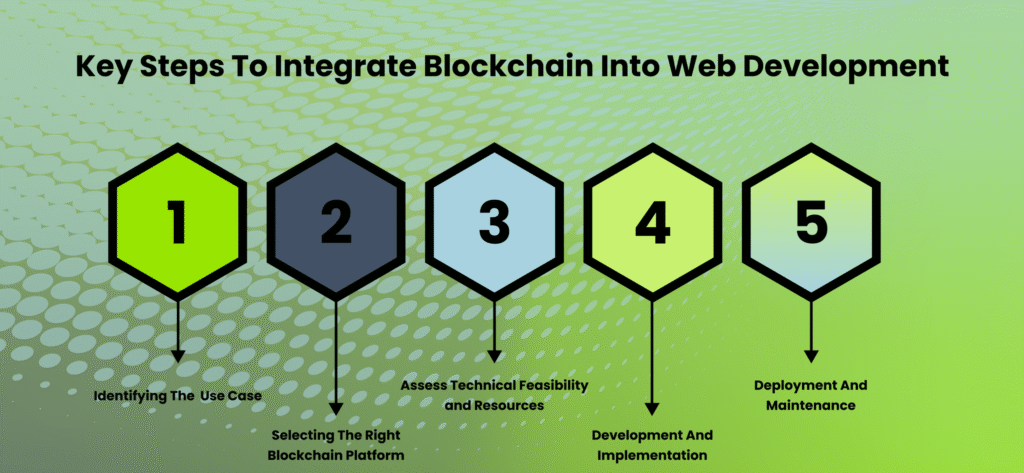
Adding blockchain to a web development project takes an organized approach. Here is an outline of the key steps:
Identifying The Use Case
Step one is to define the specific use case. Do not add blockchain just for its own sake. Instead, ask yourself a few questions. What problem are you solving? Does blockchain offer a unique advantage over traditional solutions? Do decentralization, immutability, or transparency play an essential part in your app? Related: hire cross-platform developers.
Maybe you want to enhance data security. Maybe you want secure transactions or a decentralized marketplace. Either way, a clear use case guides the development process. It also ensures the integration delivers real value to everyone involved.
Selecting The Right Blockchain Platform
Once you know your use case, choose the right blockchain platform. Weigh factors like scalability, transaction speed, cost, developer tools, and community size. Ethereum excels at complex smart contracts, thanks to its large developer community. Polygon provides solutions for scaling Ethereum apps. Solana stands out for fast transaction throughput. Hyperledger serves enterprise applications with a strong framework for private, permissioned blockchains. So weigh your project needs carefully before you pick a platform.
Evaluate Technical Feasibility and Resources
Before you start any development, assess the technical feasibility and the resources you need. Look at your team’s experience in blockchain development, such as smart contract creation and web3 integration. Note any complex issues that may need outside expertise, like library or API availability. Also review your hardware and software requirements. That includes node infrastructure and development tools. A thorough assessment prevents delays. It can also save money and keep development on track. Related: custom software development.
Development and Implementation
From here, the hard coding begins. Create smart contracts and connect them to your web app. Build front-end and back-end components with web3 libraries such as web3.js or ethers.js. These libraries let your app interact with the blockchain. Follow proper security practices, like key management and smart contract auditing. Run rigorous tests to confirm it works and is free of vulnerabilities. Finally, create user-friendly interfaces. They should simplify complex blockchain interactions for a wider audience.
Deployment and Maintenance
After careful evaluation and thorough testing, it is time to launch on the main net. This step configures infrastructure, deploys smart contracts, and makes sure users can access the app. After deployment, ongoing maintenance becomes critical. Monitor the app’s performance closely. Fix bugs and security vulnerabilities as they appear. Stay current with new blockchain developments. Update smart contracts as needed to maintain compatibility and security. Support users and keep improving based on their feedback. And regularly compare your app against competitors’ offerings.
Conclusion
Blockchain integration opens a new era of secure, transparent, decentralized apps. We have seen how it improves data integrity and enables secure transactions. We have also seen how it helps build innovative apps. The benefits include greater trust and simpler processes. Together, they create a more equitable digital landscape. Related: AI-powered app development.
Ready to explore blockchain integration? Our team can help make your vision real. Our custom software development team builds blockchain-integrated products, under your brand. Contact EchoInnovate IT to get started.
FAQs On Integrating Blockchain Technology into Web Development
Conclusion
The blockchain integrations actually adding value in 2026:
- Stablecoin payments: USDC and USDT via Stripe, Coinbase Commerce, or Circle APIs. Faster and cheaper than international wire transfers, with no chargebacks. Adoption is growing in B2B and cross-border payments.
- Sign-in with Ethereum / Sign-in with Bitcoin: Cryptographic auth without passwords. Useful for crypto-native audiences, but not yet a mainstream replacement for OAuth.
- Token-gated content + memberships: NFTs used as membership keys. Adopted by communities (Bored Ape Yacht Club spinoffs), creator platforms, and software-licensing experiments.
- Tokenized real-world assets (RWA): Tokenizing real estate, invoices, treasury bills, and carbon credits. Growing fast in B2B finance — BlackRock’s BUIDL token reached $500M+ AUM.
- Supply chain provenance: Tracking the origin of luxury goods, pharmaceuticals, and food. Real but slow-growing — it competes with traditional audit trails.
- Cross-border payroll: Crypto-payroll for distributed teams via Deel, Bitwage, and Toku. Faster and cheaper for a global workforce.
Building a web product that needs blockchain integration? EchoInnovate IT has built blockchain-integrated apps — stablecoin payment processors, tokenized RWA platforms, NFT-based memberships, supply chain tracking — through our custom software development and mobile app development services. We help teams pick the right blockchain (Ethereum, Solana, Layer 2, Polkadot, custom) and integration depth based on actual product needs. Get a free architecture consultation below.
Frequently Asked Questions
What features make a payment app truly stand out in today’s market?
A standout payment app should offer smooth user experience (UX), real-time transaction tracking, strong security (e.g., biometric login, end-to-end encryption), and multi-platform support. Integrating value-added features like budgeting tools, rewards, or crypto support can also give your app a competitive edge.
How important is UI/UX design in the success of a payment app?
UI/UX is critical. A smooth, intuitive design builds trust and keeps users engaged. Complex, clunky interfaces often drive users away—especially when dealing with something as sensitive as money. Clear navigation, responsive design, and user-centric features are key.
What security measures should be prioritized when developing a payment app?
Start with robust authentication (2FA, biometrics), encryption for data in transit and at rest, and secure APIs. Compliance with standards like PCI DSS and regular security audits are essential to ensure user trust and regulatory alignment.
Should my web app integrate blockchain in 2026?
Only if there’s a clear, specific reason. Good reasons in 2026: stablecoin payments for international transactions, token-gated communities or content for crypto-native audiences, RWA tokenization for B2B finance products, or provenance tracking for high-value goods. Bad reasons: “blockchain is the future”, “we want decentralization”, or “investors like it” — those almost always lead to over-engineered products users don’t want.
Which blockchain should I integrate with in 2026?
For most use cases: Ethereum + Layer 2 (Base, Arbitrum, Optimism) — largest ecosystem, mature tooling, lowest fees on L2. Solana for high-throughput consumer apps (DEXs, social, gaming) — fastest performance, cheapest transactions. Polygon for enterprise integrations — strong relationships with brands and ecosystem. Avoid integrating with niche chains unless your specific use case requires it; ecosystem maturity matters more than peak performance benchmarks.
How much does it cost to integrate blockchain into a web app?
A basic stablecoin payment integration (USDC via Coinbase Commerce or Circle) starts around $15K–$40K. NFT-based access control or token-gated content runs $30K–$100K. A full DeFi or RWA tokenization platform starts at $150K–$500K+ and adds significant compliance work. Smart contract audits (Trail of Bits, OpenZeppelin) typically cost $30K–$200K per audit and are non-negotiable for production deployments handling real money.
Launch Your Fintech App
Building a payment, trading, or banking app? Our fintech specialists build SEBI/RBI/PCI-compliant apps end-to-end.
