
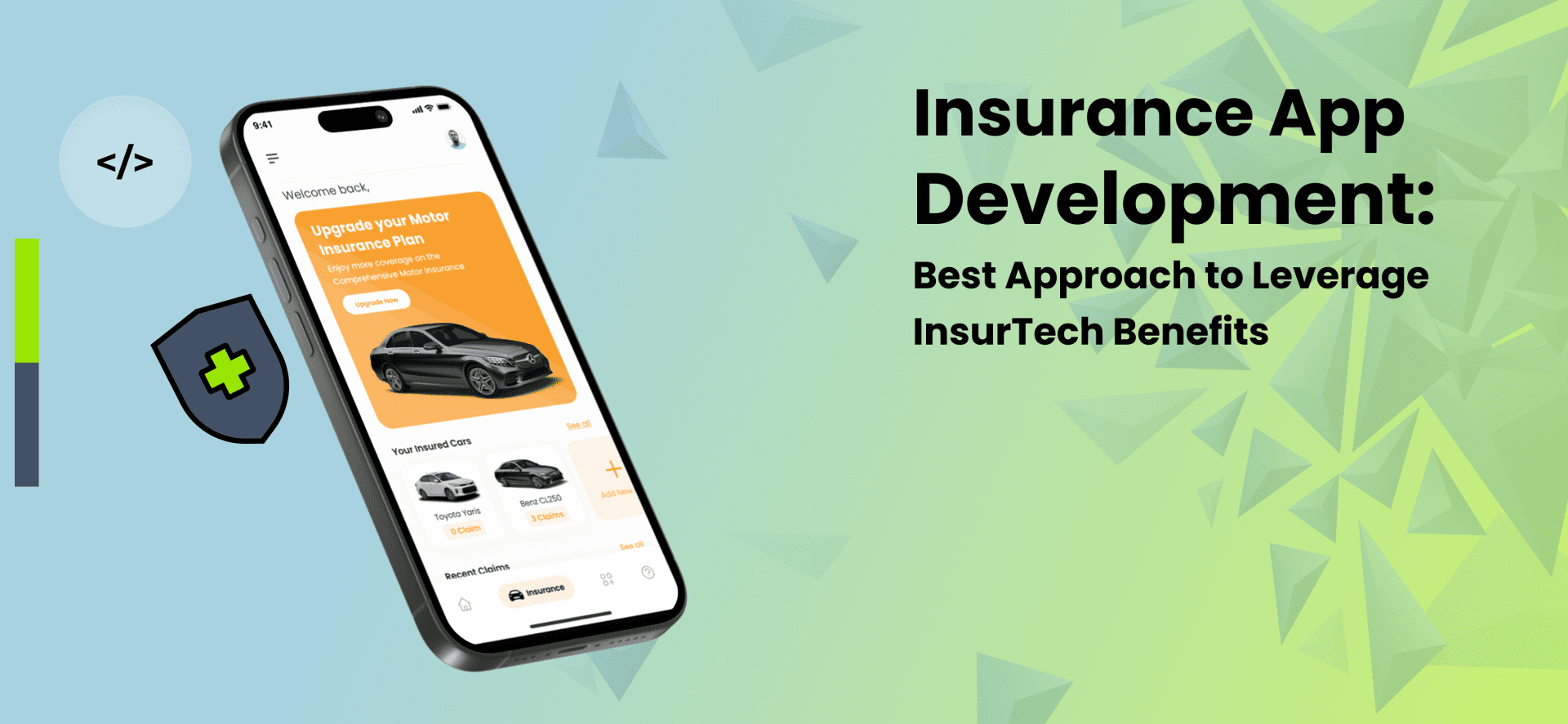
If you are planning an insurance app in 2026, cost is usually the first question, so here is the direct answer: most insurance app builds vary widely by scope, depending on how many insurance lines you support, whether you handle payments and claims end to end, and how much InsurTech automation, such as e-KYC, telematics, or AI fraud detection, you build in. A focused MVP for a single line of business, where customers view a policy and submit a claim, can start near the low end. A full InsurTech platform with underwriting logic, IoT-based pricing, and broker and adjuster portals sits at the top.
In practice, insurance apps are demanding because they combine regulated data, payments, document handling, and complex workflows, and they must integrate with core policy and claims systems that were often built decades ago.
This guide is written for the decision-maker approving the budget, not only the engineer. It covers 2026 market cost ranges, the features that matter, the tech stack and integrations, realistic timelines, what drives the price, and how a dedicated partner like EchoInnovate IT builds and maintains these products. For the wider context on app budgets, our mobile app development cost guide is a useful companion, and our mobile app development team handles the full build.
Key takeaways
- Insurance app cost depends on scope, features, and integrations; a single-line MVP is the cheapest way to launch.
- The hard part is not the app UI, it is integrating with core policy, claims, and payment systems and meeting compliance.
- InsurTech automation, such as e-KYC, telematics pricing, and AI fraud detection, is where budgets climb fastest.
- A typical first release takes 4–7 months; full platforms with underwriting take longer.
- Start with a fixed-price 2-week pilot sprint to validate scope and integrations before committing the full budget.
How much does it cost to build an insurance app?
Insurance apps do not have a single price, because scope varies enormously between a customer self-service app and a full InsurTech platform. The table below shows realistic 2026 market ranges by tier. Still, treat them as planning bands rather than quotes. The exact figure depends on your insurance lines, integrations, and compliance needs, which we confirm after a short scoping call.
| Project tier | What it includes | Investment level | Timeline |
|---|---|---|---|
| Single-line MVP | One product line, policy view, digital cards, first-notice-of-loss claim submission, push notifications | Entry-level | 4–5 months |
| Standard policyholder app | Multiple product lines, premium payments, full claims workflow, e-KYC and document upload, support chat | Mid-range | 5–7 months |
| InsurTech platform | Underwriting and rating engine, telematics or IoT pricing, AI fraud detection, broker and adjuster portals, analytics | Enterprise-scale | 8–14 months |
These ranges cover design, development, core integrations, security, testing, and launch. Ongoing costs, such as cloud infrastructure, compliance audits, and maintenance, are separate. Say you are entering a new market or testing a digital-first product. Then the lowest-risk path is to ship a single-line MVP, prove adoption, and expand. That is why we usually recommend starting with a scoped pilot rather than funding a full platform on day one. For a wider view of how MVP scope affects budget, see our MVP development cost guide.
Must-have features of an insurance app
The feature set defines both the customer experience and the budget. Some capabilities are expected in any modern insurance app. Others are InsurTech differentiators that fit specific lines like auto, health, life, or property. Below are the features that matter most in 2026.
Digital onboarding and e-KYC. Customers expect to buy or activate a policy from their phone. Identity verification, document capture, and electronic signatures turn a multi-day paper process into minutes. Increasingly, they are a regulatory expectation rather than a nice-to-have.
Policy management. This gives a clear view of active policies, coverage details, digital insurance cards, renewals, and beneficiaries. It is the core reason customers open the app, so it has to be fast and accurate against your policy system of record.
Claims submission and tracking. Here you capture first notice of loss, upload photos and documents, and track status in real time. A smooth claims flow is the single biggest driver of customer satisfaction, because claims are the moment customers judge the insurer.
Premium payments and billing. Customers need secure card and bank payments, autopay, payment history, and reminders. In turn, this requires PCI-compliant handling and integration with your billing platform.
Push notifications and reminders. Renewal alerts, payment reminders, and claim updates keep policies active and reduce lapse rates. As a result, they have a direct revenue impact.
In-app support. This covers chat, callback requests, and increasingly AI assistants that answer coverage questions and guide claims. Therefore it lowers call-center load while improving response times.
InsurTech automation. Finally, telematics for usage-based auto pricing, wearables for health, IoT sensors for property, and AI models for fraud detection and automated underwriting. These features personalize pricing and cut loss ratios, so they are what separate a digital brochure from a true InsurTech product. However, they also carry the most engineering and data cost, so phase them in deliberately.
Tech stack and integrations for insurance apps
An insurance app is mostly an integration and compliance project wearing a mobile front end. The visible app is a small fraction of the work; the value and the risk sit in the backend, the integrations, and the security model.
Mobile front end. A single cross-platform codebase in React Native or Flutter is the common choice, giving iOS and Android from one team and faster iteration. Native Swift and Kotlin are used when a feature such as advanced biometrics or telematics demands deep platform access.
Backend and APIs. A secure API layer, typically Node.js, Java, or .NET, orchestrates policy data, claims, payments, and documents. This layer enforces authentication, encryption, and audit logging, which regulators and insurers require.
Core system integrations. This is where insurance projects live or die. Apps must connect to policy administration systems (Guidewire, Duck Creek, or legacy mainframes), claims platforms, billing engines, and rating and underwriting services. Many of these expose limited or dated APIs, so integration and testing effort is significant and should never be underestimated.
Payments, identity, and third parties. PCI-compliant payment gateways, e-KYC and identity providers, e-signature services, document OCR, and, for InsurTech features, telematics providers, IoT device platforms, and AI or ML services for fraud and risk scoring.
Security and compliance. Encryption in transit and at rest, role-based access, and adherence to regulations such as HIPAA for health lines, GDPR or CCPA for personal data, and local insurance-authority rules. If you would rather extend your own engineering team than outsource the whole build, our IT staff augmentation option embeds dedicated insurance-experienced engineers alongside your team.
How long insurance app development takes
A realistic first release takes four to seven months for a standard policyholder app. The timeline is driven mostly by integrations, security review, and compliance rather than by app screens. So it pays to sequence the work carefully. Here is how the phases typically break down.
Weeks 1–3: discovery and compliance mapping. First, we confirm the lines of business, features, and the core systems the app must touch. We also map the regulatory requirements early, because compliance shapes architecture decisions you cannot easily reverse later.
Weeks 3–7: design and integration planning. Next, UX design runs in parallel with a deep look at your policy, claims, and billing APIs. Integration discovery is where hidden complexity surfaces, so we prototype the riskiest connections first.
Weeks 6–18: development and integration. Then the app, backend, and integrations are built in iterative sprints. Payments, e-KYC, and claims are wired in and tested against sandbox environments.
Weeks 16–24: security, compliance, and QA. This phase covers penetration testing, security review, and compliance validation. For regulated lines it is substantial and cannot be compressed without accepting risk.
Weeks 22–28: launch and stabilization. Finally, we handle app-store submission, production rollout, and close monitoring of the first live claims and payments. InsurTech platforms with underwriting engines then extend well beyond this, which is why phasing matters. Launching a single-line MVP first lets you go live faster and fund the platform from real usage.
What drives the cost of an insurance app
To control the budget, it helps to know which variables move the price most. On insurance projects, these are the five biggest cost drivers.
Number of insurance lines. Each product line, whether auto, health, life, or property, has its own data model, rules, and claims flow. So supporting several lines multiplies the configuration and testing work, and it is often the largest single factor.
Core system integrations. Connecting to policy administration, claims, and billing platforms is the biggest source of unpredictable effort, especially when those systems are legacy or expose limited APIs. Moreover, the more real-time and two-way the integration, the higher the cost.
Compliance scope. Regulated data, HIPAA for health, and financial rules add security engineering, documentation, and audit effort. Under-scoping compliance is the most expensive mistake, because retrofitting it is far costlier than designing for it.
InsurTech automation. Telematics, IoT pricing, and AI-driven underwriting or fraud detection require data pipelines, model work, and third-party device integration. These features deliver the strongest returns, yet they carry the highest build and data cost.
Payments and identity. PCI-compliant payments, e-KYC, and e-signature each add integration and certification work. Individually they are modest; together they are a meaningful line item. So deciding which you genuinely need for launch, versus phase two, is the fastest way to right-size the budget. That is exactly what a scoping call is for.
How EchoInnovate IT builds insurance apps
EchoInnovate IT is an India-based custom and white-label software development company with 12 years in the field, 50+ employees, and 500+ products shipped, most of them launched under our clients’ own brands. We hold a 5.0 rating on Clutch across 6 verified reviews. That white-label track record matters for insurance, because we have built regulated, integration-heavy mobile app products across finance and insurance, and we treat security, compliance, and clean core-system integration as the deliverable, not an afterthought.
Our approach is integration-first and compliance-first. We start by mapping the policy, claims, billing, and identity systems your app must touch, and we prototype the riskiest integrations before writing a line of UI, so cost and timeline surprises surface early rather than late. We design for the regulations that apply to your lines from day one, build the app on a secure, auditable architecture, and phase InsurTech automation so you launch value quickly and expand deliberately. You get a dedicated team, transparent pricing after scoping, and code you own. Because we work white-label, most clients ship the app entirely under their own insurance brand. Whether you need a full build or want to extend your own engineers with our insurance-experienced specialists, we shape the engagement around your roadmap and your compliance obligations.
How we keep an insurance build predictable
In practice, that means you are never left guessing about status or cost. We work in short, visible sprints with a named point of contact, share progress you can test at the end of each cycle, and flag scope or integration risks the moment they appear rather than at the end. For insurers moving from a legacy portal to a modern app, that transparency is often what makes the migration feel manageable. Because our team has shipped across finance and insurance, we bring proven patterns for claims intake, secure payments, and policy-data synchronization, so we spend your budget extending your product rather than relearning the domain. When the pilot ends you have working software, a clear estimate, and a team that already understands your systems.