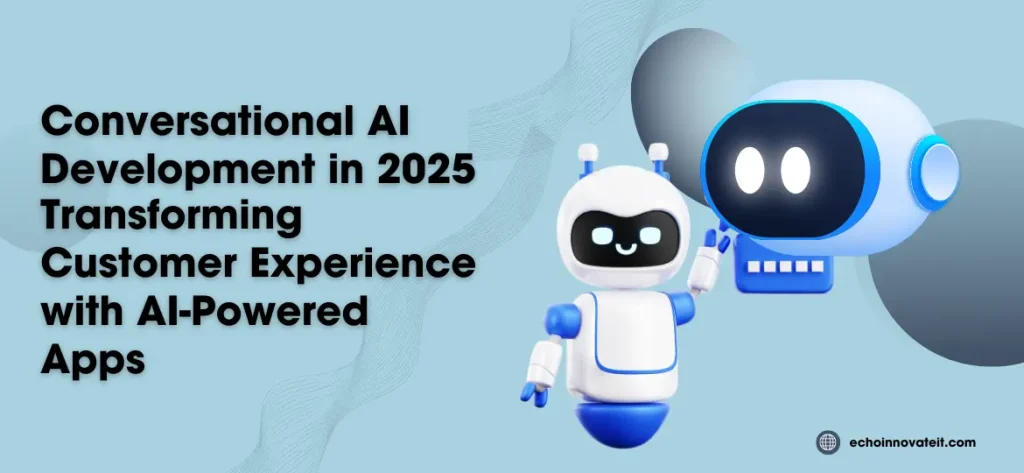
In just seconds, your voice command is processed, intent is understood, and a response is delivered seamlessly. This is the power of conversational AI, and it’s no longer limited to basic chatbots. In 2025, businesses in the USA are integrating AI development, mobile app development, iOS app development, and Android app development with conversational AI to create smarter, faster, and more human-like digital interactions.
At EchoInnovateIT, we specialize in building AI-powered applications that go beyond automation to deliver personalized customer engagement, scalable support, and innovative app experiences. Related: Android app development services.
Why Conversational AI Is Booming in 2026
Conversational AI has gone from “nice to have” to mission-critical in just three years. By 2026, the global conversational AI market crossed $28 billion and is projected to hit $50 billion by 2028. The shift was driven by three forces: large language models (GPT-5, Claude 4.5, Gemini 2.5) making chat interfaces shockingly capable, customer-support cost pressures pushing enterprises to automate, and consumers genuinely preferring chat over forms and IVR phone menus.
If you’re building a conversational AI product or chatbot in 2026, you face a different landscape than even 18 months ago. Off-the-shelf LLM APIs (OpenAI, Anthropic, Google) handle the language understanding cheaply. The differentiation is now in tool use and integrations, retrieval-augmented generation (grounding responses in your data), conversation flow design, and guardrails / hallucination prevention.
This guide covers how to develop a conversational AI product in 2026 — the modern stack, build vs. buy decisions, costs, and pitfalls. If you’re ready to build, see our AI development services for the full implementation path.
Key Trends in Conversational AI for 2026
4 min read · Last updated: May 2026

Generative AI and LLMs
With large language models (LLMs) like GPT-5, conversational AI now delivers human-like, context-aware responses, understands subtle requests, and maintains conversations over longer interactions. Businesses in the USA are embedding these features into iOS and Android apps to enhance personalization and user engagement.
Multimodal Conversations
Conversational AI is expanding beyond text and voice. In 2025, AI can process images, documents, and multimodal inputs, making apps smarter and more interactive. Imagine an AI-powered healthcare mobile app where patients upload medical reports, and the AI instantly provides context-aware assistance. Related: hire dedicated Android developers.
Deep Workplace Integration
From Microsoft Teams to Google Workspace, conversational AI is embedded directly into daily workflows. For USA businesses, this means faster collaboration, automated task management, and smoother operations.
Hyper-Automation with RPA & APIs
AI is now working hand-in-hand with Robotic Process Automation (RPA) and API orchestration. This enables companies to automate complex, multi-step business processes like billing, HR onboarding, and logistics—transforming enterprise mobile app solutions in industries like healthcare, fintech, and retail.
Advanced Analytics & Continuous Improvement
Businesses in the USA can now access real-time AI-driven insights, helping them analyze user behavior, identify gaps, and measure ROI. This improves not only customer service but also product design, marketing, and sales strategies. Related: mobile app development.
Real-Time Translation for Global Reach
AI enables seamless, real-time multilingual conversations, allowing businesses in the USA to expand globally while catering to diverse local markets. For example, a retail eCommerce app can now support Spanish, Mandarin, or Hindi customers instantly, boosting engagement and conversions.
Business Benefits of Conversational AI
- Enhanced User Engagement : Personalized, emotion-aware AI improves customer loyalty.
- 24/7 Customer Support: AI-powered chatbots provide instant, round-the-clock assistance.
- Operational Efficiency: Automating repetitive tasks reduces costs and improves team productivity.
- Competitive Advantage: Smart, multilingual apps offer a superior customer experience.
- Scalability: Businesses can scale support operations without expanding headcount.
Industry Impact of Conversational AI
- Customer Service: AI chatbots reduce wait times, resolve issues instantly, and improve CSAT scores. 2.
- Healthcare: AI-powered apps streamline appointment scheduling, telemedicine, and patient support.
- Retail & eCommerce: Conversational AI delivers personalized shopping assistance, 24/7 support, and AI-driven product recommendations in both iOS and Android apps.
What is Conversational AI?
Conversational AI is a next-generation technology that enables apps, websites, and digital platforms to communicate in natural human language—through voice or text—using AI, NLP (Natural Language Processing), and machine learning. It powers virtual assistants, chatbots, and mobile apps to provide instant, human-like responses, streamlining customer support and improving engagement.
By 2030, the conversational AI market is expected to surpass $50 billion, with industries like healthcare, retail, finance, and enterprise software relying on it for customer experience.
Core Components of Conversational AI
- Natural Language Processing (NLP) – Helps AI understand human intent, context, and tone.
- Machine Learning Models – Improve response accuracy with every interaction.
- Voice Tech (TTS & STT) – Power voice assistants in iOS apps, Android apps, and smart devices.
- Dialogue Management – Ensures conversations feel natural and logical.
- Integration Frameworks – Connects with mobile apps, payment gateways, CRMs, and third-party APIs.
How to Build Conversational AI: A 7-Step Guide
- Define user intent and business goals.
- Choose the right AI development framework (Rasa, Dialogflow, AWS Lex).
- Collect domain-specific training data.
- Design conversational flows for iOS and Android app users.
- Train and fine-tune AI models for accuracy.
- Test AI with real-world user inputs.
- Deploy, monitor, and scale across platforms.
At EchoInnovateIT, our team uses a product-first approach—aligning conversational AI with your mobile app development strategy to maximize ROI. Related: custom Android app development.
Timeline of Conversational AI Development
- Basic AI Chatbot (FAQ automation): 3–5 weeks.
- Mid-level Conversational AI (multi-platform, contextual AI): 8–12 weeks
- Advanced AI Assistants (multilingual, integrations, predictive AI): 4–6 months
The exact cost depends on app complexity, training data, iOS/Android integrations, and security requirements.
Conclusion
Building a great conversational AI product in 2026 comes down to four critical decisions:
- Pick your LLM strategy: API-first (OpenAI, Anthropic, Google) gets you to production fastest. Fine-tuned open models (Llama, Mistral) cost more upfront but reduce per-request fees at scale.
- Ground your bot: Pure LLM responses hallucinate. Use retrieval-augmented generation (RAG) with vector databases (Pinecone, Weaviate, pgvector) to ground answers in your actual data.
- Design tool use: The biggest jump in chatbot quality in 2025–2026 came from giving LLMs tools (search, database queries, API calls). Plan tool integrations, not just prompts.
- Plan guardrails early: Hallucinations, off-topic responses, and prompt injection attacks are real. Use systems like NeMo Guardrails, Llama Guard, or OpenAI’s moderation API alongside good prompt engineering.
EchoInnovate IT has built conversational AI products — chatbots, voice assistants, AI agents — across customer support, healthcare triage, fintech advisory, and ecommerce for the last 4 years through our AI development and custom software development services. Our team handles LLM selection, RAG architecture, tool integration, evaluation pipelines, and full compliance for regulated industries (HIPAA, SOC 2, GDPR). Get a free roadmap and quote below.
Frequently Asked Questions
What is conversational AI in mobile app development?
Conversational AI integrates chatbots and voice assistants into iOS and Android apps to provide real-time, human-like support.
How much does it cost to develop conversational AI in the USA in 2026?
It ranges from $12,000 to $200,000+ depending on complexity, app integrations, and training data.
How long does it take to build a conversational AI solution?
A basic AI bot takes 3–5 weeks, while advanced systems take 4–6 months.
Can conversational AI improve customer support for small USA businesses?
Yes. It provides 24/7 customer support without increasing staffing costs.
What industries in the USA use conversational AI the most?
Healthcare, eCommerce, fintech, education, and enterprise SaaS apps.
How does conversational AI integrate with iOS app development?
By embedding AI SDKs and APIs, iOS apps can use voice and chat assistants seamlessly.
Is AI development secure for handling customer data?
Yes, when built with HIPAA, GDPR, and CCPA-compliant frameworks.
What's the difference between conversational AI and generative AI?
Conversational AI focuses on real-time interactions, while generative AI creates new content (text, images, or code).
How much does it cost to build a conversational AI product in 2026?
A basic chatbot using OpenAI/Anthropic API + a simple frontend starts around $15K–$40K. A production-grade conversational AI platform with RAG, tool use, multi-tenant architecture, analytics, and admin dashboards runs $80K–$250K. Custom voice assistants or industry-specific compliant systems (healthcare triage, financial advisor) typically run $200K–$500K+. Operating costs scale with LLM API usage — typically $0.001–$0.05 per conversation in 2026.
Should I use OpenAI/Anthropic APIs or self-host an open-source LLM?
For most products in 2026, API-first wins on cost and quality at low-to-medium scale. APIs like Claude 4.7 and GPT-5 handle most tasks better than self-hosted open models, with no infrastructure burden. Self-hosting (Llama 3.3, Mistral) becomes worth it at $50K+ monthly API spend or for strict data-residency requirements (healthcare, defense, EU sovereignty). Many teams use a hybrid — API for premium features, self-hosted for high-volume routine queries.
How do you prevent a chatbot from hallucinating?
Three layers, in order of importance: (1) Retrieval-augmented generation — pull relevant data from your database/docs before the LLM responds, so it has facts to cite. (2) Tool use — let the LLM look up live data (database, search) instead of relying on its training. (3) Guardrails — moderation API checks, structured-output validation, and “I don’t know” prompting for low-confidence responses. Combined, these reduce hallucination rate from ~15% (raw LLM) to under 1% in production systems.
Stop prototyping AI. Start shipping it.
Conversational agents, RAG pipelines, fine-tuned LLMs, vector search, AI chatbots that actually convert — we move from “interesting demo” to “in production” in 6–10 weeks. OpenAI, Anthropic, open-source — we pick the right model for your latency, cost, and accuracy budget, not because it’s trendy. If your team is stuck in proof-of-concept hell, we’ll get you out of it.