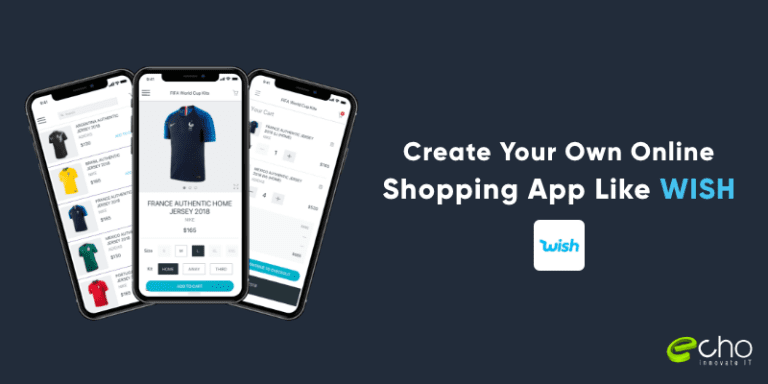
- A Wish-style shopping-app MVP sits at the entry level; a global marketplace with personalization and multi-currency reaches the enterprise scale.
- The cost driver is discovery and scale — the recommendation feed, a multi-seller platform, and payments across regions — not the product grid.
- Personalized discovery is what defines Wish; a real recommendation engine is a substantial, ongoing build.
- Expect roughly 5–9 months for a production build; the seller platform, payments, and personalization take the most time.
- The reliable way to price it is a short scoping call plus a fixed-price pilot, not a template number.
How much does it cost to build an app like Wish?
“An app like Wish” can mean a single-seller discovery shop or a global multi-seller marketplace with personalized feeds and payments in many currencies. The most honest way to budget is by tier. The tiers below reflect 2026 market complexity for custom builds, not fixed EchoInnovate IT prices — we give a transparent quote after a short scoping call, because personalization, the seller platform, and payment scale drive the number more than the storefront.
| Tier | What you get | Investment level |
|---|---|---|
| MVP | Product feed and categories, search and filters, cart and checkout, one payment method, accounts, order tracking, ratings, basic admin | Entry-level |
| Growth | Multi-seller platform with seller onboarding and payouts, personalized recommendation feed, wishlists, promotions and coupons, push notifications, reviews, moderation, analytics | Mid-range |
| Scale | Global multi-currency and multi-language, advanced personalization and A/B testing, fraud and dispute handling, shipping and logistics integrations, seller subscriptions, ongoing releases | Enterprise-scale |
The product grid and checkout are the cheap part; the recommendation engine, seller platform, and payments at scale are where the budget goes. To sanity-check your scope first, try our app cost calculator, then read the ecommerce app development cost guide for the underlying drivers.
Must-have features of a shopping app like Wish
A Wish-style app has three sides: the shopper experience, the seller platform, and the admin and trust-and-safety back office. What sets Wish apart from a normal store app is that discovery, not search, drives most purchases — so the recommendation feed is a first-class feature, not an add-on.
Shopper side. A personalized, infinite-scroll product feed, search and filters, product pages with images and reviews, wishlists, cart and one-tap checkout, multiple payment options, order tracking, and notifications for deals and shipping. Personalization and a fast, cheap-feeling browse experience are what keep shoppers coming back.
Seller platform. Seller onboarding and verification, product and inventory management, order fulfillment, payouts, performance metrics, and policy enforcement. A marketplace lives or dies on seller supply, so this platform must be genuinely usable at scale.
Admin and trust-and-safety back office. Catalog and category management, fee and promotion configuration, listing and review moderation, fraud detection, dispute and refund handling, and analytics. As the marketplace grows, trust and safety becomes central rather than optional, and mapping that scope early is exactly the work a software development company should do before estimating a build.
Tech stack and integrations
Most shopping apps in 2026 are built cross-platform (Flutter or React Native) so one team ships iOS and Android, with a back end in Node.js, Python, or Java, a PostgreSQL database, object storage for product images, a CDN for global delivery, and cloud hosting on AWS or Google Cloud. The stack is standard; the integrations are what make a Wish-style marketplace work at scale.
- Payments: Stripe, Adyen, PayPal, or regional processors, with multi-currency support and marketplace payouts to sellers.
- Recommendations: a personalization service or in-house ML pipeline that powers the discovery feed.
- Search: Elasticsearch or Algolia for fast, filterable catalog search.
- Shipping and logistics: carrier and aggregator APIs for rates, labels, and tracking across regions.
- Notifications and messaging: push, email, and in-app messaging for deals, orders, and support.
- Trust and safety: fraud scoring, identity verification for sellers, and content moderation.
The recommendation engine and marketplace payments (multi-currency and seller payouts) are the integrations that most affect budget and timeline, so they deserve careful scoping rather than an assumption that a basic store setup will scale.
How long does it take to build?
A production shopping app like Wish takes roughly 5 to 9 months depending on tier. A single-seller discovery-and-checkout MVP can reach a launchable state in about 16 to 20 weeks. A growth build that adds a multi-seller platform, a recommendation feed, and promotions usually runs 6 to 8 months. Global multi-currency, advanced personalization, and fraud tooling push toward nine months or more.
The features that stretch a shopping-app timeline are the recommendation engine, the seller platform with payouts, and payments at global scale. A phased plan — launch a curated single-seller or single-region app first, prove conversion and retention, then open the seller platform and expand regions — almost always beats trying to build a global marketplace before you have demand. If you are validating the idea, our MVP for startups approach helps decide how much to build first.
What drives the cost up or down
If two quotes for a Wish-style app differ widely, the gap is almost always in these factors:
- Single-seller vs multi-seller. A marketplace with seller onboarding, payouts, and moderation is a much larger build than a single-brand store.
- Depth of personalization. A real recommendation engine with an ML pipeline costs far more than a simple “popular items” feed, and it is ongoing work.
- Payment and currency scope. One market with one processor is cheaper than multi-currency, multi-region payments with seller payouts.
- Trust and safety. Fraud detection, seller verification, and dispute resolution add cost but are essential at scale.
- Logistics integration. Global shipping, rates, and tracking across carriers add engineering compared with a single-region setup.
- Team location and model. Onshore agency rates run well above offshore or dedicated-team rates for comparable quality; see our offshore software development rates by country, and how to hire offshore developers if that is the route you are weighing.
The controllable lever is scope. Launch the smallest version that proves shoppers convert and come back, then reinvest in personalization, the seller platform, and global payments once the core loop works.
How EchoInnovate IT builds shopping apps
EchoInnovate IT is an India-based custom and white-label software development shop with 12 years in business, a team of 50+, and 500+ products shipped — most under our clients’ own brands. For a discovery-driven marketplace like a Wish-style app, we start with a scoping phase that maps your seller model, personalization goals, and payment and logistics needs before estimating anything, so the number reflects your real requirements rather than a template.
From there we staff a dedicated team — product, mobile, back end, and QA — and build in phases: a discovery-and-checkout MVP first, then the multi-seller platform and recommendation feed, then global payments, personalization, and fraud tooling. We handle the hard integrations (marketplace payments and payouts, recommendations, search, shipping, moderation), store submissions, and ongoing maintenance. If you would rather extend your in-house team than outsource the whole build, our IT staff augmentation services let you add dedicated engineers, while our full ecommerce app development service covers the end-to-end build. Either way the goal is the same: prove the core shopping loop quickly, then scale on evidence.