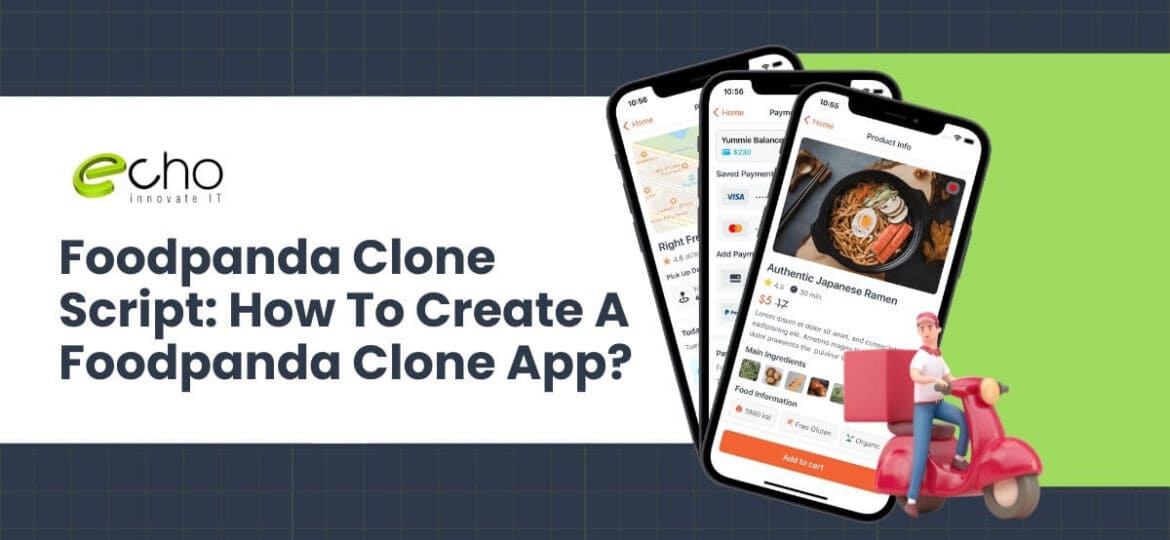
The cost of building a Foodpanda clone app in 2026 depends on scope: an MVP is the most affordable tier, a growth-stage product a larger investment, and a scaled multi-vendor platform with live tracking, dynamic dispatch, and operations at city or country scale the top end. A “Foodpanda clone” is really four connected products — a customer app, a restaurant or vendor app, a delivery-rider app, and an admin panel — and building all four correctly is what drives the effort and cost.
The phrase “clone script” suggests you can buy a ready-made copy cheaply, and off-the-shelf scripts do exist. But they rarely scale, are hard to customize, and often cost more in workarounds than they save. This guide gives you the real 2026 cost ranges for a custom or semi-custom build first, then the must-have features across all four apps, the tech stack, a realistic timeline, what moves the price, and how EchoInnovate IT builds on-demand delivery platforms. We answer the cost question up front so you can budget, then go deep enough to make decisions.
Key takeaways
- A food-delivery MVP is the most affordable tier; a scaled multi-vendor platform sits at the top end.
- You are building four connected apps — customer, restaurant, rider, and admin — not one.
- Real-time tracking, order dispatch logic, and payments are the features that most affect cost.
- Off-the-shelf clone scripts are cheap up front but usually cost more later in customization and scaling limits.
- Scope and scale drive the budget more than team location — get a transparent quote after a short scoping call.
How much does a Foodpanda clone app cost?
A food-delivery platform is priced by scope and scale, and by how many of the four apps you build in the first release. The clearest way to budget is by stage: an MVP to launch in one area, a growth product ready for many vendors and riders, or a scaled platform built for high order volume and multiple cities. The ranges below are 2026 market rates for a custom or semi-custom build by an experienced offshore or nearshore team. They are typical market bands, not a fixed EchoInnovate IT quote — we provide an exact figure after a short scoping call.
| Tier | What you get | Investment level | Timeline |
|---|---|---|---|
| MVP | Customer app, basic restaurant and rider apps, admin panel, ordering, payments, live tracking, one city or area | Entry-level | 3–5 months |
| Growth | Multi-vendor, ratings, promotions, scheduling, wallet, dispatch logic, analytics, multiple zones, iOS + Android + web | Mid-range | 5–9 months |
| Scale | Dynamic dispatch, surge pricing, multi-city, advanced logistics, fraud, loyalty, back-office ops, high concurrency | Enterprise-scale | 9–16 months |
The variables that move a delivery project up the tiers fastest are the dispatch engine and real-time logistics. Taking an order and showing it to a restaurant is straightforward; matching orders to the best available rider in real time, optimizing routes, and handling surge, cancellations, and reassignments at scale is a serious engineering effort. Our mobile app development cost guide covers the shared drivers, and our mobile app development service page shows the products we build.
Must-have features of a food-delivery app
A Foodpanda-style platform is four apps that must work in sync. The feature set below spans all four, and understanding it is the key to an accurate budget.
Customer app. This is the storefront. It needs location-based restaurant discovery, search and filters, menus with photos and customization, a cart and checkout, multiple payment options, real-time order tracking on a map, order history and reordering, ratings and reviews, promotions and coupons, and push notifications for each order stage. The customer app is where design and speed matter most, because it directly affects conversion and repeat orders.
Restaurant or vendor app. Restaurants need to accept or reject orders, manage their menu and availability, update preparation times, view earnings and reports, and handle busy-mode toggles. A reliable, simple vendor app keeps the supply side of the marketplace happy, which is just as important as the customer side.
Delivery rider app. Riders need order assignment, turn-by-turn navigation, order status updates (picked up, on the way, delivered), earnings tracking, availability toggling, and in-app communication with customers and restaurants. Good rider UX and fair dispatch directly affect delivery times and rider retention.
Admin panel. The operations backbone. Admins manage restaurants, riders, and customers, configure delivery zones and fees, run promotions, monitor live orders, handle disputes and refunds, and view analytics. This web-based panel is where the business is actually run, and underinvesting in it causes operational pain later.
Real-time tracking and dispatch. Live location for customers, riders, and admins is a defining feature. Behind it sits the dispatch logic that assigns orders to riders — the single most important piece of engineering in a delivery platform, and the one that most affects delivery times and unit economics.
Payments and payouts. Multiple customer payment methods (cards, wallets, cash on delivery), plus automated payouts to restaurants and riders and commission handling for the platform. Getting the money flows right across three parties is a substantial part of the build.
Tech stack and integrations
A delivery platform needs a stack that handles real-time location, high concurrency, and reliable payments across multiple apps. The choices below are proven for on-demand products in 2026.
Front end across the apps. A cross-platform framework such as Flutter or React Native is ideal here because you are building three mobile apps — customer, restaurant, and rider — and a single codebase per app (shared where possible) keeps cost and maintenance manageable. The admin panel is a responsive web app, usually in React or a similar framework.
Backend and APIs. A backend in Node.js, Go, or Python handles orders, users, menus, and the marketplace logic. Delivery platforms benefit from a microservices approach so ordering, dispatch, payments, and tracking can scale independently, since load is uneven and spiky around meal times.
Real-time infrastructure. Live tracking and instant order updates rely on WebSockets or a real-time messaging layer, plus location services. This real-time backbone is central to the product and needs to stay reliable under load, especially during peak hours.
Databases and caching. A relational database such as PostgreSQL for orders, users, and transactions, a fast cache like Redis for live order state and rider locations, and often a geospatial index for matching nearby riders and restaurants efficiently.
Maps and location. Google Maps or Mapbox for discovery, navigation, distance and ETA calculation, and live tracking. Map and routing usage is a real ongoing cost that scales with orders, so it belongs in the budget.
Payments and notifications. Payment processors (Stripe, local gateways, and wallet integrations), automated payout handling for restaurants and riders, push notifications across all three mobile apps, and SMS or in-app messaging for coordination. When a phase needs specialist skills quickly — a logistics engineer for dispatch, a DevOps lead for scaling — IT staff augmentation adds them without permanent hiring.
How long does it take to build?
Because a delivery platform is four apps, timelines reflect the breadth of the build. An MVP with a customer app, basic restaurant and rider apps, an admin panel, ordering, payments, and live tracking — launched in a single city or area — is realistic in three to five months with a focused team. Launching in one area first is the smart move: it lets you prove the model and unit economics before spending on scale.
A growth-stage platform adding full multi-vendor support, ratings, promotions, scheduling, a wallet, smarter dispatch, and analytics across multiple zones generally takes five to nine months. The dispatch logic and the multi-vendor operations are the workstreams that most often extend this phase, because both touch every part of the system.
A scaled platform with dynamic dispatch, surge pricing, multi-city operations, advanced logistics, fraud prevention, and a full back office is a nine-to-sixteen-month program, delivered in overlapping releases and tuned continuously as order volume grows.
The reliable path is to launch a single-area MVP, prove that customers reorder and the economics work, and fund each expansion against evidence. Delivery is an operations business as much as a software one, so validating operations early protects the larger investment. Timelines compress when the dispatch model and marketplace rules are decided during discovery and a dedicated team works the project full time.
What drives the cost
When food-delivery app quotes differ, these variables are almost always the reason. Understanding them lets you shape the budget rather than react to it.
Number of apps in the first release. Building all four apps — customer, restaurant, rider, admin — polished from day one costs more than launching a lean version of each. Deciding what each app truly needs at launch is a major lever.
Dispatch and logistics sophistication. Simple manual or nearest-rider assignment is cheap. Dynamic dispatch that optimizes routes, batches orders, and handles surge and reassignments is a serious investment that pays off at scale but is not needed on day one.
Real-time features. Live tracking, instant updates, and reliable messaging across three apps require real-time infrastructure that must stay stable under peak load. The reliability bar here adds cost.
Payment and payout complexity. Handling multiple payment methods, splitting money across platform, restaurant, and rider, managing commissions, and automating payouts is more involved than a single checkout. Cash on delivery adds reconciliation work too.
Scale and geography. One city is far simpler than many. Multi-city and multi-region operations bring zones, localization, currency, and tax handling, each adding cost.
Custom build vs clone script. An off-the-shelf clone script is cheap up front but typically limits customization and struggles to scale, so many teams that start there rebuild later. A custom or semi-custom build costs more initially but avoids that rework and scales cleanly.
Team model and location. Experienced offshore teams cost less per hour than onshore for comparable quality, as our guide to hiring offshore developers explains. Location affects rate, but the number of apps and the dispatch and scale requirements move the total far more.
How EchoInnovate IT builds food-delivery apps
EchoInnovate IT is an India-based custom and white-label software development company with 12 years in business, 50+ employees, and 500+ products shipped — most under our clients’ own brands. We hold a 5.0 rating across 6 verified client reviews on Clutch. On-demand delivery platforms are a common white-label build: many of the food, grocery, and courier apps operating today were built by teams like ours and run under someone else’s brand.
Our approach to a Foodpanda-style platform starts with a short discovery phase to define the marketplace rules, the dispatch model, the payment and payout flows, and the launch scope across the four apps — the decisions that most affect cost and operations. We favor a custom or semi-custom build over a rigid clone script so the platform can scale and adapt, and we design the dispatch and real-time layers for reliability under peak load. A dedicated team — product, design, mobile, backend, and QA — works your project full time so timelines stay predictable.
We build the three mobile apps cross-platform, deliver a robust web admin panel, integrate maps, payments, and notifications, and load-test for the meal-time spikes every delivery app faces. We handle app store releases, analytics, and ongoing maintenance, and we scale the team per phase. When a stage needs a specialist — a logistics engineer for dispatch, a DevOps lead for scaling — we add them through staff augmentation without disrupting the core team. See the full offering on our mobile app development page, and our software development company overview for how we work across projects.
We do not publish fixed prices, because scope and scale drive everything and an honest number needs your real requirements. Instead we provide a transparent, itemized quote after a short scoping call so the estimate matches the platform you actually want to build.