
Banking-as-a-service (BaaS) has lowered the barrier to launch a fintech. Entrepreneurs can start one, and existing firms can add financial services to what they already offer. These tools let you build financial features into your product with less effort. They also cut product complexity and ease the regulatory load for loans, accounts, and cards.
For real-world identity and verification products, browse these trending apps like Itsme.
As it gets easier to start a fintech, many new players have entered the market. Each one tries to serve a specific user need. But BaaS only handles the operational side. Founders still have to solve product-market fit, monetization, customer acquisition, and marketing.
This guide covers the key steps and best practices to build a fintech. It focuses on startups that offer financial accounts and card products. We mix our own experience with insights from leading fintech firms. That helps you design, build, and grow. It also helps to attend industry events to network and sharpen your marketing.
The fintech business is expanding at an unprecedented rate, transforming traditional financial services with innovative technological solutions. Fintech is changing how people and organizations handle their finances, from payments and loans to wealth management and insurance. This rapid evolution opens up the potential for budding entrepreneurs to develop ground-breaking solutions.
Starting a fintech is a strong choice if you want to build a business in finance. Traditional banks are slowly losing ground to newer, tech-driven founders. That makes fintech an exciting space to enter.
This guide is intended for entrepreneurs with a passion for finance and technology who are considering starting their own fintech business. We will also offer vital information to investors seeking emerging fintech firms.
Hire services from a top Web app development company. Get a quote for your project!
What are Fintech Companies
8 min read · Last updated: May 2026
Understanding Fintech: A Comprehensive Overview
A fintech is a business that offers financial services through software. That can mean accounts, cards, or loans. Some are “pure play” fintechs, where the financial service is the core product. An example is a fintech that lends to small businesses. Others embed financial services into their main product. For instance, a salon booking tool that adds online payments through a payment API. Related: mobile app development services.
As the industry grows, it is harder to say what counts as a fintech. Many firms now build financial services into their core strategy. That blurs the line. So more companies today can be called fintechs. It also raises the need for focused B2B marketing. If you want fintech software, there are many options to fit your model.
Fintech encompasses more than just convenient and accessible digital payment options. Innovative-driven businesses increase financial data and customer security with strong fraud protection measures. All of this helps financial organizations gain the trust of their customers. Even now, the fintech market is booming. Therefore, we will see many more wonderful features, such as eco-friendly solutions.
Key Sectors in Fintech
- Payments: As the number of digital transactions has increased, this sector has grown rapidly. Fintech businesses are transforming the way we pay with innovations such as mobile payments, peer-to-peer transfers, digital wallets, and cryptocurrency payments.
- Lending: Fintech challenges traditional lending patterns by making loans faster and more accessible. This encompasses peer-to-peer lending, crowdfunding, and alternative lending systems.
- Wealth Management: Fintech companies use technology to democratize wealth management services. Robo-advisors, investment platforms, and fractional investing are changing how people invest and manage their money.
- Insurtech: This industry applies technology to better insurance products and services. From claims processing to risk assessment, insurtech is improving the consumer experience.
- Regtech: firms focus on regulatory compliance and provide technological solutions to assist financial institutions in efficiently meeting regulatory obligations.
5 Steps to Start a Fintech Company
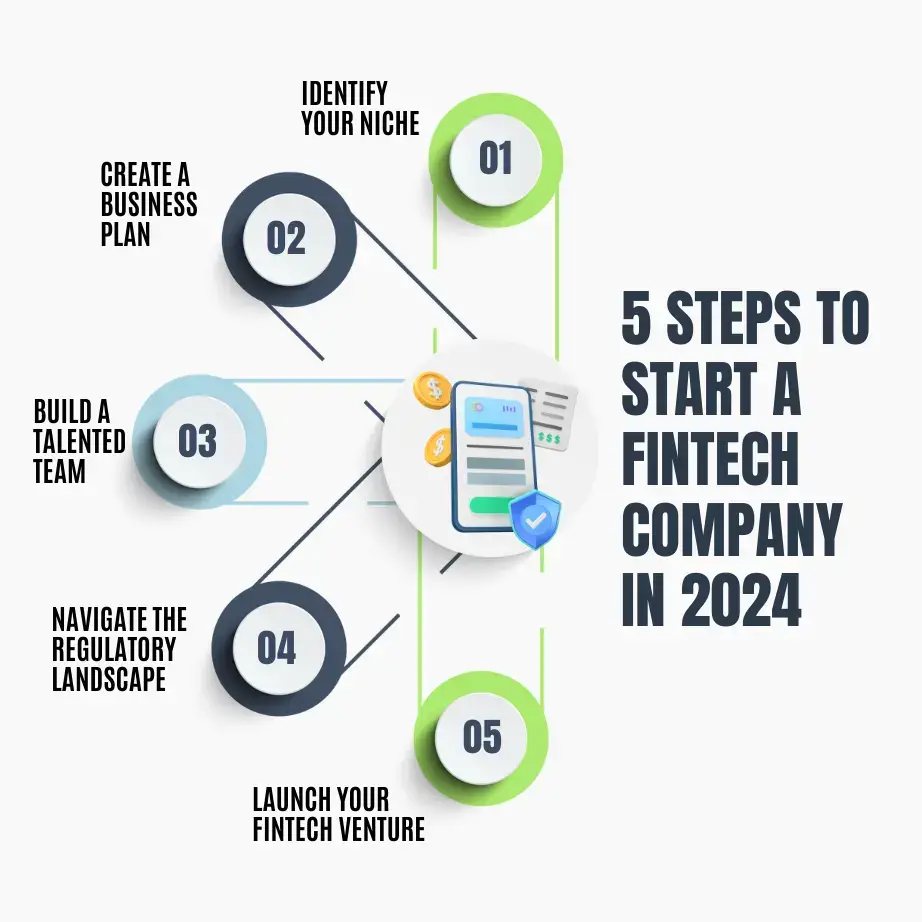
Starting a financial company is exciting, but it demands meticulous planning and execution. Here are five key stages to guide you:
Identify your niche and create a strong value proposition
Analyze the fintech environment to find untapped markets or opportunities. Identify a specific financial issue that your target audience faces. Create a unique value proposition that distinguishes your financial company. Understand your competitors and how to outperform them.
Create a Solid Business Plan
Define your target market, client needs, and the competition landscape. Create detailed financial estimates for sales, expenses, and profitability. Outline your company’s activities, personnel structure, and important milestones. Determine your finance needs and prospective sources (bootstrapped, angel investors, venture capital).
Related: hire cross-platform developers.
Build a talented team
Hire people with experience in finance, technology, and business. Create a team with diverse abilities to foster innovation and problem-solving. Develop a collaborative and entrepreneurial corporate culture.
Navigate the regulatory landscape
Recognize the regulatory obligations of your fintech firm. Seek legal guidance to ensure compliance and reduce risks. Obtain the required licenses and permits to operate legally. Implement strong data security procedures to safeguard consumer information.
Secure Funding and Launch Your Fintech Venture
Create a captivating pitch to attract investment. As your business grows, consider different funding choices (seed, Series A, and Series B). Create a simple version of your product to gauge consumer response. Continuously collect client input and improve your product.
Key Differences Between AR and VR
The fintech market is expanding rapidly, owing to technological advancements and changing consumer behaviour. Among the key trends are open banking, embedded finance, artificial intelligence and machine learning, net banking, and BNPL. These trends are reshaping the financial landscape, creating opportunities for innovation and disruption. Analyzing market trends reveals a surge in digital payments, personalized financial services, and increased focus on financial inclusion.
Opportunities lie in developing solutions for underserved markets, leveraging AI for risk assessment and fraud prevention, and exploring blockchain for secure transactions. Collaborations between fintechs and traditional financial institutions are also promising avenues for growth. A deep understanding of consumer needs, regulatory environment, and emerging technologies is essential to fully capitalize on these trends. Below given are some of the popular Fintech trends in 2026: Related: custom software development.
Cross-border payment transformation
Fintech aims to streamline work and cut costs. Banks are adopting new models to make cross-border payments faster and cheaper. This is driven by e-commerce, where people buy from overseas shops and need to send money abroad.
Payment System Innovations
Fintech runs on modern technology. In 2026, staying competitive will mean adopting new payment options like cryptocurrency. Firms will need to build customer-focused payment systems. Crypto and blockchain keep growing, and you can use them to keep pace with the newest players. Note that not every country allows crypto payments; many are still writing rules to make it safer.
Customer and payment security
Digital payments need extra security and fraud prevention. According to Statista, e-commerce could lose more than $41 billion to fraud in 2026, with another $48 billion at risk in the years after. As people move away from cash and buy more online, firms must stay secure and follow local laws.
Transparency of payments
Fintech companies want to stay transparent because it draws users and builds trust. The tendency in 2026 will be to retain the current level of transparency while also making loan pricing more transparent to consumers. Because of the macroeconomic situation, credit and lending are popular right now. Thus, offering technology that keeps individuals out of bad debt is becoming increasingly vital. Fintech enterprises will face obstacles such as inflation and the cost-of-living crises; they need to focus on transparent processes and technology to earn trust.
Conclusion
The fintech landscape is changing fast. Trends like open banking, embedded finance, AI, and neobanking are driving it. These shifts open big chances to disrupt financial services. Firms can win share through digital payments, personal service, and financial inclusion. Success takes persistence and the ability to adapt, since the market moves quickly. Related: AI-powered app development.
To succeed, fintech startups need a culture of innovation, strong partners, and a focus on the customer. A solid marketing strategy helps you plan for the long term. It means reading the trends and using new tech responsibly. Industry events add useful insight and contacts. The future of fintech is bright, but it rewards those who adapt and deliver real value.
Looking for the best fintech companies to collaborate with or outstanding Cross-Platform Developers for your startup? Hire our services!
Frequently Asked Questions
What is the first step in starting a fintech company in 2024?
The first step is identifying a specific niche or problem within the financial sector that you want to solve, such as payments, lending, or personal finance management.
How important is regulatory compliance for a fintech startup in 2024?
Regulatory compliance is crucial; fintech companies must navigate complex regulations to ensure they operate legally and avoid penalties. Understanding local and international financial laws is essential.
What role does technology play in building a fintech company?
Technology is the backbone of any fintech company. Using the latest technologies like AI, blockchain, and cloud computing is vital for creating secure, scalable, and innovative financial products.
How can a fintech startup secure funding in 2024?
Fintech startups can secure funding through venture capital, angel investors, crowdfunding, or strategic partnerships. A solid business plan and a clear value proposition are key to attracting investors.
Ship your eWallet before your competitors do.
Card-on-file, P2P transfers, NFC tap-to-pay, KYC/AML, multi-currency, crypto rails — we’ve shipped it all. Whether you’re launching an MVP or replatforming a stored-value wallet, our fintech engineers know the compliance gotchas, the BaaS integrations (Synapse, Unit, Treasury Prime), and the PCI scope tricks that save you months of pain. Get a real engineer on a call in 24 hours — not a sales rep.