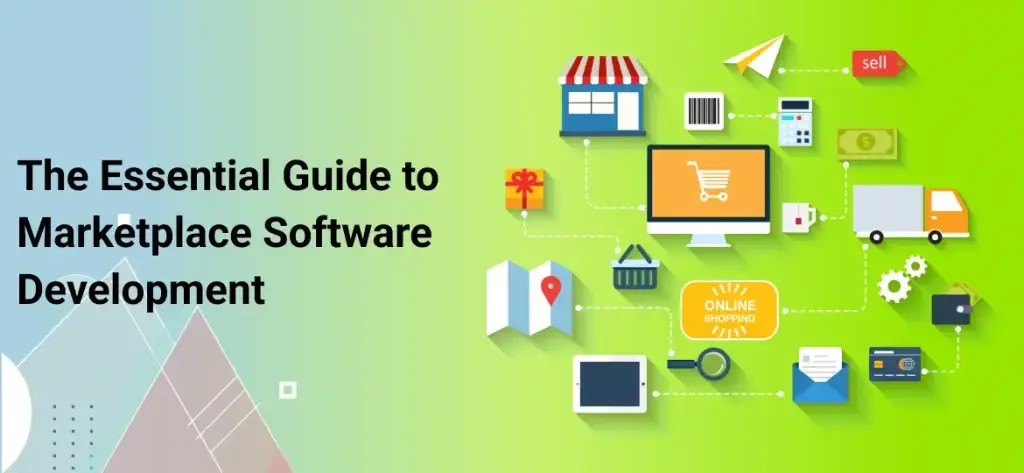
Marketplace software connects two or more sides, buyers and sellers, clients and providers, hosts and guests, on one platform that handles discovery, transactions, and trust. In 2026, building one costs the least for an MVP, more for a growth-stage build with advanced search, split payments, and dashboards, and the most for a scale platform spanning web and mobile with many participants. The price is set by how many sides you serve, how sophisticated your matching and payments are, and where your team is based.
This guide breaks down the cost tiers, the must-have features, the tech stack, the timeline, and the factors that move the price, then shows how a dedicated team like EchoInnovate IT scopes and builds marketplace platforms. Our software development company page covers the wider engagement model, and our mobile app development cost guide pairs well with this read.
Key takeaways
- A marketplace software MVP sits at the entry level; a production build in the mid-range; a large multi-sided platform at the enterprise-scale end.
- Matching and search, participant onboarding, and split payments are the features that most drive the budget.
- Trust and safety, ratings, verification, disputes, is what makes a marketplace usable and is often underscoped.
- Most platforms ship in 4–8 months; an MVP can launch in about 14–18 weeks.
- We do not publish fixed prices because scope drives everything — you get a transparent quote after a short scoping call.
In this article
- How much does marketplace software development cost?
- Must-have features of marketplace software
- Tech stack and integrations
- How long does it take to build a marketplace?
- What drives marketplace development cost?
- How marketplaces make money
- How EchoInnovate IT builds marketplace software
- Frequently Asked Questions
How much does marketplace software development cost?
| Build stage | Investment level | What you get |
|---|---|---|
| MVP | Entry-level | Two-sided flows, listings, basic search, checkout, one payment gateway, admin panel, reviews |
| Growth | Mid-range | Advanced search and matching, split payments, provider dashboards, messaging, promotions, analytics |
| Scale | Enterprise-scale | Web plus mobile apps, recommendation engine, multi-currency, fraud and trust systems, high-availability infrastructure |
Must-have features of marketplace software
Demand side (buyers, clients, guests). The demand side needs:
- registration and login
- search and discovery with filters
- listing or provider pages
- booking, or cart and checkout
- multiple payment methods
- order or booking tracking
- reviews, ratings, and messaging
- support
Above all, discovery quality is what the demand side judges you on.
Supply side (sellers, providers, hosts). The supply side needs:
- onboarding and verification
- listing or profile management
- availability and pricing
- order or booking management
- payouts and earnings
- promotions and analytics
In short, this is the supply that makes the marketplace viable.
Matching and transactions. This layer connects the two sides. It covers search relevance, filtering, and ranking, or an explicit matching algorithm, plus cart or booking, payments, and payouts. Ultimately, it is the heart of the platform.
Admin panel. The admin panel runs day-to-day operations. It handles participant approval, content management, payout settings, disputes, fraud monitoring, and analytics. However, teams frequently underscope it, even though it is the operational backbone.
Trust and safety. Finally, trust and safety rounds it out. You need ratings, verified reviews, secure messaging, refund and dispute flows, and participant vetting. On a marketplace, trust is a feature, because participants transact with strangers.
Getting matching, onboarding, and split payments right is what separates working marketplace software from a directory. These are core engineering problems, so a seasoned software development company should own them end to end.Tech stack and integrations
Front end: React or Next.js for the web platform, plus Flutter or React Native for mobile apps when you need them. Many marketplaces launch web-first and add mobile at the growth stage.
Back end: Node.js, Python, or Java with a REST or GraphQL API, organized into services so catalog, matching, and payments can scale independently.
Databases: PostgreSQL or MongoDB for core data, with Redis for caching and sessions.
Search and matching: Elasticsearch or Algolia for fast faceted search and ranking, plus custom matching logic where a simple search is not enough.
Payments and payouts: Stripe Connect, PayPal, or a regional gateway that supports marketplace split payments, escrow, and provider payouts.
Media and CDN: cloud storage plus a CDN for the images and files participants upload.
Notifications: email, SMS, and push providers for transaction and message alerts.
Infrastructure: AWS, Google Cloud, or Azure with containerized services, CI/CD, and monitoring.
Search and payment integrations also carry ongoing usage fees. So budget for those in your operating costs, not just the build. Architecting them cleanly keeps a marketplace fast and reliable as participants and listings grow. That is exactly where an experienced engineering partner earns its keep.How long does it take to build a marketplace?
Here is how the schedule breaks down:
- discovery and design: 3 to 4 weeks
- core development in two-week sprints: the bulk of the calendar
- search and payment integration: 3 to 5 weeks
- QA: 2 to 4 weeks
- launch hardening: 1 to 2 weeks
Building the demand and supply tracks in parallel with a larger dedicated team compresses the timeline. So if you need to move faster, add mobile apps, or bring in specialists mid-project, IT staff augmentation lets you scale the team without rehiring.
What drives marketplace development cost?
1. Number of sides and platforms. A simple two-sided web marketplace is the baseline. Adding a third participant type multiplies the work — and so does shipping web plus iOS and Android.
2. Matching and search depth. Basic keyword search is cheap. However, faceted search, ranking, personalization, or an explicit matching algorithm is a major cost driver — and a core differentiator.
3. Payments and payouts. Compared with a single merchant account, split payments, escrow, refunds, multi-currency, and tax handling all add substantial backend work.
4. Trust and safety. Verification, review moderation, dispute resolution, and fraud controls take real engineering. At scale, they are non-optional.
5. Provider and admin tooling. The richer your provider dashboards and admin controls, the more you build. In return, they keep the supply side and your operations team productive.
6. Team location and model. Onshore agency rates run well above offshore and dedicated-team rates for comparable quality. Our offshore rates by country guide shows how much this single factor moves a budget.
Because these factors combine differently for every product, we do not publish a fixed price. Instead, we give a transparent quote after a short scoping call, so the estimate reflects your real feature list rather than a generic package.How marketplaces make money
- Transaction commission — a percentage of each completed order or booking, and the most common model.
- Listing or subscription fees — providers pay to publish or to unlock premium tools.
- Featured placement and ads — providers pay for visibility, often the highest-margin stream.
- Lead or booking fees — a charge per connection or confirmed booking.
- Payment processing markup — a margin on top of the gateway fee.
- Value-added services — insurance, escrow, or logistics that add further revenue.
Several of these need dedicated backend logic — an ads engine, subscription billing, or a lead-fee system. As a result, your monetization plan directly affects the build estimate. So choose your primary stream early, and let the team prioritize the features that actually earn.
How EchoInnovate IT builds marketplace software
How we run a marketplace build
For a marketplace build we start with a short scoping call to pin down your participant types, matching model, revenue model, and must-have features, then map them to the MVP, growth, or scale tier so the budget is clear before code starts. You get a dedicated team, not a rotating pool: full-stack engineers, backend engineers, a designer, and a QA lead working in two-week sprints with demos you can see. We handle the hard parts, search and matching, split payments, participant onboarding, and trust systems, and we stay on for maintenance and iteration after launch.
Because we work as a white-label partner, the platform ships under your brand, not ours. If you need to scale the team quickly, add mobile apps, or bring in a specialist, our IT staff augmentation services plug directly into the same build, and our core software development company practice covers the full lifecycle from discovery through release.