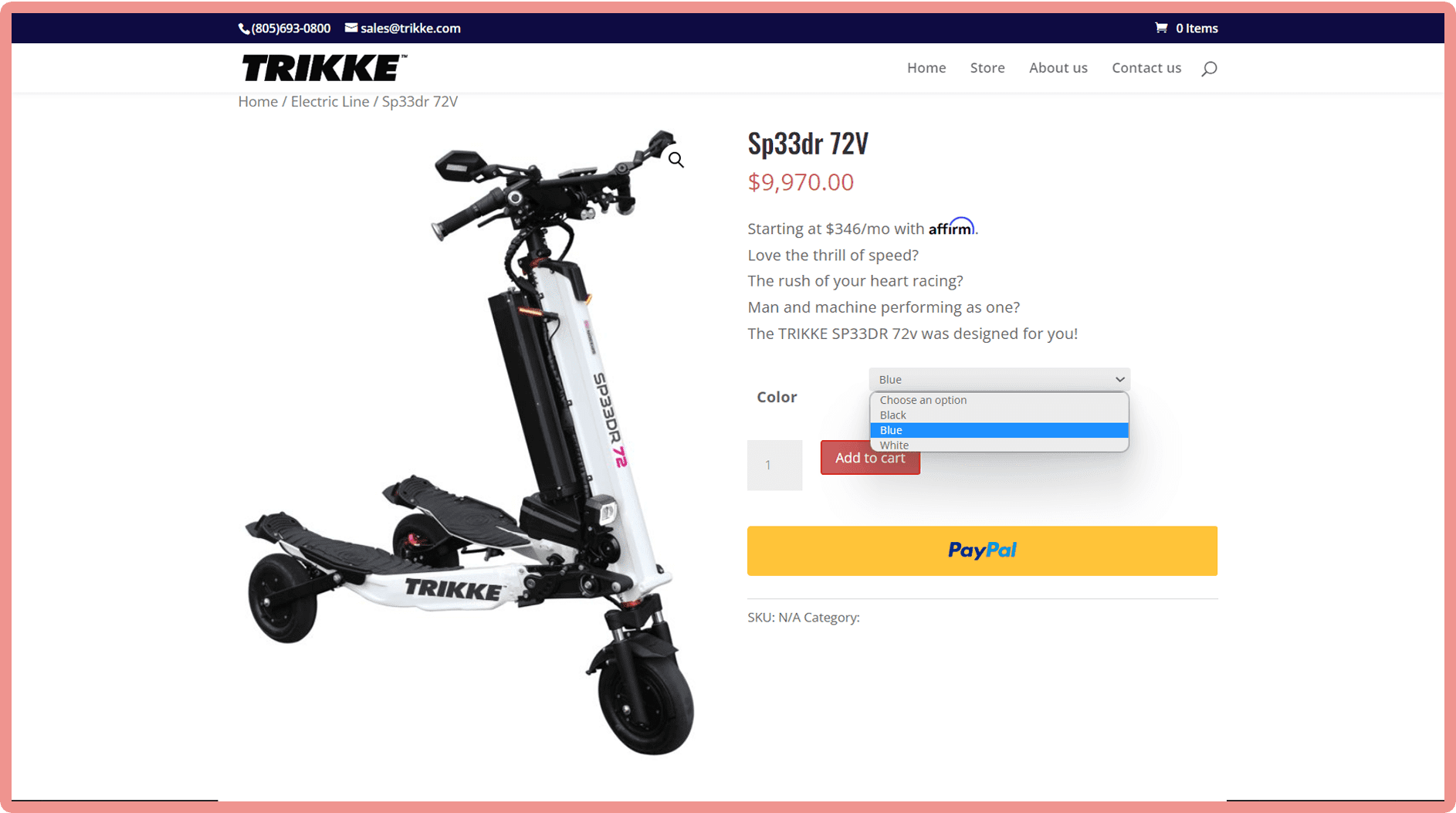
Many of Trikke’s products are available in a variety of colors, allowing you to personalize your ride and make it your own. The “Choose Color” feature makes it easy to select the color you want when making your purchase.
What a personal mobility brand needs online. Selling a vehicle online is different from selling clothes or books. Buyers want to understand how it rides, how far it goes and whether it suits their height, terrain and daily routine.
So the website has to teach as well as sell. Clear model comparisons, riding videos and plain-language specs answer most questions before a customer reaches checkout.
After the sale, the relationship continues. Riders come back for spare parts, accessories, manuals and warranty help, so the site should serve owners as well as new buyers.
Features a vehicle ecommerce store usually needs:
- Model comparison tables that line up range, weight, top speed and rider size side by side.
- Colour and configuration options with the product photo updating to match each choice.
- Accessories linked to each model so riders find compatible chargers, bags and parts.
- Spare parts catalogue organised by model and year to cut down on wrong orders.
- Manuals and safety guides available as downloads from the product page.
- Warranty registration with a simple form that captures the serial number.
- Dealer or demo locator for buyers who want to try a ride before buying.
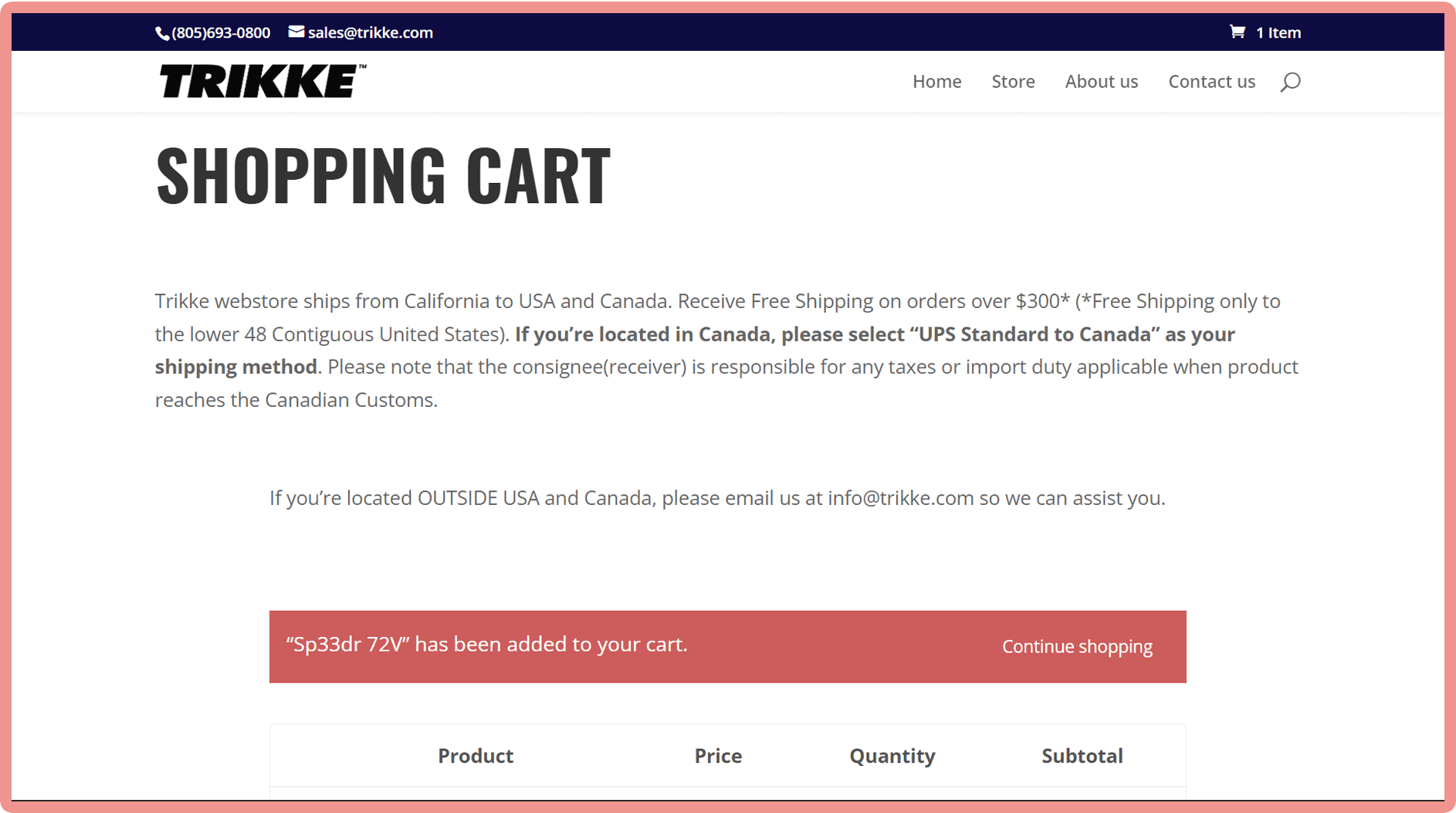
- Shipping rules for large items that handle freight sizes and regional limits.
- Reviews and rider stories that show real use cases like commuting or fitness.
Build considerations with WordPress and WooCommerce. WooCommerce adds a full store to WordPress, which suits a brand that also publishes guides, news and videos. Product variations cover colours and models, while extensions handle shipping classes and tax.
A page builder such as Divi lets the marketing team build landing pages for new models without a developer. Keep its layouts tidy, though, since heavy sections can slow pages down.
PHP and MySQL power the store, so hosting, caching and database tuning all affect checkout speed. A caching plugin and an image optimiser are usually worth adding early.
Large product photos and videos are central here. Host videos on a streaming service and embed them, rather than uploading big files to the media library.
Security covers both the store and the admin. Keep WordPress, WooCommerce, the theme and every extension updated, and use a trusted payment gateway for card data.
Electric vehicles often face shipping and battery rules. Make sure restricted regions, freight options and any safety notices are set up before orders open.
What to plan before building. List every product, variation and accessory, and gather specs in one consistent sheet. Clean data makes comparison tables and filters much easier to build.
Define a launch scope: catalogue, comparison, cart, checkout and owner support pages. Features like financing options, rider accounts or a parts finder can follow in later phases.
Vehicle store builds generally fall into entry, mid or upper bands. Custom design, catalogue size, shipping complexity and links to stock or accounting tools are what move the number.
Timelines depend on how ready the photos, videos and spec data are. After launch, a maintenance plan covers plugin updates, backups and seasonal campaign pages.
Helping buyers choose the right model. A higher-value purchase brings more questions. A short quiz or guided selector can ask about rider height, terrain, commute length and storage space, then suggest a matching model.
Plain explanations of key terms help newcomers. Words like range, motor power, battery capacity and folded size should each have a one-line meaning near the specs.
Honest guidance builds trust. Say which model suits hills, which is lighter to carry and which is better for fitness riding, so buyers feel guided rather than pushed.
Showing the product in motion. Still photos rarely capture how a leaning, three-wheeled ride feels. Short clips of turning, braking and folding show the product far better than paragraphs of text.
Rotating views and close-ups of controls, wheels and charging ports answer practical questions. Captions on videos make them useful for people browsing with the sound off.
Serving owners after the sale. Owners return for parts, tips and help with charging or storage. An owners area with how-to guides, maintenance checklists and common fixes cuts down on support calls.
A clear contact route for service questions matters too. Ask for the model and purchase date on the form, so the support team can answer on the first reply.
Email follow-ups can share riding tips, safety reminders and accessory ideas in the weeks after delivery. They keep owners engaged and help the brand earn repeat orders.
Content that brings in new riders. Guides on commuting, low-impact exercise or riding safety attract people who have not heard of the brand yet. Each guide can link to the models that suit that use.
Rider stories, photos from events and community groups give new visitors a sense of who already rides. That social proof often answers doubts better than any spec table.
Trust signals for a considered purchase. Buyers spending more want reassurance before they commit. Clear warranty terms, a visible returns window and real contact details near the price all reduce hesitation.
Secure-checkout badges mean little on their own. What helps more is a short FAQ on delivery, assembly and charging placed right on the product page.
Financing or instalment options can help some buyers, where the brand offers them. If they are added, explain the terms in plain words beside the price.
Keeping the WooCommerce store fast as it grows. Product variations, add-ons and reviews all add database work. Regular clean-ups of old orders, transients and unused plugins help the shop stay quick.
Test plugin and theme updates on a staging copy before going live. One faulty update on a busy weekend can block checkout entirely.
Uptime monitoring and automatic backups give a safety net. If something breaks, the team knows within minutes and can restore a working version quickly.
Planning for seasons and launches. Demand for personal mobility often rises in warmer months and around gift-giving periods. Plan new-model pages, stock alerts and campaign banners ahead of those peaks.
Pre-order pages let keen buyers reserve a new model before stock lands. Be clear about the expected dispatch window and what happens if it changes.
After each campaign, review which pages and products drew the most interest, and use that to plan the next one.
Planning an online store for a vehicle or mobility brand? EchoInnovate IT builds ecommerce sites and apps for product brands, with a team of 50+ people. See our ecommerce app development and EV app development services.
Our process opens with a scoping conversation about your range and riders, followed by a fixed quote.