
The global software development market is growing fast. It touches almost every business sector. It is not just e-commerce, AI, cloud computing, or supply chains. It now shapes new trends like sustainability, personalization, and manufacturing. So how does software for manufacturing work? Your first thought is likely that it simplifies production.
Building for the factory floor? Our ERP development services connect production, inventory and finance into a single source of truth for manufacturers.
Well, it does.
Manufacturing means making products, often with heavy manual labor. Picture a car plant that relies on people for welding, assembly, painting, and maintenance. That brings human errors and limited flexibility. It also brings higher labor costs, quality issues, and delays. Now picture the same plant with digital solutions. It uses robotics, AI, and automation for tasks like assembly and welding.
With a simple software update, the plant can adapt to new product designs and needs. Smart manufacturing can cost a lot upfront. But long-term costs drop through higher efficiency and lower labor spend. That was a simple example of manufacturing software development. Want to know more about how these solutions are designed? Read this blog to the end. Related: eCommerce app development.
Understanding Manufacturing Software Development
7 min read · Last updated: May 2026
Manufacturing software development helps companies plan, produce, and deliver products. It does this through a set of digital technologies. These tools automate and simplify core operations. So manufacturers can work more efficiently across many tasks. They also gain more control over proprietary data. And they can raise production speed and capacity.
Developers can use different programming languages like Python, C++, or Java. The software can fill many roles. It can track inventory, manage production schedules, and build tools to optimize the process. Once the design is set, developers write functions and complex algorithms for each part. Finally, they test each part, fix errors, and run simulations.
At launch, manufacturing software systems connect to existing ones through hardware or software interfaces. By automating this process, the software raises efficiency and removes errors. It also boosts total assembly line productivity.
The smart manufacturing market is set to grow fast. It should rise from USD 123.78 billion in 2026 to USD 358.85 billion by 2032. That is a CAGR of 14.2% over the forecast period. So early adopters of smart manufacturing gain more. They can invent new products, get accurate data, and offer custom services.
→ A Complete Guide To Nearshore Software Development
Necessary Features In Your Manufacturing Software
The features of manufacturing software depend on the industry and the provider. Still, some features are common to all. Let’s look at them in detail. Related: mobile app development.
Inventory Management
Inventory management is one of the most important tasks for manufacturers. It keeps goods flowing well, from raw materials to finished products. Smart inventory management improves stock levels and lowers carrying costs. It also prevents stockouts. The software can track inventory and automate reorder points. It can check serial numbers and support barcode and RFID.
Production Planning
This feature lets producers plan and organize their processes. That leads to the best use of resources. It includes building production schedules and assigning work. It also tracks progress to meet production goals and deadlines.
Quality Control
Manufacturers must watch product quality across the whole production process. This software function sets quality standards and runs inspections. It also records faults. That helps you find and fix quality issues fast.
Maintenance Management
This feature helps manufacturers schedule and track machine maintenance. It manages work orders and tasks. It also tracks and analyzes downtime. The result is peak equipment performance, less downtime, and longer asset life.
Data Analytics
This lets manufacturers collect, analyze, and read data from many sources. That gives useful insight. Data analytics helps you spot trends and improve processes. It also supports data-driven decisions that boost efficiency and profit. You get production metrics, cost and profit analysis, and custom reports. Business intelligence adds better accuracy, too. Related: cross-platform app development.
Integration Capabilities
Software providers use ERP integration for a smooth flow of data. It also connects to other systems like CRM, medical, and finance. APIs and data exchange link the software to machines. This integration simplifies operations. It removes manual data entry and boosts productivity.
Different Types of Manufacturing Software
Manufacturing software includes many programs. They aim to simplify and automate parts of production. These programs cover every stage. That spans product design, manufacturing, quality control, and inventory management.
Each type of manufacturing software has its own features. That makes some better suited to certain businesses and sectors. Here are a few for reference:
Quality Management System (QMS) Software
Supply Chain Management (SCM) Software
Enterprise Resource Planning (ERP) Software
Manufacturing Execution System (MES) Software
Inventory Management Software
Document Management System (DMS) Software
Materials Requirement Planning (MRP) Software
Computer-Aided Design (CAD) Software
Computer-Aided Manufacturing (CAM) Software
IoT Software For Manufacturing
Steps To Developing A Manufacturing Software Development
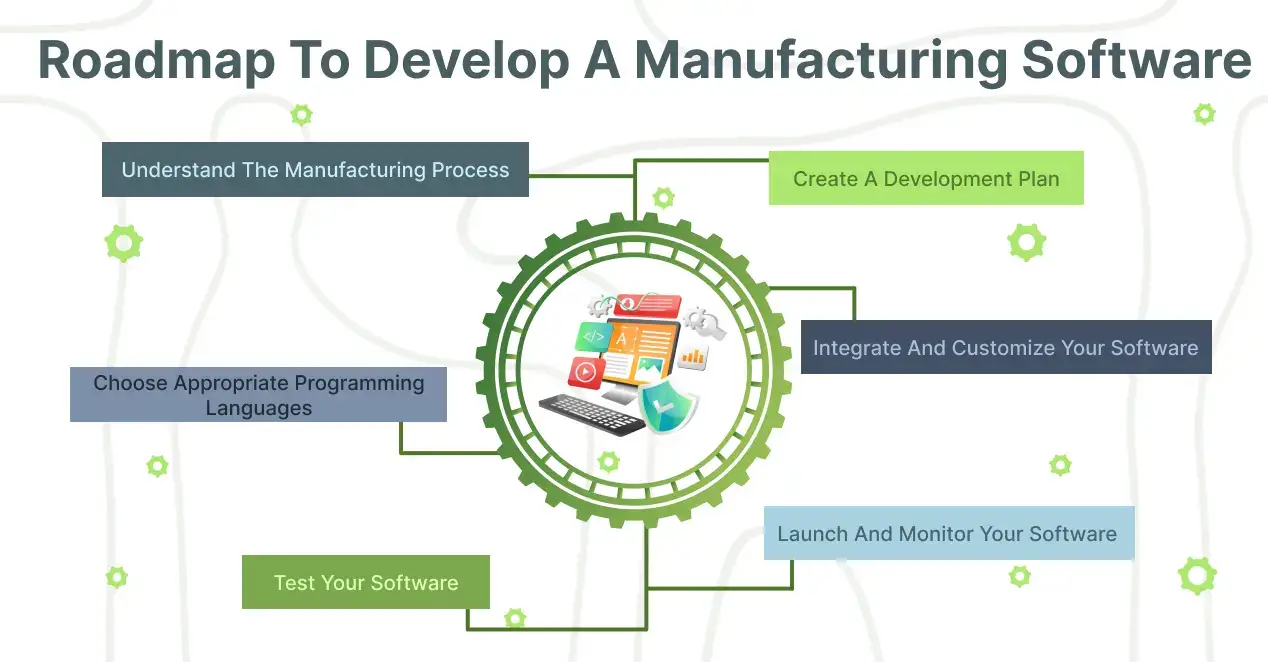
We have covered manufacturing software, its features, types, and future demand. Now let’s make it real for your business. Here is a simple process to get started with manufacturing software development:
Understand The Manufacturing Process
As noted above, every business has different manufacturing needs and its own plan. To simplify things, assess your needs first. Look at production flow, team requirements, and the best software fit. When developers understand the process, they can design software for your exact operation. Related: hire cross-platform developers.
Create A Development Plan
Next comes a well-structured development plan. It should cover the project scope, timeline, and resources. It should also describe the software’s features and capabilities in full. A clear plan keeps the project on track. It also helps deliver the results you need.
Choose Appropriate Programming Languages
You can pick a popular language like JavaScript, Python, or C++ to build efficient manufacturing software. Your choice depends on a few things. These include project complexity, performance needs, and your team’s expertise.
Integrate And Customize Your Software
Integration comes next. You can connect your software to CRM, ERP, or PLM for a smooth workflow. It is also key to customize the software for your operation. That could mean adjusting the user interface, adding features, or linking specialized hardware.
Test Your Software
The next step is testing. Check that the software is stable, works with all components, and runs well. This includes unit, integration, and user acceptance testing. Finding and fixing defects early lowers the risk of failures and production disruptions.
Launch And Monitor Your Software
Now it is time to deploy. Once testing is complete, you can launch the software for all your manufacturing needs. Over time, it may need updates or changes. These keep it in step with new company needs and technical improvements.
Create A Manufacturing Software With Echoinnovate IT
Smart digital solutions can lift your manufacturing business fast. They make automation, quality control, faster production, and supply chain easier. With strong manufacturing software, you get solid real-time results. The first step is to work with a good manufacturing software development company.
Partner with us and get a team of talented software developers, innovators, and builders. We create custom manufacturing software on a budget. Hire us and grow your manufacturing business with EchoInnovate IT!
Frequently Asked Questions
What is manufacturing software development?
Manufacturing software development involves creating customized digital solutions to streamline production processes, manage supply chains, monitor inventory, and improve efficiency in manufacturing operations. These solutions help manufacturers automate tasks, reduce errors, and boost overall productivity.
Why should entrepreneurs invest in manufacturing software?
Entrepreneurs should invest in manufacturing software to enhance operational efficiency, reduce costs, improve decision-making with data insights, and scale their businesses faster. Custom software can be tailored to the unique needs of a manufacturing business, providing a competitive edge.
How do I choose the right software development partner for my manufacturing business?
Look for a software development partner with experience in the manufacturing sector, a strong track record of building scalable and secure solutions, and expertise in technologies like IoT, ERP systems, and AI. A good partner should also understand your business goals and help design solutions tailored to your specific needs.
SaaS products engineered for retention, not just sign-ups.
Multi-tenancy, RBAC, billing (Stripe/Chargebee), audit logs, SSO/SAML, analytics, integrations marketplaces. We ship B2B SaaS used by 500+ enterprise customers. We know the small things that make SaaS sticky. That means clean admin UIs, API docs that earn trust, and onboarding that lowers TTV. Is your SaaS growing well but losing users? We’ll diagnose it.