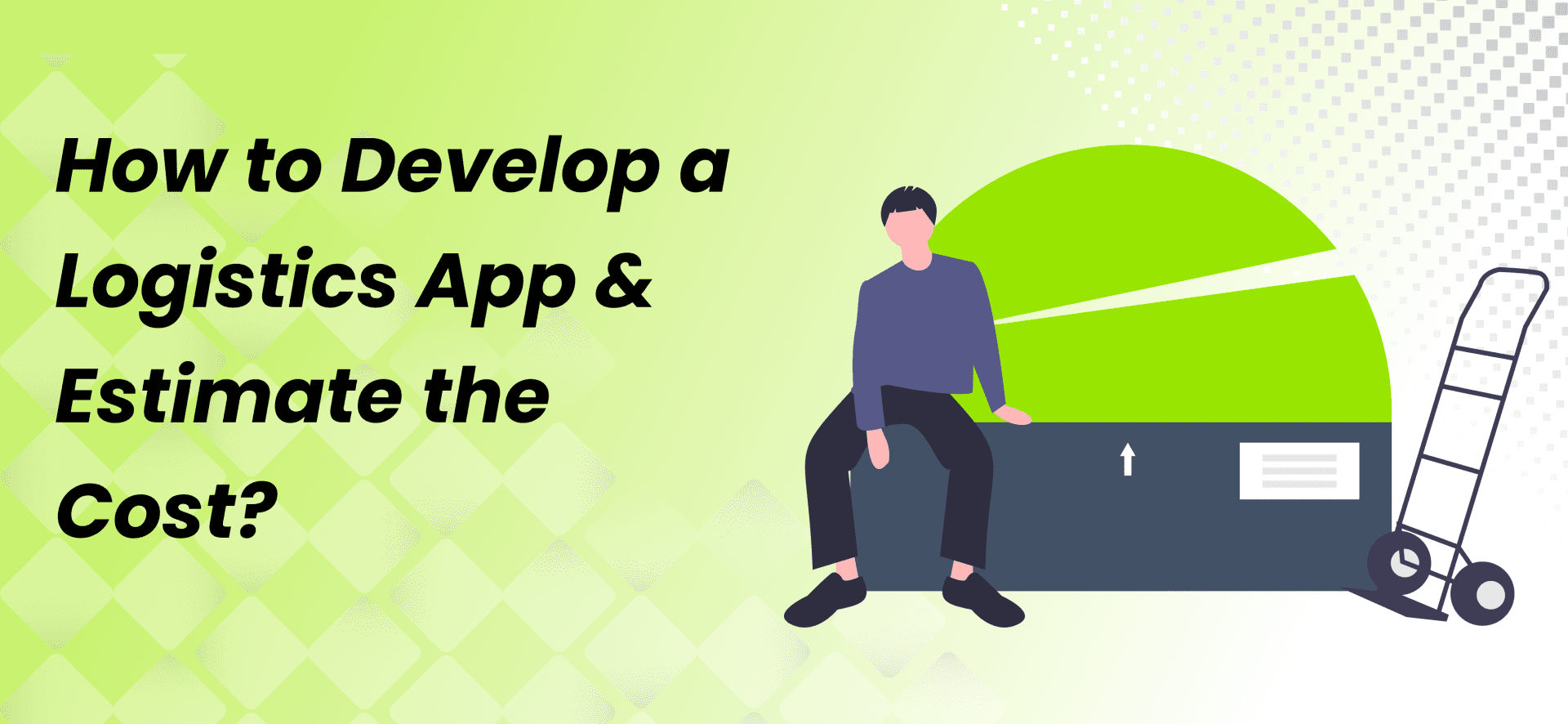
Building a logistics app in 2026 can range widely in cost, from a focused MVP to a full multi-sided platform with real-time tracking, route optimization, and fleet management. Where your project lands depends on how many user types you serve (shippers, drivers, dispatchers, and customers), how deep your tracking and automation go, and which third-party systems you connect to.
This guide gives you the cost tiers first, then the must-have features, the tech stack, a realistic timeline, and the factors that actually move the budget, so you can plan with confidence and avoid the mid-project surprises that derail most first builds. Whether you are digitizing a courier fleet, launching an on-demand delivery product, or replacing spreadsheets that no longer scale, the decisions below shape your cost more than any single technology choice. The ranges here reflect real 2026 market conditions for offshore and blended teams rather than a sales quote; you get a firm number after a short scoping call.
Key takeaways
- A logistics app MVP is the most affordable starting point; a full platform with fleet management and route optimization costs significantly more.
- The biggest cost drivers are the number of user roles, real-time tracking depth, route optimization, and integrations with carriers, ERPs, and payment systems.
- An MVP takes roughly 3–5 months; a production-grade platform takes 7–12 months depending on scope.
- Cross-platform frameworks and an offshore or blended team are the main levers for controlling cost without cutting quality.
- Start narrow: ship the core tracking and dispatch loop first, then add automation and analytics once the workflow proves out.
How much does it cost to build a logistics app?
The honest answer is that a logistics app costs whatever its scope demands, so the useful question is which tier your product belongs to. Below are the three tiers we see most often in 2026, with the market ranges that apply to offshore and blended delivery teams. These are planning ranges, not fixed prices; scope, integrations, and design complexity move the final figure in either direction, which is why we quote after a short scoping call rather than publishing a flat number.
Most first-time builders overestimate what they need on day one. A logistics operation rarely fails because the app lacked a feature in month one; it fails when the core tracking and dispatch loop is unreliable. Spending your first budget on that loop, and phasing everything else, is the single most effective way to keep costs predictable.
| Tier | Investment level | What it includes | Best for |
|---|---|---|---|
| MVP | Entry-level | Driver and customer apps, live order status, basic dispatch, maps, and a simple admin panel. | Validating a delivery or courier model before scaling. |
| Growth | Mid-range | Real-time GPS tracking, route optimization, proof of delivery, notifications, payments, and analytics dashboards. | Operators scaling past a few hundred daily shipments. |
| Scale | Enterprise-scale | Multi-sided platform, fleet management, ERP and carrier integrations, warehouse and inventory sync, and predictive ETAs. | 3PLs and enterprises running large, multi-region fleets. |
Ranges reflect 2026 market rates for offshore and blended teams; onshore-only rates run higher. Final pricing depends on scope, and we provide a transparent quote after a short scoping call. For a wider view of app budgets, see our mobile app development cost guide.
Must-have features of a logistics app
A logistics app is really three connected applications: one for the people moving goods, one for the people ordering or receiving them, and one for the team coordinating the operation. Getting the split right keeps each interface focused and keeps your build cost from ballooning. Below are the features that earn their place in most 2026 builds.
Driver app. Drivers need a fast, low-distraction interface: assigned stops in optimized order, turn-by-turn navigation, one-tap status updates (picked up, en route, delivered, failed), digital proof of delivery with photo and signature capture, and offline support for dead zones. Battery-efficient background location is non-negotiable, because a tracking feature that drains phones gets switched off.
Customer or shipper app. The people waiting on a shipment want a live map, an accurate ETA, push and SMS notifications at each milestone, order history, and a simple way to contact support or rate the delivery. For B2B shippers, add booking, rate quotes, document uploads, and invoice visibility.
Dispatcher and admin panel. This is where the operation is actually run. Dispatchers need a live map of every vehicle, drag-and-drop assignment, automated and manual route planning, exception alerts when a delivery is late or a driver goes off-route, and reporting on on-time rates, cost per delivery, and driver performance. This panel is often underestimated, yet it is where most of the operational value lives.
Cross-cutting essentials. Real-time GPS tracking, geofencing for automated status changes, in-app chat between drivers and dispatch, secure authentication with role-based permissions, and audit logs round out the core. Route optimization and predictive ETAs are the features that separate a basic tracker from a platform that genuinely reduces fuel and labor cost, and they are usually worth prioritizing once the core loop is stable.
Tech stack and integrations
The stack for a logistics app is chosen around three demands: real-time data at scale, reliable mapping, and clean integration with the systems your business already runs. Here is what a dependable 2026 setup looks like.
Mobile clients. For the driver and customer apps, a cross-platform framework such as Flutter or React Native lets one team ship to iOS and Android from a single codebase, which typically cuts mobile build cost against writing two native apps. Native modules are added only where you need deep hardware access, such as advanced background location or barcode scanning. See our mobile app development services for how we scope this.
Backend and real-time layer. A logistics platform lives or dies on its ability to move location and status updates in real time. That usually means a Node.js, Go, or Java backend, a PostgreSQL or PostGIS database for geospatial queries, Redis for fast lookups, and a streaming layer (WebSockets or a message queue such as Kafka) to push live positions to maps without hammering the database.
Maps and routing. Google Maps Platform, Mapbox, or HERE handle geocoding, navigation, and distance-matrix calculations. Route optimization is either built on these providers or on a dedicated optimization engine when you are solving multi-stop, multi-vehicle problems at scale.
Integrations that define the project. This is where logistics apps get expensive or cheap. Common connections include payment gateways, SMS and push providers, carrier and shipping APIs (for label generation and rate shopping), ERP or WMS systems for inventory and order sync, accounting software for invoicing, and telematics or ELD hardware for fleet data. Each integration adds development and testing time, so listing them early is the fastest way to get an accurate estimate. If your team is stretched, our IT staff augmentation services can add specialists for the integration-heavy phases without a permanent hire.
For consumer-facing examples of this model, see the best delivery apps like Roadie.
How long it takes to build a logistics app
Timelines track scope closely. A focused MVP with a driver app, a customer app, live tracking, and a basic admin panel usually takes 3 to 5 months from kickoff to store submission. A growth-stage build with route optimization, payments, proof of delivery, and analytics runs 5 to 8 months. A full multi-sided platform with fleet management, ERP and carrier integrations, and predictive ETAs takes 7 to 12 months, and often longer if enterprise security reviews and hardware integrations are involved.
Those figures assume a dedicated team working in parallel rather than one developer building sequentially. A typical team is a product manager or business analyst, a designer, two to four mobile and backend engineers, and a QA specialist. Discovery and design take the first few weeks, the core tracking and dispatch loop comes next, integrations and optimization follow, and the final stretch is testing across real devices, network conditions, and edge cases such as failed deliveries and offline sync.
The fastest way to compress the timeline is to phase the release. Ship the reliable core to a small set of routes or drivers, learn from real usage, and add automation and analytics in the next release. This protects your budget and gets a working tool into the field months earlier than a big-bang launch.
What drives the cost of a logistics app
Five factors explain most of the variation between a modest project and a large-scale one. Understanding them lets you make deliberate trade-offs instead of discovering the cost after the fact.
1. Number of user roles. Each distinct app (driver, customer, dispatcher, warehouse, finance) is a separate interface with its own screens, permissions, and testing. Two roles is an MVP; five roles is a platform. This is the single largest lever on cost.
2. Depth of real-time tracking. Showing a driver’s last known location is cheap. Streaming smooth, continuous positions for hundreds of vehicles, with geofencing and automated status changes, requires real-time infrastructure that costs more to build and to run.
3. Route optimization. Simple point-to-point directions come free with a maps API. True multi-stop, multi-vehicle optimization that accounts for time windows, capacity, and traffic is a specialized capability that adds meaningful engineering time, though it often pays for itself in fuel and labor savings.
4. Integrations. Every ERP, WMS, carrier, payment, or telematics connection adds development, testing, and ongoing maintenance. Enterprises with legacy systems should expect integration work to be a large share of the budget.
5. Team model and location. Onshore-only teams in North America or Western Europe carry the highest rates. An offshore or blended team delivering comparable quality is the most common way to control cost, which is why so many operators build this way. Our guide to offshore software development rates by country breaks down the differences, and how to hire offshore developers covers doing it without the usual risks.
How EchoInnovate IT builds logistics apps
EchoInnovate IT is an India-based custom and white-label software development company with 12 years of delivery experience, a team of 50+ employees, and 500+ products shipped, most of them under our clients’ own brands. We hold a 5.0 rating across 6 verified client reviews on Clutch. For logistics, that background matters: these apps fail on the unglamorous details (offline sync, battery drain, flaky GPS, failed-delivery flows) and experience is what keeps those details from becoming production incidents.
We start with a short discovery to map your operation, user roles, and integrations, then propose a phased plan that ships the core tracking and dispatch loop first. You get a dedicated team, transparent weekly progress, and a fixed scope for each phase so the budget stays predictable. We handle the full build (mobile apps, backend, admin panel, maps, and integrations), store submission, and ongoing maintenance, and we can plug specialists into your existing team when that is the better fit. As a software development company, our aim is a working tool in the field, not a slide deck.
Because we build cross-platform by default and staff blended teams, we deliver production-grade mobile app development at a cost that onshore-only shops struggle to match, without cutting corners on reliability or security. If you already have a team and need extra hands for the integration-heavy phases, our staff augmentation model scales you up and down as the project demands.