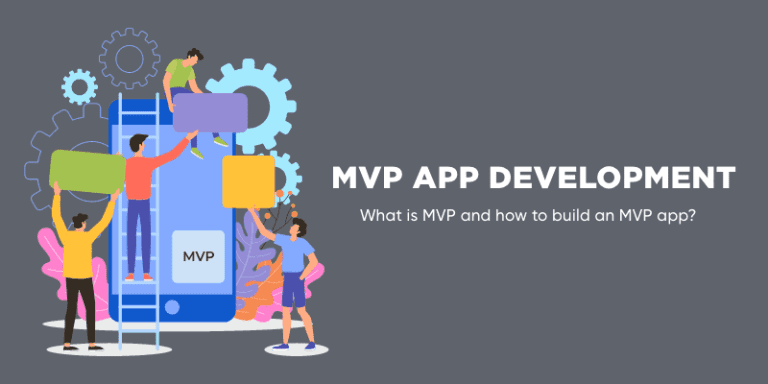
If you are planning an MVP app, the first two questions are almost always cost and time: how much will a first version take to build, and how fast can it reach real users? Here is the short answer. In 2026, a focused MVP app typically takes 6 to 16 weeks to launch, with cost depending on how many features you include and whether you build for one platform or both. Anything higher usually means you are building more than a minimum viable product — and spending money before you have proof that users want it.
An MVP is not a cheap, half-finished app. It is the smallest version of your product that delivers real value to early users, so you can learn what to build next with actual data instead of assumptions. Done well, it protects your budget, shortens time to market, and gives investors evidence rather than a pitch. This guide covers what an MVP should and should not include, honest 2026 cost ranges, the features that matter, the tech stack, realistic timelines, and how we build MVPs at EchoInnovate IT so founders reach validation without overspending.
Key takeaways
- A focused MVP app in 2026 typically launches in 6–16 weeks, with cost driven by scope.
- An MVP is the smallest valuable version of your product, built to learn from real users — not a cheap, unfinished app.
- Include only the one core workflow plus the essentials around it; defer everything else to the roadmap.
- Cross-platform (Flutter, React Native) usually gives the best cost-to-reach ratio for a first version.
- The biggest risk is building too much before you have proof of demand. Scope tightly, ship, then iterate.
How much does it cost to build an MVP in 2026?
MVP cost is driven by one thing above all: how disciplined you are about scope. The whole point of a minimum viable product is to spend as little as possible to answer one question — will people use and pay for this? The table below shows realistic 2026 market ranges for three levels of MVP, from a bare-bones prototype to a fuller first release ready for a real launch.
| MVP tier | What you get | Investment level | Timeline |
|---|---|---|---|
| Prototype MVP | One core flow, 4–8 screens, single platform, basic backend, for early user tests and demos | Entry-level | 6–10 weeks |
| Launch MVP | Core workflow, auth, payments, push, cross-platform, analytics, ready for real users | Mid-range | 10–14 weeks |
| Scale-ready MVP | Multiple roles, 3–5 integrations, admin panel, robust infra for investor-grade traction | Enterprise-scale | 14–20 weeks |
These are planning anchors, not quotes. If you are seeing numbers far above these for a first version, the scope has almost certainly crept beyond what an MVP needs. We do not publish fixed per-project prices because two MVPs with the same screen count can differ once integrations and compliance enter the picture; we give a transparent quote after a short scoping call. Our mobile app development cost guide breaks the line items down further.
What an MVP app is (and what it is not)
A minimum viable product is the smallest version of your app that delivers genuine value to early users and lets you test your core assumption with real data. The keyword is viable: it must actually work and be worth using, not feel broken. The goal is learning, not completeness.
What an MVP is: one core workflow done well, enough polish that users trust it, and instrumentation so you can measure whether people adopt it. It answers a single question — do the people you are targeting use this, come back, and value it enough to pay?
What an MVP is not: it is not a cheap, buggy version of the full vision, and it is not the full vision with a smaller budget. The most common and expensive mistake founders make is loading the MVP with features “we will need eventually.” Every extra feature adds cost and delay while lowering the odds you ship before your runway runs low. If a feature does not directly test your core assumption, it belongs on the roadmap, not in version one.
Think of the MVP as the first turn of a build-measure-learn loop. You ship the smallest useful thing, watch how real users behave, and let that data decide what to build next. That discipline is what makes an MVP a budget protector rather than a budget drain. Our MVP development for startups service is designed around exactly this loop.
Must-have features of an MVP app
Every MVP is different, but most share a small set of essentials. The art is including these and almost nothing else.
- One core workflow. The single job your app exists to do — booking a service, sending money, tracking a habit — built end to end so users can complete it without friction.
- User onboarding and authentication. Simple sign-up and login, often via email or social login. Keep it light; friction here kills early adoption.
- A clean, trustworthy UI. It does not need to be elaborate, but it must feel reliable. Users abandon apps that look unfinished.
- Core data and profiles. The minimum user or content data needed for the core workflow to make sense.
- Payments, only if they are the point. Include billing or in-app purchase only when charging is the assumption you are testing.
- Notifications, if they drive the loop. Push or email that brings users back — but only if retention is central to your hypothesis.
- Analytics. Non-negotiable. Without event tracking you cannot tell whether the MVP is working, which defeats the purpose.
Notice what is missing: admin dashboards, multiple user roles, social feeds, gamification, settings for every preference, and “nice to have” screens. Those are roadmap items. If you catch yourself justifying a feature with “users will expect it,” ask whether it tests your core assumption. If not, defer it. A tightly scoped feature set is the difference between a 10-week launch and a 10-month one.
Tech stack and integrations
For an MVP, the stack should optimize for speed and low cost of change, because you expect to rewrite parts of it as you learn.
Front end. Most MVPs are best served by a cross-platform framework so a single codebase reaches both iOS and Android. Flutter and React Native are the common choices in 2026: they cut cost roughly 30 to 40 percent versus two native builds and keep near-native performance, which is more than enough for a first version. If your MVP is web-first or content-heavy, a progressive web app can be even faster and cheaper to ship.
Back end. A lightweight cloud API (Node.js or Python) with a managed database (PostgreSQL or MongoDB) covers most MVPs. Many teams accelerate further with managed platforms like Firebase or Supabase for authentication, storage, and real-time data, which removes a lot of backend plumbing early on.
Integrations. Keep them minimal. Typical MVP integrations are authentication (email or social login), payments if you are testing willingness to pay (Stripe, Razorpay, in-app purchases), push notifications via Firebase, and a single analytics tool. Every additional integration adds build and QA time, so add only what your core hypothesis requires.
Infrastructure. Cloud hosting on AWS, Google Cloud, or Azure with straightforward CI/CD is plenty. Do not over-engineer for scale you have not proven you need. If you need to add engineers quickly as the MVP gains traction, our IT staff augmentation services let you extend your team with vetted mobile and backend developers.
Before you commit to a build, compare the leading app mockup and wireframing tools.
How long it takes to build an MVP
A well-scoped MVP usually reaches real users in 6 to 16 weeks. A rough breakdown for a dedicated team:
- Discovery and scoping (1–2 weeks): define the core assumption, the one workflow, and success metrics. This is where most budget is saved or wasted.
- Design (1–3 weeks): user flows, wireframes, and a clean UI for the core screens.
- Development (4–10 weeks): build the core workflow, backend, and essential integrations, in short iterative sprints.
- QA and launch (1–2 weeks): testing, store submission where relevant, and instrumentation checks.
The fastest way to compress this is not to add developers late; it is to cut scope early. Every feature you defer removes design, build, and testing time across the whole timeline. Founders who insist on a tight core ship in weeks; those who keep adding “just one more thing” watch months disappear and runway with them. Our recommended starting point is a two-week pilot sprint that turns a rough idea into a scoped plan, a proof of concept, and a fixed quote — so you know exactly what your MVP will cost and take before you commit.
What drives the cost of an MVP
Five factors move an MVP’s price within the ranges above:
1. Scope discipline. By far the biggest lever. Each extra feature multiplies design, development, and testing effort. A ruthlessly scoped MVP can cost half of a padded one.
2. Platforms. One codebase (cross-platform or web) versus two native builds is a large swing. Most MVPs should not build two native apps.
3. Integrations and payments. Each payment gateway, third-party API, or compliance requirement adds engineering and QA. Include only what tests your hypothesis.
4. Design depth. A clean, template-informed UI is inexpensive. Bespoke animation and a full custom brand system cost more than an MVP usually needs.
5. Team model and location. Blended rates vary widely by geography. A dedicated offshore or nearshore team often delivers comparable quality well below onshore rates, which is why many founders build their MVP this way. Our offshore rates by country guide shows how much this choice moves the total.
Because these factors interact, we quote after a short scoping call rather than publishing a fixed price. The scoping conversation itself often saves money by cutting features that do not serve the core assumption.
How EchoInnovate IT builds MVPs
EchoInnovate IT is an India-based custom and white-label software development company with 12 years of experience and a team of 50+ people. We have shipped 500+ products — most under our clients’ own brands — and hold a 5.0 rating across 6 verified reviews on Clutch. A large share of those products started as MVPs, so we have seen first-hand which first versions turn into funded companies and which stall.
Our MVP process starts with scoping, not code. We help you name the single assumption the MVP must test, then cut everything that does not serve it. We recommend the leanest stack that fits — usually cross-platform or a PWA — staff a dedicated team, and build in short sprints with working software you can see every week. We instrument the app so you get real adoption and retention data from day one, and we plan the roadmap so version two is informed by evidence rather than opinion. Because we are white-label engineers, most of the apps we have built carry someone else’s logo; we are comfortable being the team behind your product.
Most founders start with our MVP for startups engagement or the two-week pilot sprint below, which de-risks the decision before any large commitment. Whatever path you choose, the objective is the same: reach validation with the least time and money, and keep your options open for whatever the data tells you to build next.