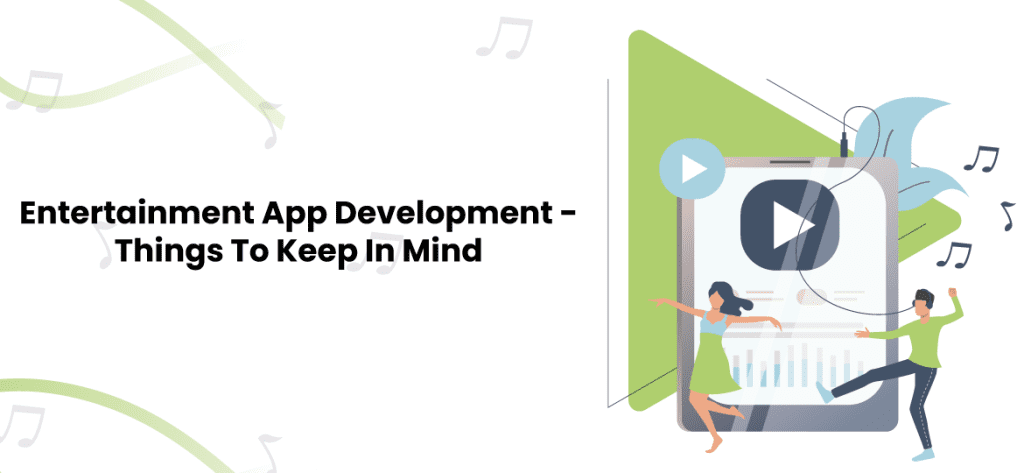
Entertainment app development in 2026 depends on scope, features, and region — an MVP at the entry level, a growth-stage product in the mid-range, and a scaled streaming or social platform at the enterprise-scale end, with live features, recommendations, and a large content library. “Entertainment app” covers a wide range — video and music streaming, short-form video, live streaming, gaming and quiz apps, OTT platforms, and social entertainment — and where your idea sits on that spectrum decides most of the budget.
What these apps share is the hard part: delivering media smoothly to millions of devices, keeping people engaged with recommendations and social features, and monetizing through subscriptions, ads, or in-app purchases. This guide gives you the cost drivers first, then the must-have features, the tech stack, a realistic timeline, the factors that move the price, and how EchoInnovate IT builds entertainment products. We answer the money question up front so you can plan a budget, then go deep enough to make real decisions.
- An entertainment app MVP sits at the entry level of investment; a scaled streaming or live platform reaches the enterprise-scale end.
- Media delivery — streaming, transcoding, CDN, and DRM — is the biggest single cost driver, ahead of the interface.
- Recommendations, social features, and monetization (subscriptions, ads, in-app purchases) are what turn an app into a business.
- A cross-platform build plus managed streaming infrastructure keeps costs controlled across mobile, web, and TV.
- Scope, content volume, and concurrency drive the price far more than team location — get a quote after a short scoping call.
How much does entertainment app development cost?
Entertainment apps are priced by scope and by how much media infrastructure they need. A social quiz app and a Netflix-style OTT platform are both “entertainment apps,” but they live in different budget worlds. The most practical way to plan is by stage: an MVP to validate the concept, a growth product ready for a real audience and monetization, or a scaled platform built for high concurrency and a large content library. The tiers below reflect typical 2026 market scope for an experienced offshore or nearshore team. They are relative bands, not a fixed EchoInnovate IT quote — we provide an exact figure after a short scoping call.
| Tier | What you get | Investment level | Timeline |
|---|---|---|---|
| MVP | Content catalog, on-demand video or audio playback, accounts, search, basic profiles, one platform or cross-platform mobile | Entry-level | 2–4 months |
| Growth | Recommendations, social features, subscriptions and ads, offline downloads, watchlists, iOS + Android + web | Mid-range | 4–9 months |
| Scale | Live streaming, DRM, personalization engine, multi-region CDN, TV and console apps, high concurrency, analytics at scale | Enterprise-scale | 9–16 months |
The variables that push a project up the tiers are live streaming, digital rights management (DRM), and the personalization engine. On-demand playback of a modest catalog is well understood and affordable; low-latency live streaming to a large concurrent audience, protected by DRM and tuned by real-time recommendations, is a major engineering effort. Our mobile app development cost guide breaks down the shared drivers, and our mobile app development service page shows the kind of products we ship.
Must-have features of an entertainment app
Whatever category you are in, entertainment apps succeed or fail on discovery, playback quality, and engagement. These are the features that define a competitive product in 2026 and that you should budget for deliberately.
Content catalog and discovery. Users need to find something to watch, listen to, or play within seconds. That means a well-organized catalog, fast search, categories and genres, curated rows, and trending or editorial sections. Discovery is not a nice-to-have; it is the difference between an app people open once and one they open daily.
High-quality media playback. The player is the product. Adaptive bitrate streaming for smooth playback on any connection, quick start times, resume-where-you-left-off, background audio, casting to TV, and picture-in-picture are all expected. For audio apps, gapless playback and a persistent mini-player matter. Getting playback right is where a lot of the engineering budget goes, and rightly so.
Personalization and recommendations. Retention in entertainment is driven by recommendations. Even a simple “because you watched” or “more like this” system lifts engagement, and a full personalization engine that learns from behavior is what keeps subscribers. This can start rule-based and grow into a machine-learning system as your data grows.
User accounts, profiles, and watchlists. Multiple profiles per account, watch history, favorites, watchlists, and cross-device sync are standard expectations set by the major platforms. Users assume they can start on their phone and finish on their TV.
Social and interactive features. Depending on your category, this ranges from sharing and comments to live chat, reactions, following creators, and user-generated uploads. Social features drive virality and time-in-app, but they also add moderation and infrastructure requirements.
Monetization. Entertainment apps make money through subscriptions, advertising, in-app purchases, pay-per-view, or a hybrid. Each model has technical implications: subscriptions need billing and entitlement logic, ads need an ad-server integration and frequency control, and in-app purchases must follow app store rules. Building the monetization layer correctly from the start avoids expensive rework.
Offline downloads and DRM. Letting users download content for offline viewing widens your audience, and if you license premium content you will need DRM to protect it. Both add complexity but are often non-negotiable for a serious streaming product.
Notifications and live events. Push notifications for new releases, live events, and personalized nudges bring users back. If you run live streams or premieres, low-latency delivery and real-time chat become part of the core build.
For examples of what audiences already use, browse the best live streaming apps.
Tech stack and integrations
Entertainment apps put unusual demands on infrastructure because they move large amounts of media to many devices at once. The stack below is proven for streaming and social entertainment products in 2026.
Front end across devices. A cross-platform framework such as Flutter or React Native covers iOS and Android from one codebase, with a web app for browser users. For living-room reach you may add TV apps (Apple TV, Android TV, Roku, Fire TV), which share business logic with the mobile clients but need their own interface work. Building mobile and web cross-platform first, then expanding to TV, is the cost-efficient sequence.
Backend and APIs. A backend in Node.js, Go, or Python handles the catalog, user data, entitlements, and recommendations. Entertainment backends benefit from a microservices approach so that playback, billing, and social features can scale independently under load.
Streaming infrastructure. This is the heart of the system. Most teams use a managed video pipeline — transcoding to multiple bitrates, packaging for adaptive streaming (HLS/DASH), a global CDN for delivery, and DRM where content is licensed. Using managed services here is dramatically faster and cheaper than building streaming from scratch, and it scales as your audience grows.
Databases and caching. A relational store for users and billing, a fast cache like Redis for sessions and trending content, and often a search engine such as Elasticsearch for catalog discovery. Recommendation data may live in a separate analytics or ML pipeline.
Cloud and scaling. AWS, Google Cloud, or Azure provide compute, storage, and autoscaling. Entertainment traffic is spiky — a premiere or live event can multiply load in minutes — so autoscaling and load testing are essential rather than optional.
Key integrations. Expect payment and subscription billing (Stripe, app store billing, or a regional gateway), an ad server for ad-supported tiers, analytics and A/B testing, push notifications, and social login. Live products add a real-time layer for chat and low-latency streaming. When a phase needs specialist skills quickly — a streaming engineer or an ML specialist for recommendations — IT staff augmentation lets you add them without permanent hiring.
For a creator-focused build, see our guide to building a video editing app.
How long does it take to build?
Timelines follow the tiers. An MVP with a content catalog, on-demand playback, accounts, and search is realistic in two to four months with a focused team. That is enough to launch to an early audience and measure whether people come back, which is the metric that matters most in entertainment.
A growth-stage product adding recommendations, social features, subscriptions and ads, offline downloads, and full cross-platform coverage generally takes four to nine months. The recommendation system and the monetization layer are the two workstreams that most often extend this phase, because both touch data and multiple parts of the app.
A scaled platform with live streaming, DRM, a personalization engine, multi-region delivery, and TV apps is a nine-to-sixteen-month program, delivered in overlapping releases rather than a single launch. Live streaming in particular is usually its own phase because low-latency delivery, real-time chat, and high concurrency need dedicated engineering and load testing.
The most reliable path is to ship the MVP, prove retention with real users, and then fund each subsequent phase against evidence. This staged model controls both risk and cash flow, and it mirrors how most successful streaming and social entertainment products actually grew. Timelines compress when a dedicated team works full time and the content and monetization models are decided early.
What drives the cost
When entertainment app quotes differ, these variables are almost always the reason. Knowing them lets you shape the budget rather than react to it.
Live vs on-demand. On-demand playback is well-understood and affordable. Live streaming — especially low-latency live with chat and large concurrent audiences — is a different tier of complexity and cost.
DRM and content licensing. If you license premium content, DRM and secure delivery are mandatory and add both engineering and ongoing licensing cost. User-generated or original content you own can avoid some of this.
The recommendation engine. A few curated rows are cheap. A behavior-driven personalization system that measurably lifts retention is a real data and ML investment. How smart it needs to be at launch is a major lever.
Content volume and moderation. A large catalog, or a platform with user uploads, brings storage, transcoding, and moderation costs. Moderation in particular — human, automated, or both — is easy to underestimate.
Concurrency and scale targets. Building for ten thousand users is not the same as building for ten million, or for a premiere spike. Your scale target shapes architecture decisions that carry real cost.
Platforms and devices. Mobile only is cheaper than mobile, web, and TV. Each living-room platform has its own interface and certification work. Cross-platform frameworks reduce mobile and web cost, which is why we usually recommend them.
Monetization model. Subscriptions, ads, in-app purchases, and pay-per-view each carry their own billing and integration work. Hybrid models multiply that. Team location affects hourly rate — experienced offshore teams cost less than onshore for comparable quality, as our guide to hiring offshore developers explains — but scope moves the total far more than location does.
How EchoInnovate IT builds entertainment apps
EchoInnovate IT is an India-based custom and white-label software development company with 12 years in business, 50+ employees, and 500+ products shipped — most under our clients’ own brands. We hold a 5.0 rating across 6 verified client reviews on Clutch. In entertainment, that white-label track record is common: a large share of streaming and social apps in the market were built by teams like ours and launched under someone else’s name.
Our approach starts with a short discovery phase to pin down the category, the media pipeline, the monetization model, and the launch scope — the decisions that most affect cost. We build cross-platform for mobile and web first, integrate a managed streaming pipeline rather than reinventing transcoding and delivery, and design the recommendation and billing layers so they can grow from simple rules into full engines without a rewrite. A dedicated team — product, design, mobile, backend, and QA — works your project full time so timelines stay predictable, and we load-test for the traffic spikes that entertainment apps inevitably see.
We handle app store and TV platform releases, analytics, and ongoing maintenance, and we scale the team per phase. When a stage needs a specialist — a streaming engineer, an ML engineer for recommendations, a DevOps lead for scaling — we add them through staff augmentation without disrupting the core team. You can see the full offering on our mobile app development page, and our software development company overview explains how we work across projects.
We do not publish fixed prices, because scope drives everything and an honest number needs your real requirements. Instead we provide a transparent, itemized quote after a short scoping call so the estimate matches the product you actually want to launch.