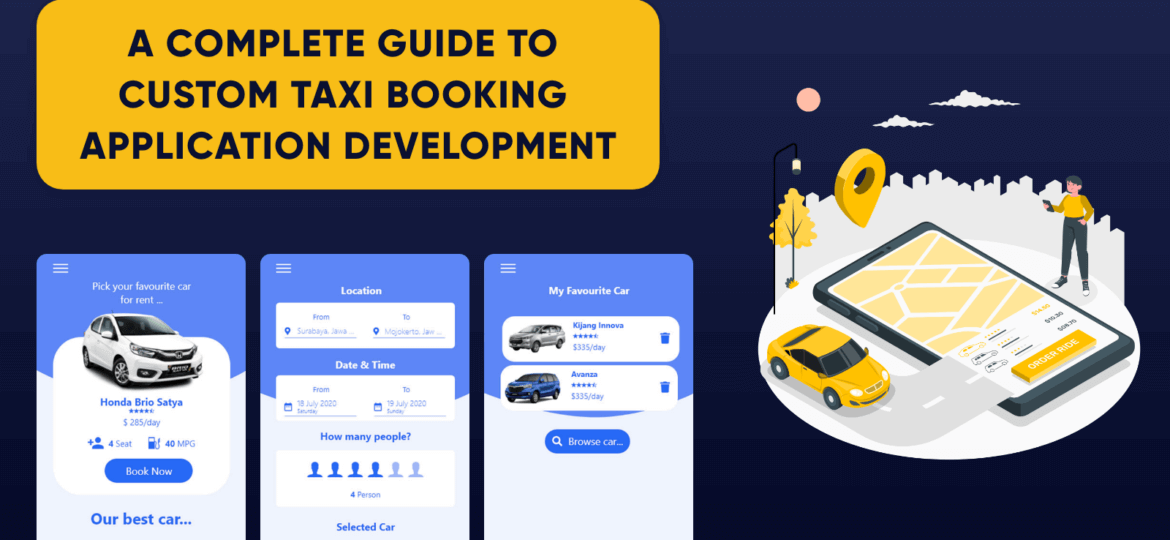
Building a taxi booking app like Uber is a significant investment in 2026, because you are really building three connected apps: a rider app, a driver app, and an admin dashboard. A focused MVP across all three sits at the entry level; a growth build with live tracking, in-app payments, and ratings moves into a mid-range investment; and a scale platform with surge pricing, multiple ride types, and dispatch intelligence reaches enterprise-scale. The final figure depends on features, integrations, platforms, and the team you hire, so we give a transparent quote after a short scoping call rather than a fixed price. This guide breaks down every cost driver.
EchoInnovate IT is an India-based custom and white-label development shop with 12 years of experience, 50+ employees, 500+ products shipped, and a 5.0 rating across 6 verified Clutch reviews. We build on-demand and ride-hailing apps like this under our own name and under our clients’ brands. Explore our mobile app development services to see how we deliver.
Key takeaways
- A taxi app like Uber is a substantial investment in 2026 because it is three apps: rider, driver, and admin.
- Cost is driven by real-time GPS tracking and dispatch, in-app payments, ratings, notifications, and platform count.
- Real-time location matching and payments are the features that make a ride-hailing app complex.
- A typical three-app MVP takes 4-6 months; a full platform with surge pricing and multiple ride types takes 8-12 months.
- Start with a $1,500 fixed-price 2-week pilot sprint to validate scope and get a firm quote before committing budget.
How much does it cost to build a taxi app like Uber?
Cost scales with scope, and a ride-hailing app carries a cost multiplier most apps do not: you build and maintain three connected products at once, plus a real-time backend that matches riders and drivers on a live map. Below are the three tiers we most often scope, from entry-level to enterprise-scale. These are relative investment levels, not quotes; your real number comes after a short scoping call.
| Tier | What you get | Investment level |
|---|---|---|
| MVP | Rider, driver, and admin apps; registration, ride request and matching, live map, fare estimate, one payment method, trip history | Entry-level |
| Growth | Everything in MVP plus live driver tracking and ETAs, multiple payment methods and wallets, ratings and reviews, in-app chat, push notifications, scheduled rides, promotions | Mid-range |
| Scale | Everything in Growth plus surge pricing, multiple ride types, intelligent dispatch, SOS and safety, multi-city and multi-currency, driver incentives, advanced analytics | Enterprise-scale |
Most founders launch a lean three-app MVP in one city, prove the model, then reinvest in the Growth features that demand supports. That staged approach keeps the initial budget defensible. See our detailed mobile app development cost guide for a wider breakdown.
The three apps behind a ride-hailing platform
Understanding why a taxi app costs more than a typical app comes down to one fact: it is not one app, it is a system of three, all talking to a shared real-time backend.
- The rider app lets passengers set pickup and drop-off, see nearby cars, request a ride, watch the driver approach on a live map, pay in-app, and rate the trip.
- The driver app receives ride requests, provides navigation, tracks earnings, manages availability, and handles payouts. It has different screens, permissions, and background-location needs than the rider app.
- The admin dashboard is where you run the business: manage drivers and riders, set pricing and commissions, monitor live trips, handle disputes, and read analytics.
Beneath all three sits the real-time matching engine that pairs a rider with the best nearby driver, calculates fares, and streams location updates continuously. That engine is the heart of the platform and the reason ride-hailing is more complex than most on-demand apps. Deciding how sophisticated the matching and pricing logic needs to be at launch is the biggest lever on your budget, and it is exactly what a scoping call resolves.
Must-have features for a taxi booking app
A ride-hailing app succeeds on speed of matching, trust, and a smooth payment. These are the features we consider non-negotiable for a credible launch, grouped by the three apps.
Rider app:
- Registration and profile with saved places and payment methods
- Set pickup and destination with map and address search
- See nearby drivers, fare estimate, and request a ride
- Live driver tracking, ETA, and trip status
- In-app payment, receipts, ratings, and support
Driver app:
- Onboarding with document upload and verification
- Availability toggle and incoming ride requests with accept or decline
- Turn-by-turn navigation to rider and destination
- Earnings, trip history, and payout tracking
Admin dashboard:
- Driver and rider management and verification
- Live trip monitoring and dispatch controls
- Pricing, commission, and promotion configuration
- Disputes, refunds, and analytics
Ship reliable matching, live tracking, and one solid payment method first. Surge pricing, multiple ride types, and safety features are Growth and Scale investments. Our mobile app development team helps you sequence this so you launch sooner and spend smarter.
Tech stack and integrations
There is no single correct stack, but a real-time, location-heavy app has a sensible default. A common, proven setup looks like this:
- Mobile apps: React Native or Flutter for the rider and driver apps, giving a single codebase across iOS and Android to keep build and maintenance cost down.
- Backend: Node.js or Go for the real-time matching and trip services, with PostgreSQL (plus PostGIS) for geospatial queries and Redis for live driver locations.
- Real-time layer: WebSockets or a managed pub/sub service to stream location and trip updates between rider, driver, and server.
- Maps and routing: Google Maps Platform or Mapbox for maps, directions, ETAs, and geocoding, billed per use.
- Admin dashboard: a web app (React or Next.js) for operations.
Key integrations usually include a payment gateway and wallet (Stripe, Braintree, or a regional provider), SMS and push (Twilio, Firebase), identity and document verification for drivers, and analytics. Choosing a cross-platform stack is one of the biggest cost decisions; our React Native vs Flutter comparison explains the trade-offs, and React Native app development is one of our core services.
How long does it take to build?
Timeline tracks scope closely, and building three apps at once shapes it. As a rule of thumb:
- MVP (4-6 months): discovery and design, then rider, driver, and admin apps with matching, live map, fare estimate, one payment method, and trip history.
- Growth build (7-9 months): add live tracking, multiple payment methods and wallets, ratings, in-app chat, scheduled rides, and promotions.
- Scale platform (9-12 months+): add surge pricing, multiple ride types, intelligent dispatch, safety features, and multi-city support, usually phased after launch.
A dedicated team of seven to nine, mobile engineers for rider and driver apps, one or two backend engineers for the real-time services, a web developer for the dashboard, a designer, a QA engineer, and a project lead, is a typical shape for this build. Ride-hailing needs heavy real-world testing of matching, GPS, and payments, so budget serious QA time. Working in two-week sprints, you see a usable flow early and steer with real feedback. If you need specialists mid-project, our IT staff augmentation services let you scale the team up or down without long hiring cycles.
What drives the cost
Six factors move the budget more than anything else:
- Three apps, not one. Rider, driver, and admin each need their own design, development, and testing, which is the core reason ride-hailing costs more.
- Real-time matching and tracking. Streaming locations and pairing riders with drivers reliably is significant backend engineering.
- Payments and payouts. Charging riders, handling wallets, and paying drivers with commission splits adds financial and compliance complexity.
- Maps and location usage. Google Maps and Mapbox bill per call for maps, directions, and geocoding, so cost scales with rides.
- Pricing and dispatch intelligence. Basic fares are affordable; surge pricing, multiple ride types, and smart dispatch are larger investments.
- Team location and model. Onshore rates can be several times offshore rates for comparable quality, which is why most cost-conscious founders build with an offshore dedicated team.
The biggest savings lever is team model. Our guide to offshore software development rates by country shows how much location affects the bill, and how to hire offshore developers covers doing it without quality risk.
How taxi apps make money
Revenue design should shape the build, so plan it early. The proven models for a taxi app are:
- Commission per ride: a percentage of each fare, the primary model for Uber-style platforms.
- Surge and dynamic pricing: higher fares during peak demand, increasing both rider revenue and driver supply.
- Driver subscriptions: a flat fee for drivers in exchange for lower or zero commission, popular in some markets.
- Booking or service fees: a small fixed fee added to each trip.
- Advertising and partnerships: in-app promotions and tie-ins with local businesses, plus premium ride tiers.
Most platforms lead with commission and add booking fees and surge pricing. Deciding your primary model up front determines which pricing and payout features are revenue-critical, and that keeps the first build focused on what pays back.
How EchoInnovate IT builds taxi apps
EchoInnovate IT is an India-based custom and white-label software development company with 12 years in business, 50+ employees, and 500+ products shipped, most of them under our clients’ own brands. We hold a 5.0 rating across 6 verified Clutch reviews. For an on-demand product like a taxi app, we assign a dedicated team, work in transparent two-week sprints, and start with a discovery phase that turns your idea into a scoped, priced plan across all three apps before any production code is written.
We build cross-platform to control your cost, engineer the real-time matching and payments layer for reliability, handle the app-store releases, and stay on for maintenance after launch. Because so much of our work is white-label, you own the product and the brand; we are the engineering team behind it. Whether you need a full build or extra hands, our mobile app development and software development company services cover the entire lifecycle, and you can add specialists any time through IT staff augmentation.