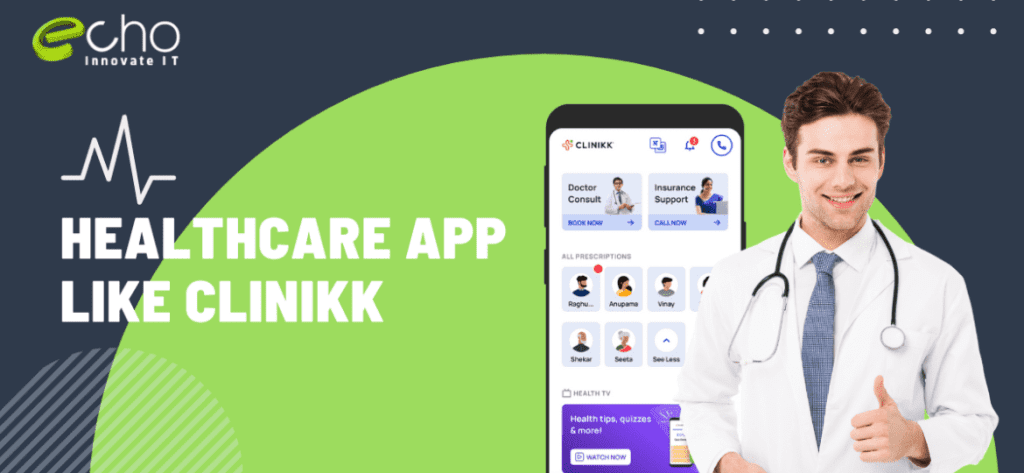
- A healthcare-app-like-Clinikk MVP is an entry-level build; a full telehealth-and-membership platform is a substantially larger, enterprise-scale investment.
- Clinikk’s model is three products in one — teleconsultation, a health-membership/insurance layer, and continuous care — and each adds cost.
- Compliance drives the budget: HIPAA (US), India’s DPDP Act, and secure handling of protected health data are core engineering, not paperwork.
- Expect roughly 5–9 months for a production build, with video consults, EHR integration, and payments taking the most time.
- The reliable way to price it is a short scoping call plus a fixed-price pilot, not a template number.
How much does it cost to build an app like Clinikk?
“An app like Clinikk” can mean a lean teleconsultation MVP or a full platform that also sells health memberships and coordinates ongoing care. The most honest way to budget is by tier. The tiers below reflect 2026 build scopes for custom builds, not fixed EchoInnovate IT prices — we give a transparent quote after a short scoping call, because feature depth, compliance region, and the insurance layer drive the number far more than any generic feature list.
| Tier | What you get | Investment level |
|---|---|---|
| MVP | Patient signup, doctor profiles and booking, secure video consultation, e-prescriptions, in-app payments, basic patient records, one region’s compliance | Entry-level |
| Growth | Health-membership/subscription layer, EHR/EMR integration, lab and pharmacy tie-ins, care plans and reminders, clinician dashboard, analytics | Mid-range |
| Scale | Insurance/claims module, multi-specialty and multi-region, wearable and remote-monitoring data, AI triage/assist, full audit and admin tooling, ongoing releases | Enterprise-scale |
The teleconsultation flow is the visible part; the records, compliance, and membership or insurance logic are where most of the budget goes. To sanity-check your own scope first, try our app cost calculator, then read the mobile app development cost guide for the underlying drivers.
Must-have features of a healthcare app like Clinikk
A Clinikk-style app has three sides: the patient app, the clinician app, and the admin and operations back office. Getting the feature scope right on each is what separates a real product from a demo.
Patient app. Onboarding and identity, symptom or reason-for-visit capture, doctor discovery and booking, secure in-app video and chat consultation, e-prescriptions, digital health records, lab-test and pharmacy ordering, payments, and a membership or subscription view if you run a Clinikk-style health plan. Reminders and follow-ups keep patients engaged between visits.
Clinician app. Schedule and queue, patient history and records, consultation notes, prescription and referral issuance, and secure messaging. Clinician time is expensive, so the workflow must be fast and low-friction.
Admin and operations back office. Provider onboarding and credentialing, catalog of services and plans, membership and billing management, claims handling if you offer insurance, reporting, and role-based access controls for protected health data. This back office is usually larger than founders expect, and mapping it early is exactly the work a software development company should do before estimating a build.
Tech stack, integrations, and compliance
Most healthcare apps in 2026 are built cross-platform (Flutter or React Native) so one team ships iOS and Android, with a back end in Node.js, Python, or Java, a PostgreSQL database, and cloud hosting on AWS or Google Cloud configured for health-data compliance. The stack is standard; the integrations and the compliance posture are what make a health app harder than a typical consumer app.
- Video and messaging: a secure real-time SDK (for example Twilio, Agora, or Vonage) for consultations, with encrypted chat.
- EHR/EMR: FHIR/HL7-based integration so records interoperate with clinical systems.
- Payments and subscriptions: Stripe, Razorpay, or a regional processor, plus recurring billing for membership plans.
- Lab and pharmacy: APIs for test ordering, results delivery, and medicine fulfillment.
- Insurance/claims: connectors to insurers or a TPA if you offer a Clinikk-style plan.
- Wearables and monitoring: Apple Health, Google Fit, or device APIs for remote monitoring.
Compliance is core engineering, not paperwork. Depending on your market you design for HIPAA (US), the DPDP Act (India), GDPR (EU), encryption at rest and in transit, audit logging, consent management, and role-based access to protected health information. This work is invisible to users but consumes real engineering time, and skipping it is not an option for a healthcare product.
How long does it take to build?
A production healthcare app like Clinikk takes roughly 5 to 9 months depending on tier. A teleconsultation MVP with booking, secure video, e-prescriptions, and payments can reach a launchable state in about 16 to 20 weeks. A growth build that adds a membership layer, EHR integration, and lab/pharmacy tie-ins usually runs 6 to 8 months. Adding an insurance or claims module and multi-specialty support pushes toward nine months or more.
The features that stretch a healthcare timeline are secure video at scale, EHR/EMR interoperability, and the compliance and security work that must be built in from the start rather than bolted on. A phased plan — launch teleconsultation first, prove engagement, then add membership and insurance — almost always beats trying to ship the whole platform at once. If you are validating demand, our MVP for startups approach helps decide how much to build before committing the full budget.
What drives the cost up or down
If two quotes for a Clinikk-style app differ widely, the gap is almost always in these factors:
- Whether you include a membership or insurance layer. Recurring plans and claims logic are a substantial build beyond simple pay-per-consult.
- Compliance scope. One region’s rules are cheaper than building for HIPAA, GDPR, and DPDP at once.
- EHR and clinical integration depth. Full FHIR/HL7 interoperability costs more than a self-contained record store.
- Number of specialties and providers. A single-specialty clinic app is simpler than a multi-specialty marketplace with credentialing.
- AI features. Triage, symptom assistance, and documentation support add cost and require careful validation in a clinical context.
- Team location and model. Onshore agency rates run well above offshore or dedicated-team rates for comparable quality; see our offshore software development rates by country, and how to hire offshore developers if that is the route you are weighing.
The controllable lever is scope. Launch the smallest compliant version that delivers real care, then reinvest in the layers that measurably improve retention and outcomes.
How EchoInnovate IT builds healthcare apps
EchoInnovate IT is an India-based custom and white-label software development shop with 12 years in business, a team of 50+, and 500+ products shipped — most under our clients’ own brands. For a regulated product like a Clinikk-style health app, we begin with a scoping phase that maps your care model, compliance region, and integration needs before estimating anything, so the number reflects your real requirements rather than a template.
From there we staff a dedicated team — product, mobile, back end, and QA — and build in phases: a compliant teleconsultation MVP first, then membership, records, and clinical integrations, then insurance and multi-specialty expansion. We handle the hard parts (secure video, EHR/FHIR interoperability, payments and subscriptions, HIPAA/DPDP-aligned security), store submissions, and ongoing maintenance. If you would rather extend your in-house team than outsource the whole build, our IT staff augmentation services let you add dedicated engineers, while our full mobile app development service covers the end-to-end build. Either way the goal is the same: ship something safe and usable quickly, then grow it on evidence.