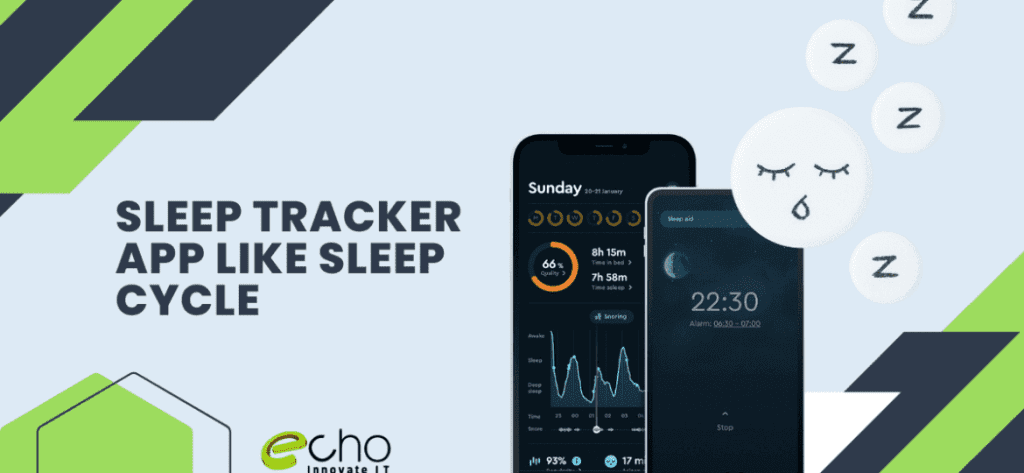
Building a sleep tracker app like Sleep Cycle spans a wide investment range in 2026, depending on how much sensor and health-data work you need. A focused MVP that tracks sleep with the phone’s microphone and accelerometer, shows a morning sleep score, and includes a smart alarm usually sits at the entry level of the market. A production app with wearable integrations, AI sleep-stage analysis, HealthKit and Google Fit sync, and subscription billing moves into the higher end of the market. This guide breaks down features, tech stack, timeline, and the real cost drivers so you can budget with confidence, then shows how EchoInnovate IT builds mobile apps for founders and product teams. We build under our own name and as a white-label partner, with 500+ products shipped over 12 years and a 5.0 rating across 6 verified Clutch reviews.
- A sleep-tracking MVP sits at the entry level; a full app with wearables and AI sleep staging is a substantially larger investment. Cost depends on scope, features, and integrations.
- The two features that decide the budget are sleep-detection accuracy (sensors vs. wearables) and health-platform integrations (HealthKit, Google Fit, Fitbit, Oura).
- Most teams ship an MVP in 3–5 months; a polished, subscription-ready product takes 6–9 months.
- Cross-platform (Flutter or React Native) keeps one codebase for iOS and Android and controls cost; native modules still handle the audio and motion sensing.
- Recurring revenue comes from subscriptions, so plan billing, paywalls, and retention analytics from day one.
How much does it cost to build a sleep tracker app?
Cost depends almost entirely on how you detect sleep and how many health platforms you connect. Tracking sleep from the phone alone (microphone for snore and movement, accelerometer for motion) is far cheaper than syncing with wearables and running AI sleep-stage models. The tiers below reflect the 2026 market for a sleep and wellness app built by an experienced team; they are planning guides, not quotes. We do not publish fixed prices because scope drives everything, and we give you a transparent quote after a short scoping call.
| Tier | What you get | Investment level |
|---|---|---|
| MVP | Phone-sensor sleep tracking, smart alarm, morning sleep score, basic charts, one platform or cross-platform | Entry-level |
| Growth | HealthKit and Google Fit sync, snore and sound recording, trends and insights, subscription paywall, iOS and Android | Mid-range |
| Scale | Wearable integrations (Apple Watch, Fitbit, Oura), AI sleep-stage analysis, personalized coaching, backend analytics, HIPAA-aware data handling | Enterprise-scale |
For a wider view of how mobile budgets are built, see our mobile app development cost guide. If you want to validate the idea before committing to the full build, an MVP for startups approach keeps early spend tight.
Must-have features of a sleep tracker app
A sleep app lives or dies on how accurately it measures the night and how clearly it explains the morning. Sleep Cycle earned its audience by turning raw sensor data into a simple, trustworthy sleep score and a gentler wake-up. Your feature set should aim at that same clarity before it adds extras. Here are the features that matter most, roughly in the order you should build them.
- Sleep detection and tracking. Use the accelerometer for movement and the microphone for breathing, snoring, and sleep sounds. This is the core, and its accuracy sets user trust.
- Smart alarm. Wake the user during a light sleep phase inside a chosen window so mornings feel easier. This is the signature feature of apps like Sleep Cycle.
- Sleep score and stages. A single morning number plus a breakdown of light, deep, and REM sleep, shown as a clean graph.
- Trends and insights. Weekly and monthly views, consistency streaks, and plain-language tips that turn data into behavior change.
- Snore and sound recording. Optional audio capture with playback, a popular premium hook.
- Health-platform sync. Read and write to Apple HealthKit and Google Fit so sleep data joins the rest of the user’s health picture.
- Wearable support. Apple Watch, Fitbit, Oura, and Garmin add heart-rate and richer sleep-stage data for higher accuracy.
- Subscriptions and paywall. Free tracking with premium insights, coaching, and unlimited history is the standard revenue model.
- Onboarding and reminders. Bedtime reminders and a short setup flow drive the nightly habit the whole product depends on.
Ship the first four in the MVP, then layer the rest as usage and revenue justify them. Feature-heavy apps that skip accuracy rarely retain users, so protect the core.
Tech stack and integrations
A sleep app is a cross-platform product with a native sensing core. Most teams keep one shared codebase for the interface and drop into native modules for the audio and motion work that has to run efficiently overnight. A typical 2026 stack looks like this:
- Frontend: Flutter or React Native for a single iOS and Android codebase, with native modules (Swift, Kotlin) for microphone and accelerometer sampling and background execution.
- Sleep and health data: Apple HealthKit and Google Fit for read/write sync; SleepKit-style on-device processing for stages; optional Core ML or TensorFlow Lite for AI sleep-stage classification.
- Wearables: Apple Watch (WatchKit), Fitbit Web API, Oura API, Garmin Health API for heart-rate and richer sleep signals.
- Backend: Node.js or Python with PostgreSQL, hosted on AWS or Google Cloud; time-series storage for nightly data and trends.
- Auth and billing: Firebase Auth or Auth0; RevenueCat or native StoreKit and Google Play Billing for subscriptions.
- Analytics: product analytics plus crash reporting to watch retention, the metric that makes or breaks a subscription app.
Sleep data is sensitive health data, so plan encryption at rest and in transit, clear consent, and HIPAA-aware handling if you serve regulated markets. Our mobile app development team scopes this stack to your accuracy and compliance needs, and our AI development services handle the sleep-stage modeling when you want on-device intelligence rather than raw thresholds.
How long it takes to build
Timeline tracks scope, not calendar optimism. A phone-sensor MVP with a smart alarm and sleep score usually takes 3 to 5 months with a small dedicated team. A production app with health-platform sync, wearables, AI sleep staging, and subscriptions takes 6 to 9 months. A realistic phased plan looks like this:
- Weeks 1–2 — Discovery and design: user flows, sleep-score logic, wireframes, and a clickable prototype.
- Weeks 3–10 — MVP build: sensor tracking, smart alarm, sleep score, charts, onboarding, and store submission.
- Weeks 11–20 — Growth features: HealthKit and Google Fit, snore recording, trends, and the subscription paywall.
- Weeks 21–36 — Scale: wearable integrations, AI sleep-stage analysis, coaching, and analytics maturity.
Accuracy tuning is the step teams underestimate. Detecting sleep phases reliably across devices takes real-world testing, so budget iteration time after launch. A staffing partner such as IT staff augmentation lets you add a specialist for the sensor or AI work without hiring full-time for a short phase.
What drives the cost
Five factors move a sleep-app budget more than anything else. Knowing them up front helps you decide what to build now and what to defer.
- Sleep-detection method. Phone-only sensing is the cheapest path. Adding wearable integrations multiplies the work because each device has its own API, data model, and edge cases.
- AI sleep staging. Threshold-based staging is inexpensive. On-device machine-learning models that classify light, deep, and REM sleep add data collection, training, and validation effort.
- Health-platform integrations. HealthKit and Google Fit are moderate; each extra platform (Fitbit, Oura, Garmin) adds development and testing cost.
- Compliance and data security. Health data raises the bar. Encryption, consent flows, and HIPAA-aware architecture add cost but protect you legally and build user trust.
- Team location and model. Onshore rates run several times higher than offshore for comparable quality, which is why many teams build with an offshore or dedicated-team partner. See offshore rates by country for current benchmarks.
The single biggest lever is scope discipline. A tight MVP that nails accuracy and the smart alarm can launch, earn subscription revenue, and fund the rest, instead of spending the whole budget before the first user tries it.
How EchoInnovate IT builds your sleep app
EchoInnovate IT is an India-based custom and white-label software development company with 12 years of experience, 50+ employees, and 500+ products shipped, most of them under our clients’ own brands. We hold a 5.0 rating across 6 verified Clutch reviews. For a sleep tracker, we assign a dedicated team: a product designer, cross-platform engineers, a native specialist for the sensor and background work, and a QA lead who tests accuracy across real devices.
Our process is answer-first: we start with a short scoping call, agree on the sleep-score logic and MVP feature set, and give you a transparent quote tied to real requirements rather than a guess. We build in two-week sprints with a working demo at the end of each, so you always see progress. When you need extra capacity for a phase, our IT staff augmentation services add vetted engineers to your team without long-term hiring. If your roadmap is broader than a single app, our software development company services cover the full backend, web dashboard, and data platform around it. Because so much of our work ships under partners’ brands, white-label delivery is the norm, not an exception.