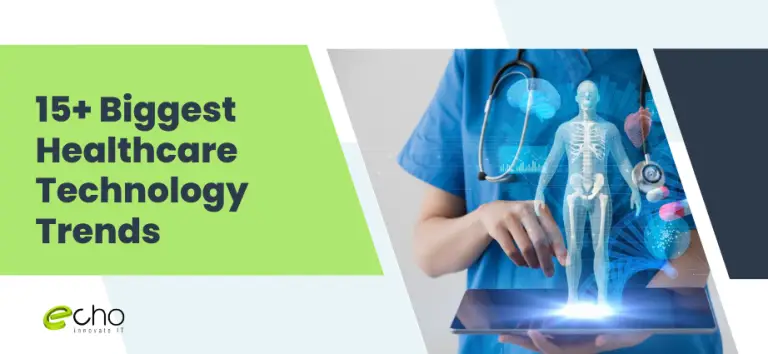
Technology is opening new possibilities in healthcare. It helps medical professionals, patients, and the people they treat. Leading healthcare app development providers now focus on solutions built around one of the technologies below.
Let’s look at the trends that will shape healthcare in the years ahead.
Nanomedicine
10 min read · Last updated: May 2026
In this article
- 1. Nanomedicine
- 2. Artificial Intelligence & Robotics
- 3. AR/VR/ MR
- 4. Blockchain
- 5. Internet Of Medical Things – IOMT
- 6. Remote Patient Monitoring
- 7. Robotic Process Automation
- 8. mHealth Technology
- 9. Big Data & Analytics
- 10. Cloud Technology
- 11. 3D Bioprinting
- 12. Genomics
- 13. Conclusion
- 14. Count On EchoInnovate IT For Your Healthcare App!
This may sound like science fiction. But nanotechnology is slowly entering our daily lives. In medicine, it is being applied right now. Scientists are building self-replicating nanorobots known as Xenobots. These could transform nanomedicine.
It is safe to assume that 2026 may bring major news in nanomedicine. The field welcomes early investors and holds strong potential.
Wondering what nanomedicine is? Here is a brief definition. It is the use of nanoscale (microscopically tiny) materials and objects for medical purposes. These include biocompatible nanoparticles, nanoelectronic devices, and even nanorobots. They handle tasks like diagnosing or treating living things. Related: healthcare app development.
For example, it could hunt cancer cells or viruses. A group of nanorobots would be injected into a person’s blood vessels.
This trend is expected to fight many diseases at the cellular level. That includes genetic, cancer-related, and autoimmune conditions like arthritis and tumors.
Artificial Intelligence & Robotics
Over the last decade, AI has spread across every industry, and that trend is likely to continue. In medicine, AI is used for everything from better diagnostic accuracy to disease detection.
The pandemic disrupted healthcare, and computerized diagnosis became the norm. This put radiologists under great strain. An AI-based system eased that burden by making the diagnostic process faster.
In seconds, AI algorithms can run scans, spot patterns, and provide diagnoses. Today, tech giants like Google and IBM have released AI tools that help medical facilities find useful data.
The industry will use AI tools to find new drugs quickly and act on trends. AI chatbots are also becoming popular in healthcare. They help customers by email and through 24/7 phone support.
Companies are combining AI with robotics to build virtual assistants for doctors and nurses. This also lets doctors provide care without getting close to the patient.
AR/VR/ MR
Augmented Reality (AR), Virtual Reality (VR), and Mixed Reality (MR) are evolving fast. They are set to shape healthcare in the coming years. These tools make medical education and training more interactive and immersive. Students can view anatomy and practice procedures in a virtual environment. This helps them grasp complex medical concepts and build their skills.
AR and VR offer countless benefits in healthcare. AR can project medical images onto a patient’s body, which helps doctors diagnose conditions accurately. VR can simulate complex surgical procedures. This lets doctors practice before operating on a real patient. MR combines AR and VR. It creates immersive, 3D, interactive experiences that blend the physical and digital worlds.
In the coming years, the use of AR, VR, and MR in healthcare should grow a lot. Better technology and cheaper AR and VR headsets will make these tools more accessible and affordable. In the end, they can improve health outcomes and cut costs and errors. They also give medical students a more engaging way to learn. Another strong healthcare technology trend! Related: mobile app development services.
Blockchain
Blockchain suits many clinical uses because it offers anonymity and accountability. A few examples include digital medical records, remote patients, pharmaceutical supply networks, and health insurance claims.
The blockchain system covers both EHR management and FHIRChain for exchanging healthcare data. Patient records sit on digital ledgers that healthcare experts can access. This boosts transparency and patient trust in the system.
It also supports a consensus mechanism. It helps stop the faking of prescription drugs. And it stores, transfers, and provides access to genomic samples collected electronically.
Internet Of Medical Things – IOMT
This isn’t the first time IoMT has come up, and it won’t be the last. In the Internet of Medical Things, wearables and trackers are growing more popular in healthcare IT. Their main benefit is simple. They give doctors current, detailed data on each patient’s health. IoMT also drives a big change in patient awareness.
Trackers collect data on daily activities in real time. Users can also adjust it as they go. If the device supports gamification, patients can be rewarded for healthier habits. In this way, technology blends healthy behavior with entertainment to make a big impact.
Doctors can now get alerts about their patients’ treatments and take a more active role in care. This technology also generates a rich data set. It tracks eating habits, sleep patterns, and activity levels. Providers can use this data to build realistic training programs and to assess treatment outcomes.
Looking for opportunities in the healthcare market? Partner with a mobile application development company that follows healthcare technology trends in 2026. This can help you stay ahead of the competition. Contact a startup tech development company to get started and build an IoMT-based solution for your business.
Remote Patient Monitoring
In 2026, the global market for RPM systems will keep growing steadily. It is projected to become a multi-billion-dollar market by 2027. That is a huge opportunity. Remote healthcare remains common and adds a lot to health equity.
Hands-free communication is an emerging healthcare trend that will keep expanding. During the last pandemic, remote monitoring played a key role in care. It reached patients who could not attend appointments in person. Related: cross-platform app development.
Remote Patient Monitoring (RPM) lets healthcare professionals track a patient’s condition from a distance. It is especially useful for older or chronically ill people. They need regular monitoring but cannot always attend appointments in person.
RPM uses the Internet of Medical Things and special digital health devices. Examples include glucose meters and blood pressure monitors. Apps connect to these devices, collect data, and alert healthcare professionals the moment something looks wrong. So RPM should become a key part of ongoing care for at-risk patients.
Robotic Process Automation
The World Health Organization (WHO) predicts a global shortage of health workers. It could reach 12.9 million professionals by 2035. That would make in-person appointments a luxury few patients can afford. Wide adoption of robotic process automation (RPA) in healthcare can fix many of these inefficiencies.
Robotic Process Automation bots are an important milestone in healthcare IT. Providers gain precise automation, lower costs, and a better-used workforce. With good insight, they can also make major changes. On the patient side, AI algorithms scan symptoms and guide people to the right doctor. They do this more precisely than a traditional search engine.
In short, RPA has introduced robots that mimic human behavior in healthcare. They can do many things, including script detection, data entry, and set actions. Today, healthcare organizations use RPA widely. It handles appointment scheduling, information management, claims, hospital management, and better care delivery.
mHealth Technology
The COVID-19 pandemic pushed the mental health field to go digital. Today, HIPAA-compliant video conferencing tools make mental health apps available online. At a critical moment, technology came to the rescue.
Since the pandemic, the US government has focused heavily on mental health solutions. That work paid off with EndeavorRX, launched for children ages 8-12 with ADHD. The game helps them focus on several things at once to sharpen their mental skills.
Smartphone Therapy: Today, smartphones come with built-in AI assistants and features. The same algorithms power chatbots that record and analyze speech. This helps them detect abnormalities or mental illness. Bots can also provide therapy to patients 24/7.
Big Data & Analytics
Big data analytics offers insights into clinical data. This helps teams make informed decisions about diagnosis, treatment, disease prevention, and more. With big data and analytics, healthcare experts can easily access and study a patient’s health status. This is a key trend for 2026 and beyond. Related: hire cross-platform developers.
Cloud Technology
Cloud computing is becoming more available to patients and staff in healthcare. By using data stored remotely, clinicians and patients can access recent and past clinical results fast. They find it all on a single platform.
Also, as electronic medical records spread, cloud technology will grow more affordable and secure. This creates new opportunities for big data software.
Cloud technologies give staff a scalable way to deliver better patient care. They also let patients take charge of their own health. But leaders should watch for the barriers. These include data migration costs, cultural change, security compliance, and interoperability standards and rules.
The healthcare cloud computing market is also set to grow sharply over the next ten years. It is expected to more than double in size. That makes it another strong trend on our list.
3D Bioprinting
In healthcare, 3D bioprinting is not new. Still, it can create three-dimensional structures much like natural tissue. That ability is drawing real attention from scientists and researchers.
Prosthetic treatment is getting more advanced, backed by AI and many improved technologies. It is only a matter of time before the field takes off. That should lower the high cost of implants and prosthetic care.
Patients also have more options for cardiovascular and neurological implants. 3D bioprinting may improve bionic knee and hip prostheses too.
Genomics
Lately, there have been strong efforts to build genomics tools for many uses in healthcare. A genetic test can give patients clear communication and practical advice. Physicians can secure this by adding genomic data and procedures into their existing clinical workflows.
Genomics discoveries have made customized medicine possible. Gene therapy and biomarker treatments have reshaped clinical medicine and specialized care. They now address several major unmet needs.
Conclusion
Technology improvements in healthcare are not slowing down. As new technologies arrive, things will only get more interesting. Related: custom software development.
In healthcare apps, we know how much data protection, accuracy, and security matter. So we put real effort into research, development, and testing for our customers. This makes sure our apps meet high quality standards. We are always ready to help you deliver new solutions built on growing healthcare technology trends.
Count On EchoInnovate IT For Your Healthcare App!
Technology improvements in healthcare are not slowing down. As new technologies arrive, things will only get more interesting. Whether you want to build a custom healthcare app or just learn more, EchoInnovate IT is ready to help!
We have years of industry experience. We have helped many companies build high-quality, robust web and mobile applications. Our team has worked in healthcare and built apps that improve the patient experience, automate slow tasks, and more.
So what are you waiting for? Contact us to learn more about designing a healthcare app that can handle future industry shifts.
Frequently Asked Questions
How does telemedicine benefit healthcare?
Telemedicine improves accessibility, reduces travel time, and allows remote consultations, enhancing patient care.
What role do wearable devices play in healthcare?
Wearables monitor health metrics, track fitness, and provide real-time data for personalized patient care and preventive measures.
How is AI used in healthcare?
AI is used for diagnostics, personalized treatment plans, predictive analytics, and streamlining administrative tasks, improving efficiency and accuracy.
What are the biggest healthcare technology trends in 2025?
AI diagnostics, remote patient monitoring, IoMT wearables, blockchain-secured medical records, AR/VR training, and cloud-based EHR access are leading the way.
How are mobile apps changing healthcare delivery?
Mobile apps now connect patients to providers, manage chronic conditions, track vitals via wearables, and offer secure telemedicine services.
Which technology is most important for remote patient monitoring in the USA?
IoMT devices paired with mobile apps are essential for real-time health tracking and chronic disease management.
How is AI used in healthcare mobile apps?
AI powers virtual assistants, analyzes diagnostic images, predicts health risks, and personalizes patient care plans.
Are AR and VR really being used in healthcare?
Yes, AR and VR are used for surgical simulations, anatomy visualization, patient education, and immersive rehabilitation programs.
Reading about trends is easy. Shipping ahead of them is hard.
Every trends article you read, your competitor read too. The advantage isn’t knowing — it’s executing first. We help founders and product teams turn market signals into shipped product within 90 days. Whether it’s AI, on-device ML, AR, voice, or whatever’s next, our team can scope, design, and engineer ahead of the curve. Let’s talk about where you want to be 12 months from now.