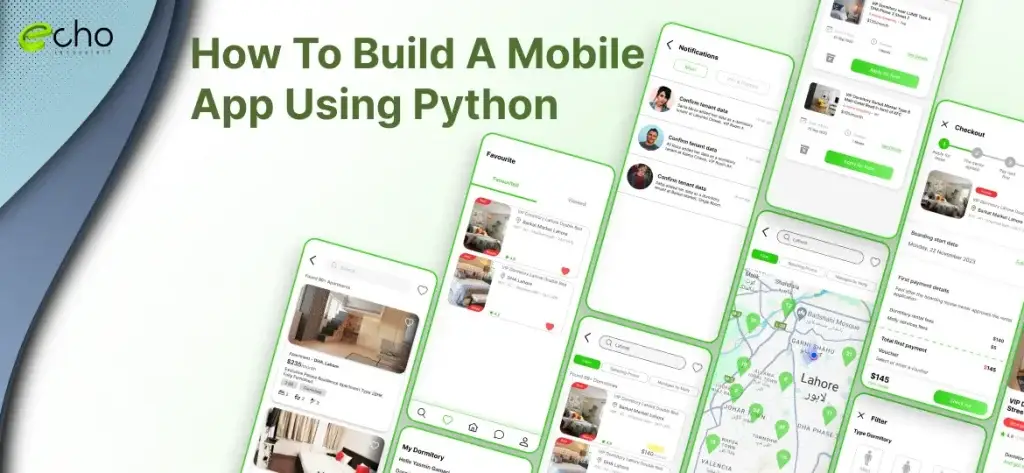
Yes, you can build a mobile app with Python, and in 2026 the cost of a Python-based build depends on scope, features, and integrations. Frameworks like Kivy, BeeWare, and Flet let you write app logic in Python and ship to iOS and Android, and Python is an excellent choice for the backend of almost any app. A focused MVP lands at the lower end, while a feature-rich production app with integrations and a scalable backend sits well above it.
There is an honest trade-off to understand first, though. Python is superb for backend services, data, and AI, but it is not the mainstream language for polished mobile front ends — that space is dominated by Swift, Kotlin, Flutter, and React Native. The most common professional pattern in 2026 is a Python backend paired with a native or cross-platform front end, which gives you Python’s strengths where they matter and a smooth mobile experience where users see it. This guide covers when pure-Python mobile makes sense, the tools that make it work, realistic costs, and how a build actually comes together.
Key takeaways
- A Python-based mobile app’s cost varies widely in 2026; scope and integrations drive the number.
- Kivy, BeeWare, and Flet let you ship real mobile apps written in Python, and each suits a different kind of project.
- Python shines on the backend, data, and AI; for the front end, many teams pair a Python backend with Flutter or React Native.
- Pure-Python mobile is a strong fit for internal tools, prototypes, data-heavy apps, and teams whose skills are already in Python.
- A short scoping call produces a transparent, fixed quote and confirms whether pure Python or a hybrid stack fits your product.
Can you build a mobile app with Python?
The short answer is yes — and the useful answer is “it depends on what kind of app.” Python can produce genuine, installable iOS and Android apps through frameworks that package your Python code and a runtime into a native bundle. But Python occupies a different position in mobile than it does on the server, and choosing it well means matching the tool to the job.
Where pure-Python mobile shines. Internal business tools, data-entry and data-visualization apps, scientific and engineering utilities, rapid prototypes, and products built by teams whose expertise is already in Python. If your app’s value is in logic, data, or computation rather than a highly polished consumer interface, Python lets you move fast and reuse skills you already have.
Where a hybrid approach wins. Consumer apps that live or die on smooth animations, platform-native feel, and access to the newest device features are usually better served by a native or cross-platform front end. In those cases the smart move is to keep Python where it is strongest — the backend, the data pipeline, the AI — and build the interface in Flutter, React Native, Swift, or Kotlin. This hybrid pattern is extremely common and gives you the best of both worlds.
The backend point that often gets missed. Even when the front end is not Python, most apps still benefit from a Python backend. Django and FastAPI are mature, fast to build with, and unmatched for anything involving data science or machine learning. So “build a mobile app with Python” frequently means “build the brain of the app in Python,” which is almost always a sound choice. Our mobile app development team helps clients pick the right split before committing to a stack.
Python mobile frameworks and tools
Several mature tools let you build and ship mobile apps in Python. Each has a sweet spot, and picking the right one up front saves a great deal of rework.
Kivy. The most established option for pure-Python mobile. Kivy draws its own interface, so your app looks the same on every platform, and it handles multi-touch, gestures, and custom graphics well. It is a strong fit for games, kiosks, data dashboards, and utilities where a custom look is acceptable. The trade-off is that Kivy apps do not use native controls, so they feel slightly different from a typical iOS or Android app. Buildozer and python-for-android package Kivy projects for the app stores.
BeeWare (Toga + Briefcase). BeeWare takes the opposite approach: it renders true native widgets, so your app uses the platform’s own buttons, lists, and navigation. That makes BeeWare apps feel more native than Kivy, and Briefcase packages them for iOS, Android, and desktop from one codebase. It is younger and its widget coverage is still growing, but for apps that want a native feel from Python it is compelling.
Flet. A newer framework that lets you build apps in Python using Flutter’s rendering under the hood, so you get modern, polished UI with a Python-only codebase. Flet has gained real traction for internal tools and quick-to-market apps because it combines Python simplicity with Flutter’s visual quality.
Kotlin/Swift or Flutter for the front end, Python for the back. The hybrid pattern again: when the interface needs to be flawless, build it in a native or cross-platform framework and connect it to a Python backend over a clean API. This is the most common professional setup for consumer-grade apps that still want Python’s data and AI strengths.
The right choice comes down to how important a fully native look is, how custom the interface needs to be, and where your team’s skills already sit. There is no single winner — only the best fit for a specific product.
How much does it cost to build a Python mobile app?
Cost tracks scope, not language. A Python mobile app is priced much like any mobile build — the framework choice affects developer productivity more than the headline number. The tiers below reflect relative 2026 investment levels for mobile app builds, not fixed EchoInnovate IT prices; we provide a transparent quote after a short scoping call because integrations and backend complexity move the figure most.
| Tier | Investment level | What it includes | Timeline |
|---|---|---|---|
| MVP | Entry-level | Core screens, one platform or cross-platform, a Python backend, authentication, basic data features | 6–10 weeks |
| Growth | Mid-range | Both platforms, richer UI, payments, push notifications, third-party integrations, admin dashboard | 3–5 months |
| Scale | Enterprise-scale | Complex features, AI/ML, real-time data, multiple integrations, scalable cloud backend, ongoing releases | 6–10 months |
One nuance specific to Python: if your app’s value is data or AI — recommendations, forecasting, computer vision — a Python backend can actually lower cost, because the language’s data and machine-learning ecosystem is unmatched and your team builds those features faster. For broader context, see our mobile app development cost guide and, if AI is central to your product, our AI chatbot development cost guide.
Must-have features
Whatever framework you choose, a first version should focus on the features that prove the concept and keep users coming back. The language does not change what makes a good app; it changes how quickly the team can build these things.
Authentication and user accounts. Secure sign-up and login, ideally with social or single sign-on options and biometric unlock. Python backends handle auth cleanly with mature libraries.
Core workflow screens. The two or three screens that deliver your app’s main value, built well rather than the twenty screens you might eventually want. Everything else is secondary until these earn engagement.
Data sync and offline support. Reliable synchronization between the app and your backend, with sensible behavior when the connection drops. Data-heavy Python apps especially benefit from a well-designed sync layer.
Push notifications. Timely, relevant notifications drive retention. This is a platform integration regardless of framework, and worth getting right early.
Payments, if relevant. In-app purchases or subscriptions through the app stores, or external payment for services. Payment flows carry store rules and testing overhead.
Search, filtering, and profiles. As content grows, users need to find things fast and manage their own settings and data.
Admin dashboard. A web console — naturally built in Python with Django — for managing users, content, and configuration. The app is only half the product.
Features usually deferred: complex social features, advanced analytics, and AI capabilities beyond the core. Each adds cost and is easier to justify once the essentials prove their worth. If AI is central to your value, though, a Python stack lets you build it into version one more affordably than most alternatives, and our AI development services team can scope that phase.
Tech stack and integrations
A Python mobile project has two layers: the app itself and the backend that powers it. The backend is where Python is at its strongest, and it is a sound choice almost regardless of what the front end is written in.
Backend. Django for feature-rich apps that benefit from its batteries-included admin, ORM, and auth, or FastAPI for high-performance APIs and async workloads. Pair either with PostgreSQL for relational data, Redis for caching and queues, and Celery for background jobs. This stack scales from MVP to production without a rewrite.
Front end. Kivy, BeeWare, or Flet for a pure-Python app, or Flutter/React Native/native when the interface needs to be flawless. The front end talks to the Python backend over a clean REST or GraphQL API, which keeps the two layers independent and easy to evolve.
Cloud and delivery. AWS, Google Cloud, or Azure for hosting, with containerized deployment so the same build runs everywhere. Buildozer or Briefcase package Python apps for the stores; standard toolchains handle Flutter or native front ends.
The integrations that most affect cost and complexity are:
- Payments (Stripe, in-app purchase APIs) for subscriptions and one-off charges
- Push notifications (Firebase Cloud Messaging, APNs)
- Authentication and identity (OAuth providers, single sign-on)
- Analytics and crash reporting for understanding real usage
- AI/ML services or in-house models where data intelligence is the point of the app
Each integration adds development, testing, and a little ongoing maintenance. A disciplined build adds the two or three that matter most first and layers in the rest as the product grows. Where a Python-specialist team is needed for a phase, IT staff augmentation is an efficient way to add that skill without permanent hiring.
How long it takes
A Python mobile app timeline runs from about six weeks for a lean MVP to roughly ten months for a feature-rich production app. The phases match any mobile build, and Python’s productivity often helps the backend-heavy stretches move faster.
Discovery and scoping (1–2 weeks). Choosing the framework (pure Python versus hybrid), mapping features, and defining the backend and integrations. This is where the fixed quote comes from and where the pure-Python-versus-hybrid decision is settled.
Design and architecture (1–3 weeks). Interface design plus the backend data model and API contract. Getting the API right early keeps the front end and backend teams unblocked.
Core build (3–10 weeks). The main screens, authentication, data sync, and the Python backend. An MVP often ships at the end of this phase and goes to a pilot group.
Integrations and polish (3–10 weeks). Payments, notifications, analytics, and any AI features, plus the UI refinement that separates a prototype from a product. This phase usually overlaps with early real-world use.
Testing and store launch (2–4 weeks). Device testing, performance tuning, and app-store submission. Packaging Python apps with Buildozer or Briefcase has its own quirks, so allow time for the first submission.
The biggest lever, as always, is scope discipline: ship a focused MVP, learn from real users, and expand. Building with a dedicated offshore Python team can compress the calendar while keeping cost predictable — see our guide on how to hire offshore developers.
What drives the cost
Five drivers explain most of the range between a lean Python MVP and a full platform build. Notice that the framework choice is not the biggest one — scope is.
1. Feature scope and screen count. The number of distinct workflows and screens is the primary driver. A tight app with three core screens is far cheaper than one with twenty, regardless of language.
2. Backend and data complexity. A simple CRUD backend is inexpensive; real-time data, complex business logic, and heavy processing take more engineering. Python keeps this efficient, but complexity still costs.
3. Integrations. Each external system — payments, notifications, third-party APIs — adds build, testing, and maintenance. This is one of the largest swing factors between tiers.
4. AI and machine learning. If your app includes recommendations, forecasting, or computer vision, that is real work — but here Python’s ecosystem actually lowers the cost relative to building the same capability in another language.
5. Platforms and UI polish. One platform is cheaper than two, and a custom, highly polished interface costs more than a functional one. This is where the pure-Python-versus-hybrid decision has a real budget impact: a consumer app that needs flawless UI may justify a Flutter or native front end.
The practical takeaway: be ruthless about the first version’s scope, lean on Python where it makes the team faster (backend, data, AI), and choose a hybrid front end only when the user experience genuinely demands it. Our mobile app development team helps make that call during scoping so the budget matches the product.
How EchoInnovate IT builds your app
EchoInnovate IT is an India-based custom and white-label software development company with 12 years of experience and a team of 50+ employees. We have delivered 500+ products, most under our clients’ own brands, and hold a 5.0 rating across 6 verified reviews on Clutch. Python is one of our core backend languages, and we build both pure-Python mobile apps and hybrid products that pair a Python backend with a native or cross-platform front end.
Our approach starts with a scoping session that settles the most important question first: does your product call for pure-Python mobile, or for a hybrid stack? From there we map features, backend, and integrations and produce a fixed, transparent quote. A dedicated team then builds a focused MVP, launches it to a pilot group, and expands from real feedback rather than assumptions. Because Python is so productive on the backend and in data and AI, we can often deliver intelligent features earlier than a comparable build in another language.
As a full mobile app development partner that also offers IT staff augmentation, we can deliver the whole app or add Python and mobile specialists to your existing team for a single phase. You own the code, the architecture, and the roadmap throughout, and the same team can layer in AI capabilities when you are ready.