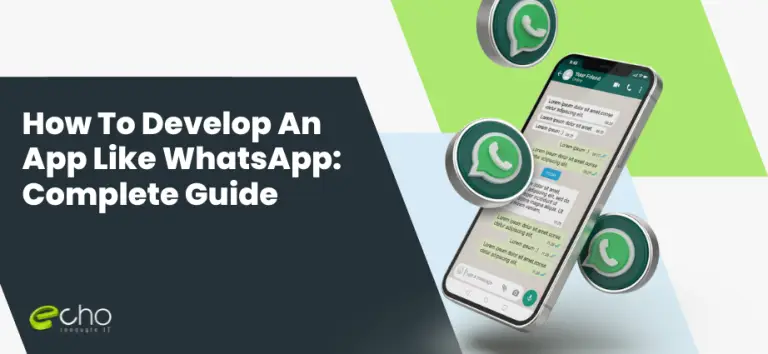
A messaging app like WhatsApp varies widely in cost to build, depending on how much of WhatsApp you actually need. A lean one-to-one messenger with text, media, and push notifications sits at the low end; a full platform with encrypted group chat, voice and video calling, and infrastructure that survives millions of concurrent users sits at the high end. Most funded startups land in the mid-range for a credible first release.
This guide answers the questions buyers actually ask before they commit budget: what a WhatsApp-style app costs in 2026, which features are non-negotiable, the tech stack and integrations that make real-time messaging work at scale, how long the build takes, and what pushes the price up or down. EchoInnovate IT has shipped 500+ products over 12 years—most under our clients’ own brands—so the numbers and timelines below reflect real mobile app development projects, not spreadsheet guesses.
Key takeaways
- Cost spans a wide range: an MVP messenger is entry-level, a group-and-media app mid-range, and a full voice/video/E2E platform enterprise-scale.
- The hard part is not the chat bubble UI—it is real-time delivery, presence, media handling, and end-to-end encryption at scale.
- Timeline runs 10–16 weeks for an MVP and 6–12 months for a WhatsApp-scale build.
- Most cost is people-time. Team seniority, feature depth, and infrastructure choices drive the number more than the platform (iOS vs Android vs cross-platform).
- We do not publish fixed prices because scope decides everything; you get a transparent quote after a short scoping call, or a $1,500 2-week pilot sprint to price it precisely.
How much does it cost to build a messaging app like WhatsApp?
The honest answer is a range, because “an app like WhatsApp” can mean a weekend-scale chat feature or a global communications platform. The table below breaks the market into three realistic tiers for 2026 so you can see where your idea sits before you talk to anyone about a quote. These are relative tiers for custom builds, not our fixed prices—your real number depends on the scope we agree together.
| Tier | What you get | Investment level | Timeline |
|---|---|---|---|
| MVP messenger | 1:1 text chat, media sharing, push notifications, contacts, single platform | Entry-level | 10–16 weeks |
| Mid-market app | Group chat, read receipts, presence, media pipeline, both platforms, basic voice | Mid-range | 4–7 months |
| WhatsApp-scale platform | Voice & video calling, end-to-end encryption, multi-device sync, scale to millions | Enterprise-scale | 8–12+ months |
Two things move you between tiers faster than anything else: real-time voice/video calling and end-to-end encryption. Both are solvable, but each adds specialist engineering, third-party services, and testing. If your goal is to validate demand rather than clone WhatsApp on day one, start at the MVP tier, prove people message each other, and fund the rest from traction. Our mobile app development cost guide breaks the line items down further, and our mobile app development team will map your specific feature list to a tier on a scoping call.
Must-have features of a WhatsApp-like app
WhatsApp feels simple, and that simplicity is expensive to reproduce. Underneath the clean chat screen sits a stack of features users now treat as table stakes. Build the wrong subset and the app feels broken; build all of it on day one and you overspend before you have a single active user. Here is the feature set that matters, roughly in the order you should build it.
Core messaging. Real-time one-to-one text, delivery and read receipts, typing indicators, and online/last-seen presence. This is the beating heart of the product and where most of your early engineering effort goes. Messages must arrive instantly, survive poor connectivity, and sync when a device comes back online.
Media and files. Photos, video, voice notes, and documents, with compression, thumbnails, and a storage pipeline that does not bankrupt you at scale. Voice notes in particular are a defining WhatsApp behavior and deserve first-class handling.
Group chat. Group creation, admin roles, member management, and message fan-out to many recipients. Groups multiply the complexity of delivery and notifications, which is why they usually sit in the mid tier rather than the MVP.
Voice and video calling. One-to-one and group calls over WebRTC, with call signaling, TURN/STUN servers for connectivity, and graceful fallback on weak networks. This is the single biggest jump in engineering effort.
Security and accounts. Phone-number onboarding with OTP, end-to-end encryption for messages and calls, and multi-device support. Encryption is not a feature you bolt on later—design for it early. If your app touches regulated data, our software development company team can align the build with the compliance regime you operate under.
Retention layer. Push notifications, status/stories, contact sync, and search. These are what bring users back daily and turn a demo into a habit.
Tech stack and integrations
Real-time messaging lives or dies on its infrastructure choices, so the stack matters more here than in most apps. There is no single correct answer, but there are well-proven combinations. Below is the shape of a modern 2026 build and the integrations that do the heavy lifting.
Client apps. A cross-platform framework such as Flutter or React Native lets one team ship iOS and Android from a shared codebase, which is usually the most cost-effective route for a messaging app. Where you need the absolute best call quality or deep OS integration, native Swift and Kotlin modules can be dropped in alongside. See our React Native vs Flutter comparison for how that choice affects cost and hiring.
Real-time transport. A persistent WebSocket layer, often built on the MQTT or XMPP pattern, delivers messages with low latency and handles reconnection. Many teams accelerate this with managed real-time platforms rather than building the socket layer from scratch.
Backend and data. A scalable API layer (Node.js, Go, or Elixir are common for chat because of their concurrency models), a fast datastore for message history, and a queue for reliable delivery and offline sync. Media goes to object storage behind a CDN, never through your app servers.
Calling. WebRTC for peer-to-peer audio and video, with TURN/STUN servers for NAT traversal. Providers such as Agora, Twilio, or LiveKit can shorten the path to production calling significantly.
Encryption. The Signal Protocol is the de facto standard for end-to-end encrypted messaging and is worth adopting rather than inventing your own scheme.
Supporting services. Push notifications via APNs and FCM, an OTP/SMS provider for phone onboarding, crash and performance monitoring, and analytics. If you need to scale the team quickly to hit these pieces in parallel, IT staff augmentation lets you add vetted real-time and mobile engineers without long hiring cycles.
How long does it take to build?
A realistic first release of a WhatsApp-style app takes between three months and a year, and the honest version of the timeline depends entirely on where you draw the feature line. Trying to compress a full platform into a few weeks is the most common way these projects fail.
An MVP messenger—1:1 chat, media, push, single platform—is achievable in 10 to 16 weeks with a focused team. That window covers discovery and design, the real-time messaging core, a media pipeline, onboarding, and enough testing to put it in front of real users. A mid-market app that adds group chat, presence, both platforms, and basic voice typically runs four to seven months. A WhatsApp-scale platform with encrypted group calling, multi-device sync, and infrastructure hardened for millions of users is an eight-to-twelve-month-plus commitment, and it keeps evolving after launch.
The fastest way to protect the timeline is to sequence the build: ship the messaging core, get it into users’ hands, then layer calling and encryption on a stable base rather than building everything at once. A dedicated team working in two-week sprints gives you a shippable increment every fortnight and a clear view of progress, so the launch date is something you manage rather than hope for.
What drives the cost up or down
When two quotes for “an app like WhatsApp” differ by six figures, it is almost never the chat screen. These are the factors that actually move the number, and understanding them lets you control your budget instead of reacting to it.
Feature depth. Text messaging is comparatively cheap. Voice and video calling, end-to-end encryption, and multi-device sync are the expensive trio—each one adds specialist engineering, third-party services, and a long testing tail. Deciding which of these you truly need at launch is the single biggest lever you control.
Scale targets. An app for 10,000 users and an app for 10 million users are different engineering problems. Designing for massive concurrency, message fan-out, and global low latency costs real money up front, so be honest about the scale you need on day one versus the scale you are architecting toward.
Platform coverage. iOS plus Android plus web plus desktop multiplies QA and release effort. A cross-platform framework tames this, but every additional surface still adds cost.
Team seniority and location. Real-time systems reward experienced engineers, and rates vary widely by geography. An offshore or dedicated-team model commonly delivers comparable quality at a lower blended rate—see our guide to hiring offshore developers for how that math works.
Design and polish. The reason WhatsApp feels effortless is relentless attention to micro-interactions and edge cases. That polish is worth paying for, but it is a choice, and it belongs on the roadmap deliberately rather than by accident.
How EchoInnovate IT builds messaging apps
EchoInnovate IT is an India-based custom and white-label software development company with 12 years of delivery behind us, 50+ people on the team, and 500+ products shipped—most of them under our clients’ own brands rather than ours. We are the engineers behind the products, not a badge on them, which is exactly what you want when you are building something users will trust with their private conversations.
For a messaging app we start with a short scoping phase to pin down the feature tier, scale targets, and non-negotiables such as encryption and compliance. We then assign a dedicated team—mobile engineers, a real-time/backend specialist, a designer, and a QA lead—and work in two-week sprints so you see a shippable increment every fortnight. The messaging core comes first, hardened and tested, before we layer on calling and encryption, so you are never betting the whole budget on a big-bang launch.
Because we have built across Flutter, React Native, and native stacks, we recommend the architecture that fits your product and your in-house team rather than defaulting to whatever we used last. If you already have developers, we can slot specialists alongside them through IT staff augmentation; if you are starting from zero, we run the whole build as a mobile app development engagement end to end. Either way you get transparent pricing, source-code ownership, and a team that has solved real-time delivery, media at scale, and store releases many times before.