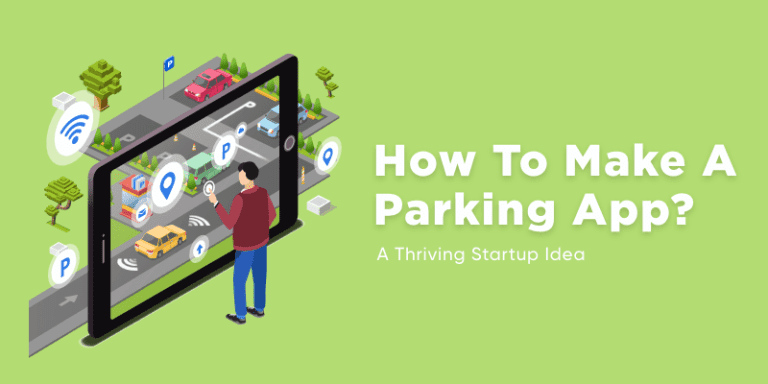
If you are planning a parking app — one that helps drivers find, reserve, and pay for parking, or one that lets lot owners manage and sell their spaces — the first question is cost. Here is the short answer. In 2026, parking app development can range from a lean, single-city MVP to a full smart-parking platform. A lean MVP that lets drivers find and pay for parking in one city sits at the entry level; a full smart-parking platform with real-time space availability, reservations, IoT sensors, and an operator dashboard is an enterprise-scale build. The spread exists because a parking product is usually a system: a driver app, an operator or admin side, payments, and live location data.
Urban parking is a real, expensive problem — drivers waste time and fuel circling for spaces, and lot owners struggle to fill and price inventory. That is why parking apps keep attracting startups, cities, and property operators. The ones that succeed make finding and paying for a space genuinely effortless, and give operators the tools to manage occupancy and pricing. This guide covers the parking app models, must-have features, honest 2026 cost ranges, the tech stack, timelines, and how we build them at EchoInnovate IT.
Key takeaways
- A parking app in 2026 ranges from an entry-level to an enterprise-scale build, depending on whether you add reservations, real-time availability, and IoT sensors.
- A single-city MVP to find and pay for parking is the entry-level tier.
- Decide your model first: find-and-pay, reservation marketplace, or smart-parking with sensors — each changes cost sharply.
- The core is accurate location and availability data plus reliable payments.
- Start narrow — one city, one model — prove drivers pay, then expand and add hardware.
How much does parking app development cost in 2026?
Parking app cost depends most on your model and on how you get availability data. A simple find-and-pay app is far cheaper than a smart-parking platform that relies on real-time sensors. The table below shows relative investment levels by ambition level.
| Tier | What you get | Investment level | Timeline |
|---|---|---|---|
| MVP | One city, driver app to find lots on a map, view pricing, and pay, with a basic operator/admin view | Entry-level | 3–5 months |
| Growth | Reservations, real-time availability, wallet, navigation, ratings, operator dashboard, promotions | Mid-range | 5–8 months |
| Scale | Multi-city, IoT sensors, dynamic pricing, EV charging, ANPR/gate integration, analytics, high-traffic infra | Enterprise-scale | 8–12 months |
Treat these as planning anchors, not quotes. The biggest single driver is how you source availability data — manual and operator-entered is cheap, while real-time IoT sensors and gate integrations add hardware and integration cost. We do not publish fixed per-project prices because two parking apps with the same screens differ once real-time data and hardware enter the picture; we give a transparent quote after a short scoping call. Our mobile app development cost guide breaks down the wider line items.
Types of parking apps (which model to build)
Deciding which model you are building is the most important cost decision you will make, because each one implies a different data source and a different level of complexity.
1. Find-and-pay (mobile payment for parking). Drivers find nearby lots or on-street zones, see pricing, and pay from their phone instead of a meter. Availability may be approximate or operator-entered. This is the simplest and cheapest model and a common MVP starting point.
2. Reservation marketplace. Drivers reserve a guaranteed space in advance, often at garages, event venues, or airports. Lot owners list inventory and pricing, and the platform takes a commission. This adds a two-sided marketplace with an operator side, booking logic, and payouts.
3. Smart parking with real-time availability. The app shows live space availability using IoT sensors, cameras, or gate systems, and can support dynamic pricing. This is the most capable and most expensive model because it depends on hardware and real-time data pipelines.
4. Private and enterprise parking. Apps for a specific operator, campus, or residential complex to manage their own spaces, permits, and access, often with gate or ANPR (number-plate recognition) integration.
Most successful products start with the simplest model that solves a real pain in one market — usually find-and-pay or reservations — prove that drivers will pay, and then layer on real-time data and hardware once the business is working. Trying to launch full smart-parking with sensors across a whole city on day one is the most common way these projects overrun. A short scoping call helps you pick the model that fits your market and budget.
Must-have features of a parking app
For a first version, build the essentials that make finding and paying for parking effortless, and defer the rest.
Driver app essentials:
- Sign-up, profile, and saved vehicles
- Map-based search for nearby parking with pricing
- Filters (covered, EV charging, height limits, price)
- Reservation or start/stop parking session
- Turn-by-turn navigation to the space
- In-app payments, wallet, and digital receipts
- Session reminders and expiry notifications
Operator / admin essentials:
- Lot and space listing with pricing rules
- Availability and occupancy management
- Bookings, check-in/out, and payouts
- Reporting on revenue and utilization
- Promotions and discount controls
Advanced features — real-time sensor-based availability, dynamic pricing, EV-charging integration, license-plate recognition and automated gates, permit management, and loyalty programs — are what separate growth and scale tiers from an MVP. They add clear value but also hardware and integration cost, so they are best added after drivers are paying reliably. The discipline of shipping the core find-pay-park loop first is what keeps a parking project on budget.
Tech stack and integrations
The parking app stack centers on accurate location, reliable payments, and — for smart parking — real-time data.
Driver and operator apps. A cross-platform framework such as Flutter or React Native keeps cost down by serving iOS and Android from one codebase per app. Native is an option when you need the deepest background-location or performance behavior, but most parking apps do well cross-platform. The operator side is often a web dashboard in React, Next.js, or Angular.
Back end. A scalable API (Node.js, Python, or Go) with a database suited to geospatial queries (PostgreSQL with PostGIS is a common choice) so you can find nearby spaces efficiently, plus caching for real-time availability.
Key integrations. Maps, geolocation, and navigation (Google Maps or Mapbox); payment gateways with wallets and, for marketplaces, split payouts (Stripe, Razorpay); push notifications and SMS for reminders; and, for smart parking, IoT sensor platforms, ANPR/camera systems, or gate-controller APIs. EV-charging and permit integrations are common add-ons. Each integration adds build and testing effort, which is a major reason cost varies between similar-looking apps.
Infrastructure. Cloud hosting on AWS, Google Cloud, or Azure with autoscaling for peak demand. If you need to grow the team as you expand to new cities or add hardware, our IT staff augmentation services add vetted engineers, and our software development company can own the full build.
How long it takes to build
As rough 2026 planning numbers for a dedicated team:
- Single-city find-and-pay MVP (driver app plus basic operator view): 3 to 5 months.
- Growth platform (reservations, real-time availability, wallet, operator dashboard): 5 to 8 months.
- Smart-parking scale platform (IoT sensors, dynamic pricing, gate/ANPR integration, multi-city): 8 to 12 months, plus hardware procurement and installation time you should plan separately.
The fastest way to launch is to narrow the model and the market, not to add developers. Start find-and-pay or reservations in one city, prove drivers pay and operators list, then add real-time data and hardware. Smart-parking hardware in particular introduces procurement, installation, and field-testing timelines that software estimates do not capture, so treat it as its own phase. We usually recommend a short pilot sprint first to lock the model and scope and produce a working proof of the core booking-and-payment flow before the full build.
What drives the cost
Five factors decide where a parking app lands within the ranges above:
1. Your model and data source. Find-and-pay with operator-entered data is the cheapest. Real-time availability from IoT sensors, cameras, or gates is the most expensive because it adds hardware and real-time engineering.
2. Reservations and marketplace logic. A two-sided marketplace with operator listings, bookings, and split payouts costs more than a simple pay-for-parking app.
3. Hardware integration. Sensors, ANPR cameras, and gate controllers add procurement, integration, and field-testing effort well beyond the app itself.
4. Cities and scale. Every additional city adds mapping, operator onboarding, and pricing rules. Starting narrow keeps cost down.
5. Team model and location. Blended rates vary widely by geography, and a dedicated offshore or nearshore team often delivers comparable quality below onshore rates. Our offshore rates by country guide shows the effect.
Because these factors interact, we quote after a short scoping call rather than publishing a fixed price. The scoping conversation itself often saves money by matching the model to what your market actually needs on day one.
How EchoInnovate IT builds parking apps
EchoInnovate IT is an India-based custom and white-label software development company with 12 years of experience and a team of 50+ people. We have shipped 500+ products — most under our clients’ own brands — and hold a 5.0 rating across 6 verified reviews on Clutch. That includes location-based and marketplace apps where accurate mapping and reliable payments decide whether users come back.
For parking apps, we start with the model, not the screens. We help you choose between find-and-pay, reservations, and smart parking based on your market and budget, and we are honest about when IoT hardware is worth it and when it is premature. We scope a single-city MVP that proves drivers will pay, build the driver and operator apps cross-platform to control cost, engineer the geospatial search and payment layer carefully, and give operators a dashboard they can run. We staff a dedicated team, handle maps, payments, and any sensor or gate integrations, and support the platform after launch as you expand to new cities and add hardware.
You are hiring a team that has built location-based marketplaces before, not a template. Most clients begin with our mobile app development team through the two-week pilot sprint below, which locks the model and scope and de-risks the build before any large commitment.