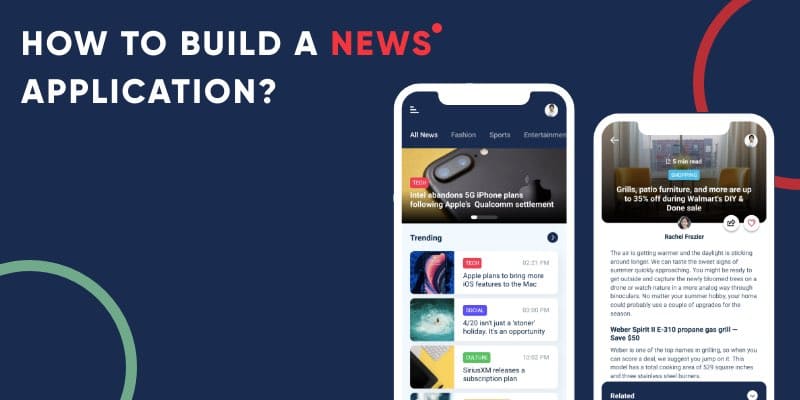
Building a news application in 2026 is an investment that scales widely, depending on how much personalization, real-time delivery, and monetization you need. A focused MVP with a clean feed, categories, and push notifications sits at the entry level, while a full personalized platform with recommendation algorithms, subscriptions, and a custom content management system reaches the enterprise-scale tier. Timelines run from roughly 8 weeks for an MVP to 8 months or more for a large-scale product.
A modern news app is not just a list of articles. It is a content pipeline, a personalization engine, a notification system, and a monetization layer working together, all tuned to deliver fresh content fast and keep readers coming back. This guide breaks down the types of news apps, realistic 2026 costs, the features that drive engagement, how content and revenue fit together, the tech stack, and how long a build actually takes — written for publishers, founders, and product leaders sizing up a build.
Key takeaways
- A news app in 2026 ranges from an entry-level to an enterprise-scale investment; personalization, real-time delivery, and monetization drive the number.
- Start with an MVP — feed, categories, article view, and push notifications — then add personalization and paid features.
- A solid content management system and content pipeline are as important as the app itself; plan for both.
- The biggest cost drivers are recommendation algorithms, real-time and breaking-news delivery, subscriptions/paywalls, and content ingestion from many sources.
- A short scoping call produces a transparent, fixed quote and a clear phase plan.
Types of news apps
“News app” spans several distinct product models, and the one you are building shapes cost, content strategy, and technical complexity. Deciding your category early keeps the budget honest.
Single-publisher apps. A branded app for one newspaper, magazine, or broadcaster, pulling content from that publisher’s own newsroom and content management system. The main work is a great reading experience, reliable content sync, and monetization. This is the most common commissioned build.
News aggregators. Apps that pull stories from many sources — RSS feeds, APIs, and partner publishers — and present them in one place. The hard part is ingestion at scale, de-duplication, categorization, and rights management. Personalization is usually central to the value.
Personalized and AI-curated feeds. Products whose main promise is a feed tuned to each reader’s interests and behavior. These lean heavily on recommendation algorithms and data pipelines, which is where most of the engineering investment goes.
Niche and vertical news. Apps focused on a single topic — sports, finance, crypto, local news — often with specialized data feeds (scores, prices) and real-time updates. The narrow focus can make the MVP smaller while the real-time layer adds cost.
Community and citizen journalism. Apps where readers also contribute, which adds user-generated content, moderation, and reputation systems to the standard news feature set.
Most successful products start narrow — one audience, one content source, a clean reading experience — and expand once engagement is proven. Building it as a well-scoped mobile app keeps the first version affordable and fast to launch.
How much does it cost to build a news app?
News app cost scales with personalization, real-time delivery, and monetization complexity. The tiers below show the relative investment level for mobile news builds, not fixed EchoInnovate IT prices — we provide a transparent quote after a short scoping call, because content sources and recommendation features move the figure most.
| Tier | Investment level | What it includes | Timeline |
|---|---|---|---|
| MVP | Entry-level | Feed, categories, article view, search, bookmarks, push notifications, one content source, one platform | 8–12 weeks |
| Growth | Mid-range | Both platforms, personalization, multiple sources, offline reading, CMS integration, ads or subscriptions, analytics | 4–6 months |
| Scale | Enterprise-scale | AI recommendation engine, real-time breaking news, paywall/subscription platform, custom CMS, high-volume ingestion | 6–10 months |
Two factors move a project up the tiers fastest: personalization (a real recommendation engine is a data-science project in itself) and monetization (subscriptions and paywalls add billing, entitlement, and account complexity). For broader app economics, see our mobile app development cost guide, and if you plan to sell subscriptions, our SaaS development cost guide covers the billing side.
Must-have features
A news app earns loyalty through a fast, clean reading experience and timely, relevant content. These are the features that matter most, and the ones best deferred.
Clean feed and article view. A fast-loading, well-typeset feed and reading view are the product. Everything else is secondary to how good it feels to scan headlines and read a story. Performance here is not optional.
Categories and sections. Clear navigation across topics and sections so readers find what they care about. The backbone of both discovery and personalization.
Search and bookmarks. Fast full-text search and the ability to save articles for later. Simple features that readers use constantly.
Push notifications. Breaking-news alerts and personalized digests are the single biggest driver of return visits. Getting notification timing and relevance right is worth real attention.
Offline reading. Caching articles for reading without a connection — valued by commuters and travelers, and a genuine differentiator.
Personalization. A feed that adapts to what a reader opens and follows. It can start simple (follow topics and sources) and grow into a full recommendation engine later.
Sharing and social. Easy sharing to messaging and social platforms extends reach and is cheap to build.
Media support. Images, video, and increasingly audio (article narration, podcasts) are expected in a modern news product.
Features usually deferred: AI recommendation engines, live blogs, comment and community systems, and complex subscription tiers. Each adds cost and is easier to justify once the core reading experience proves it retains readers. If AI-driven curation is central to your pitch, our AI development services team can scope that engine as a dedicated phase.
Content management and monetization
Two things separate a news app that survives from one that quietly dies: where the content comes from, and how it makes money. Neither is glamorous, and both are easy to underestimate.
The content pipeline. Every news app needs a reliable way to get stories in. For a single publisher, that usually means integrating with an existing CMS such as WordPress, Arc, or a custom system, so editors keep working in familiar tools while the app pulls structured content through an API. For aggregators, it means ingesting many sources — RSS, third-party APIs, partner feeds — then normalizing, de-duplicating, and categorizing them. This ingestion-and-normalization layer is often the most underestimated part of an aggregator build. Whatever the model, editors need a smooth workflow to publish, schedule, tag, and correct stories, because the app is only as good as the content flowing into it.
Monetization models. Most news apps rely on one or a mix of these:
- Advertising — display and native ads, usually through an ad network or direct sales; requires ad slots, targeting, and analytics.
- Subscriptions and paywalls — metered or hard paywalls with recurring billing and entitlement management; the highest-value but most complex model.
- Freemium — free core content with premium articles, ad-free reading, or exclusive features behind a subscription.
- Sponsored content and newsletters — lighter revenue streams that add up and deepen engagement.
Subscriptions are where most of the engineering complexity lives: secure recurring billing, entitlement checks on every article, account management across devices, and app-store payment rules all add up. It is worth deciding your primary model early, because it shapes the data model and a meaningful share of the budget. A phased plan — launch with ads, add subscriptions once you have an audience — is often the most capital-efficient route.
Tech stack and integrations
A news app is a content-delivery system, so the stack is chosen for speed, scale, and the ability to push fresh content to many devices at once. On the client, a cross-platform framework like Flutter or React Native is the pragmatic default, since a single codebase serving iOS and Android keeps cost down and a reading app rarely needs deep platform-specific features. Native (Swift, Kotlin) is worth it when you want the smoothest possible scrolling and media performance.
The backend typically runs on Node.js or Python, with PostgreSQL for structured content and user data, and a fast cache layer (Redis) plus a CDN to serve articles and media quickly to a large audience. A search engine such as Elasticsearch powers full-text search and feeds. For personalization, a dedicated recommendation service — often Python-based — sits alongside the main backend.
The integrations that most affect cost and complexity are:
- Content sources — your CMS, RSS feeds, and third-party news APIs for ingestion
- Push notifications (Firebase Cloud Messaging, APNs) for breaking news and digests
- Ad networks (Google Ad Manager and others) for display and native advertising
- Payments and subscriptions (Stripe, in-app purchase APIs) for paywalls
- Analytics for reading behavior, retention, and content performance
Each integration adds development, testing, and ongoing maintenance, and content ingestion in particular needs robust handling of malformed feeds and rate limits. A disciplined build connects the one content source and the one monetization method that matter most first, then expands. Where a specialist is needed for a heavy ingestion or recommendation phase, IT staff augmentation adds that skill without permanent headcount.
How long it takes
A news app timeline runs from about eight weeks for a lean MVP to roughly ten months for a large personalized platform. The phases are predictable, and knowing them helps you plan launch and content operations together.
Discovery and scoping (1–2 weeks). Defining your app type, content sources, monetization model, and personalization ambitions. This is where the fixed quote and phase plan come from.
Design and content modeling (2–4 weeks). Reading experience, navigation, and the content data model that everything hangs off. Typography and layout matter more here than in most apps because reading is the product.
Core build (4–10 weeks). Feed, article view, categories, search, bookmarks, push notifications, and the content pipeline for one source. An MVP often launches at the end of this phase to a pilot audience.
Personalization and monetization (4–12 weeks). Recommendation logic, additional content sources, offline reading, and ads or subscriptions. This is where timelines stretch most, especially if a real recommendation engine or paywall is in scope.
Testing and store launch (2–4 weeks). Performance tuning (critical for a reading app), device testing, and app-store submission. Content-heavy apps benefit from load testing before a public launch.
Scope discipline is the biggest lever, as always. Launching a fast, clean MVP with one content source and one revenue method — then expanding from real engagement data — consistently beats trying to ship personalization and subscriptions on day one. A dedicated offshore team can compress the calendar while keeping cost predictable; see our guide on how to hire offshore developers.
What drives the cost
Five drivers explain most of the gap between an entry-level news MVP and an enterprise-scale platform. Control these and you control the budget.
1. Personalization depth. A “follow topics” feed is inexpensive. A true recommendation engine that learns from behavior is a data-science project with its own pipeline, models, and tuning — often the single largest cost in a modern news app.
2. Number of content sources. One publisher CMS is straightforward. Ingesting, normalizing, and de-duplicating dozens of external feeds and APIs is a substantial engineering effort and the defining cost of an aggregator.
3. Monetization complexity. Ads are relatively cheap to add. Subscriptions and paywalls require recurring billing, entitlement checks, account management, and app-store compliance — a meaningful chunk of budget on their own.
4. Real-time and breaking news. Instant delivery of breaking stories and live updates needs more infrastructure and testing than periodic content refreshes, and raises running costs.
5. Platforms, media, and scale. Two platforms cost more than one; rich video and audio add media handling; and designing for a large concurrent audience adds caching, CDN, and load-testing work.
The practical takeaway: launch with a clean reading experience, one content source, and one revenue method, then add personalization and subscriptions once you have readers and data to justify them. That phasing often halves the initial budget. Our mobile app development team scopes exactly this sequence before any code is written.
How EchoInnovate IT builds your news app
EchoInnovate IT is an India-based custom and white-label software development company with 12 years of experience and a team of 50+ employees. We have delivered 500+ products, most under our clients’ own brands, and hold a 5.0 rating across 6 verified reviews on Clutch. Our mobile work includes content-driven and media apps, so the specific demands of a news product — fast reading, reliable content pipelines, and monetization — are familiar territory.
For a news build we start with a scoping session that settles the app type, content sources, monetization model, and personalization ambitions, then produce a fixed, transparent quote and a phase plan. A dedicated team builds a fast, clean MVP with one content source and one revenue method, launches it to a pilot audience, and expands into personalization and subscriptions from real engagement data rather than guesswork.
As a full mobile app development partner that also offers IT staff augmentation, we can deliver the whole product or add specialists — content ingestion, recommendation systems, or payments — to your existing team for a single phase. You own the code, the content model, and the roadmap throughout. When AI-driven curation becomes a priority, our AI development services team can build and tune the recommendation engine.