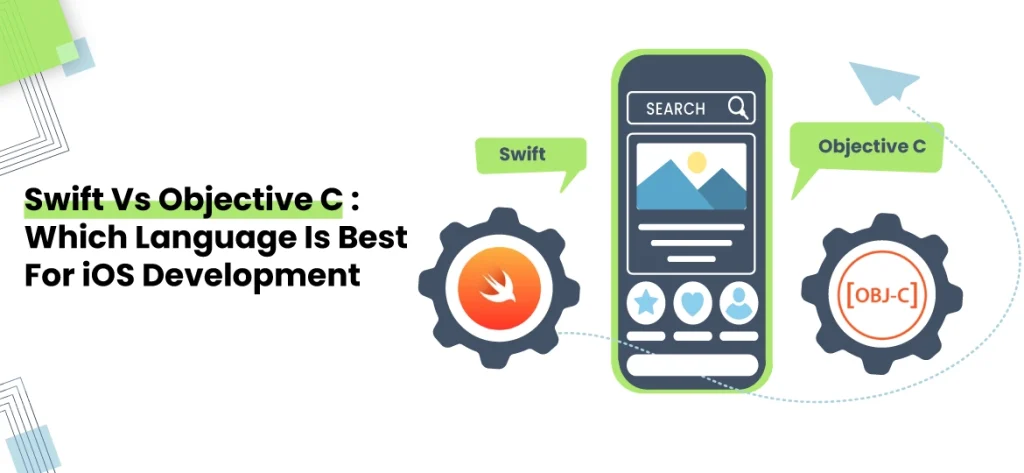
If you are planning an iOS product or budgeting to maintain one, the Swift vs Objective-C decision shows up early and shapes cost, hiring, and long-term maintainability. This is not a religious debate for a business owner; it is a practical question about which language reduces risk and total cost of ownership for the app you actually need to ship. Objective-C carried Apple platforms for decades and still runs inside large parts of the ecosystem. Swift, now more than a decade old and the default for new iOS work, has matured into a stable, well-supported language that most new hires expect to write. The honest answer to objective-c vs swift depends on whether you are starting fresh or maintaining an existing codebase, how large your engineering budget is, and how easily you can hire the right people. In this guide we compare the two languages on the factors that affect a build decision, not just the ones that interest engineers: performance, type safety, hiring and talent supply, maintainability, legacy support, and best-fit scenarios. We give a plain quick verdict, explain when each language fits, walk through cost and hiring implications, cover migration considerations for teams sitting on older code, and show how we approach iOS work in either language at EchoInnovate IT so you can move from decision to a working plan.
In this article
- Quick verdict: Swift for new builds, Objective-C for legacy and maintenance
- Swift vs Objective-C at a glance: the comparison that matters for a build decision
- When Swift is the right choice for a new iOS build
- When Objective-C still makes sense in 2026
- Cost and hiring implications of each language
- Migration considerations: moving from Objective-C to Swift
- How EchoInnovate IT builds and maintains iOS apps in either language
- Putting the decision together for your business
- Frequently Asked Questions
Quick verdict: Swift for new builds, Objective-C for legacy and maintenance
If you want the short answer to swift or objective c before reading the detail, here it is. For almost any new iOS app in 2026, Swift is the right default. It is the language Apple invests in, the one most current iOS developers write daily, and the one that ships with modern safety features that catch whole classes of bugs before they reach users. Choosing Swift for a greenfield build lowers your hiring risk, keeps you aligned with the direction of Apple’s tools and frameworks like SwiftUI, and makes it easier to onboard new engineers over the life of the product. Objective-C, on the other hand, remains the pragmatic choice when you already own a substantial Objective-C codebase that works, is well tested, and does not need a rewrite to meet your goals. Rewriting a stable app purely to change languages rarely pays for itself; the money is usually better spent on features your users actually asked for. There is also a large middle ground where a mixed codebase is correct: many mature apps run Swift and Objective-C side by side, adding new modules in Swift while leaving proven Objective-C code in place. The decision is therefore less about which language is better in the abstract and more about your starting point. If you are unsure which situation you are in, a short scoping call and a look at your existing code will settle it quickly, and it is the first thing we assess before quoting any iOS engagement or a new build on our mobile app development service.
Swift vs Objective-C at a glance: the comparison that matters for a build decision
Engineers can argue syntax for hours, but a business owner needs a compact view of how the two languages differ on the axes that change budgets and timelines. The table below summarizes swift vs objective-c for ios across performance, safety, hiring and talent supply, maintainability, legacy support, and best-fit use. Read it as guidance for a decision, not as absolute rules, because a skilled team can build a solid app in either language.
Use this as a starting filter. Once you know whether you are building new or maintaining old, the rest of the decision, including budget and team shape, follows naturally, and it is the same triage we run on our mobile app development engagements.
| Factor | Swift | Objective-C |
|---|---|---|
| Performance | Compiled, statically typed, competitive to fast for most app workloads | Mature runtime, dynamic messaging adds overhead in hot paths |
| Type safety | Strong; optionals and compile-time checks reduce null and type crashes | Weaker; nil messaging and dynamic typing let more errors reach runtime |
| Hiring and talent | Large, growing pool; expected by most new iOS hires | Shrinking pool; strongest among senior maintenance engineers |
| Maintainability | Concise, readable, fewer files; easier onboarding | Verbose header/implementation split; proven but slower to ramp on |
| Legacy support | Interoperates with Objective-C; not needed for very old code | Native fit for decade-old apps and C/C++ heavy integrations |
| Best fit | New apps, active roadmaps, SwiftUI, long-lived products | Maintaining stable legacy apps, incremental fixes, mixed codebases |
When Swift is the right choice for a new iOS build
For a new product, Swift is the default we recommend, and the reasons are practical rather than fashionable. First, Swift is where Apple is putting its effort. Modern frameworks such as SwiftUI, Swift Concurrency, and the latest APIs are designed with Swift first, so building in Swift keeps you aligned with the tools your engineers will actually use over the next several years. Second, Swift’s type system does real work for your budget. Optionals force developers to handle the absence of a value explicitly, and the compiler rejects many mistakes before code ever runs. In practice that means fewer crash reports, fewer emergency patches, and less time spent chasing null-reference bugs in production. Third, Swift is what the current talent pool knows. New iOS developers learn Swift, conference talks and tutorials assume Swift, and a Swift codebase is easier to staff as your team grows or turns over. Fourth, Swift code is generally more concise and readable, which shortens onboarding for every engineer who joins later. There are trade-offs to acknowledge honestly: Swift has changed a lot across its history, and older Swift code can need updates as the language evolves, though the pace has settled considerably in recent years. For a business, the net effect is that a new Swift app tends to have a lower total cost of ownership across its lifetime, and it pairs well with a cross-platform strategy if you later evaluate React Native app development for shared business logic across iOS and Android.
When Objective-C still makes sense in 2026
Objective-C is not a dead language, and treating it as one leads to expensive mistakes. The clearest case for staying with Objective-C is a large, stable, well-tested app that already exists and does what your business needs. If that app is generating revenue and its roadmap is mostly incremental, rewriting it in Swift is a cost with little user-visible benefit, and every rewrite carries the risk of reintroducing bugs that were fixed years ago. In that situation, the sound decision is to keep maintaining the Objective-C code and add new functionality carefully. Objective-C also has a genuine technical edge in a few niches. Its dynamic runtime supports patterns like method swizzling and heavy runtime introspection that some analytics, instrumentation, and older third-party SDKs rely on. Apps that integrate deeply with C or C++ libraries often sit comfortably in Objective-C, since Objective-C’s C heritage makes that bridging straightforward. There is also the reality of the talent market from the other direction: the senior engineers who know a legacy Objective-C system best are often the ones already maintaining it, and continuity of that knowledge has real value. The honest caution is that the Objective-C talent pool is shrinking, so relying on it long term raises staffing risk. The balanced approach most mature teams take is a mixed codebase, keeping proven Objective-C in place while writing new modules in Swift, which Apple’s tooling supports well. If your legacy app needs steady upkeep rather than a rebuild, our software development company keeps those systems healthy without forcing a premature rewrite.
Cost and hiring implications of each language
Language choice affects two budget lines directly: what you pay to build and what you pay to staff over time. On hiring, Swift has the advantage for most companies because the supply of Swift developers is larger and still growing, which keeps recruiting timelines and rates more predictable. Objective-C specialists are fewer and skew senior, so filling a pure Objective-C role can take longer and cost more, particularly for maintenance-only work that many developers view as a career risk. That scarcity is a real factor in long-term planning, not just a hiring inconvenience. On build cost, the language is rarely the biggest driver; scope, integrations, design, and backend work usually dominate. Still, Swift’s safety features and concise code tend to reduce debugging and maintenance hours over a product’s life, which lowers total cost of ownership even when the initial build estimate looks similar. As a general market reference, small iOS apps often land in the low tens of thousands of dollars, mid-complexity apps commonly run from roughly forty to well over a hundred thousand, and large, integration-heavy platforms go higher; treat those as ranges, not quotes. We never publish fixed prices for custom work because the honest number depends on your requirements, and we give a transparent quote after a short scoping call. For a deeper breakdown of what drives the number, see our guide on mobile app development cost, and if the constraint is capacity rather than budget, IT staff augmentation services can add vetted Swift or Objective-C engineers to your existing team.
Migration considerations: moving from Objective-C to Swift
If you decide your Objective-C app should move toward Swift, the important thing is to resist the urge to rewrite everything at once. A full rewrite freezes feature work, concentrates risk, and often costs far more than expected because subtle behavior encoded in years of bug fixes has to be rediscovered. The lower-risk path that most experienced teams use is incremental migration. Apple’s interoperability between Swift and Objective-C is strong enough that the two languages can live in the same project and call each other, which lets you add new features in Swift and convert existing modules only when you are already touching them for other reasons. Start by establishing a clean boundary: pick a self-contained module, port it to Swift, cover it with tests, and ship it before moving on. Prioritize areas that change often, since those benefit most from Swift’s safety and readability, and leave stable, rarely-touched Objective-C code alone until there is a concrete reason to change it. Good test coverage is the safety net that makes migration affordable, because it tells you quickly if a ported module behaves differently. Plan for a mixed codebase to exist for a long time; that is a normal, healthy state, not a failure to finish. The wrong reasons to migrate are fashion or resume-building. The right reasons are concrete: recurring crashes tied to Objective-C’s weaker type safety, difficulty hiring, or a roadmap that leans on Swift-first frameworks. We scope migrations module by module so you keep shipping while the codebase modernizes, and we plan each step against the real risk in your mobile app development roadmap rather than a blanket rewrite.
Weighing cross-platform options? Compare Flutter vs Kotlin vs Swift.
How EchoInnovate IT builds and maintains iOS apps in either language
We are an India-based custom and white-label software development studio, and iOS is core to what we do. Over twelve years and more than 500 products shipped, most of them under our clients’ own brands, we have built new Swift apps, maintained long-lived Objective-C systems, and modernized mixed codebases that grew across both. That range matters for your decision because we are not selling you a single language; we recommend the one that fits your situation and your budget. For new products we default to Swift, using current Apple frameworks and a test-backed structure that keeps the app maintainable as it grows. For existing Objective-C apps, we provide steady maintenance, careful feature work, and, when it is genuinely worth it, an incremental migration plan that keeps you shipping the whole time. Our team is 50-plus people, and we hold a 5.0 rating across six verified reviews on Clutch, which reflects how we work rather than how we market. Engagements can run as a full delivery team or as embedded engineers who extend your in-house group, and for longer programs many clients set up a dedicated offshore development center with us to keep a stable iOS team over time. On pricing we stay transparent: we share honest market ranges up front and give a firm quote only after a short scoping call, because a real number depends on your requirements. Whether you are starting fresh in Swift or keeping an Objective-C app healthy, our mobile app development team can take it from decision to a working plan.
Putting the decision together for your business
Stepping back, the swift vs objective-c question resolves into a small set of clear signals once you look at your own situation rather than the abstract debate. If you are building something new, choose Swift; it aligns with Apple’s direction, it is easier and cheaper to staff, and its safety features lower your maintenance bill over the product’s life. If you own a stable, revenue-generating Objective-C app, keep maintaining it and add new work in Swift where it makes sense, rather than paying for a rewrite that your users will never notice. If you are somewhere in between, a mixed codebase is a legitimate long-term state, and the practical goal is to modernize the parts that change most while leaving proven code alone. The factors that should drive the call are hiring risk, total cost of ownership, and the pace of your roadmap, not language loyalty. Two mistakes cost the most in practice: rewriting a working app for fashion, and clinging to Objective-C so long that you cannot staff it. Avoid both by deciding on evidence from your codebase and your goals. If you are weighing a broader technology choice at the same time, our comparison of React Native vs Flutter covers the cross-platform side, and if you plan to extend your team to do the work, our guide to hire offshore developers walks through how to add capacity without losing quality. When you are ready to translate the decision into a scope and a number, a short scoping call is the fastest next step.
Start with a 2-week pilot sprint
Not sure whether Swift or Objective-C is right for your next release? Start with our $1,500 fixed-price 2-week pilot sprint. In two weeks our iOS engineers assess your codebase or requirements, recommend Swift, Objective-C, or a mixed approach, and deliver a working slice of real functionality plus a clear scope and estimate, with no obligation to continue. It is the fastest way to turn the decision into a plan backed by shipped code. Learn more about our approach on our mobile app development service page, then book a short scoping call and we will follow up with a transparent quote tailored to your project.
See the service →Book a scoping call →Frequently Asked Questions
Swift or Objective-C — which should I use in 2026?
For nearly any new iOS app in 2026, use Swift. It is Apple’s default language, it is far easier to hire for, and its type safety reduces crashes and long-term maintenance cost. Choose Objective-C when you already own a stable, well-tested Objective-C app that works and does not need a rewrite, or when you rely on runtime features and C/C++ integrations that Objective-C handles naturally. Many mature apps correctly run both, adding new modules in Swift while keeping proven Objective-C in place. The right call depends on whether you are building new or maintaining existing code.
Is Objective-C still supported and safe to use for a business app?
Yes. Apple continues to support Objective-C, and it runs inside large parts of the iOS ecosystem, so an existing Objective-C app is safe to keep running and maintaining. The main long-term risk is staffing, because the Objective-C talent pool is shrinking and skews senior, which can make maintenance-only hiring slower and costlier. For a stable app with an incremental roadmap, continuing on Objective-C is often the sound financial choice; rewriting it purely to change languages rarely pays off for the business.
Does Swift perform better than Objective-C?
For most app workloads the difference is not the deciding factor. Swift is compiled and statically typed, which is competitive to faster in typical code paths, while Objective-C’s dynamic messaging adds some overhead in hot loops but is well optimized and battle-tested. Real-world app performance is usually dominated by network calls, image handling, and data layers rather than the language itself. A skilled team can build a fast app in either. Base your decision on safety, hiring, and maintainability, and treat raw language performance as a minor input unless you have a specific compute-heavy requirement.
How much does it cost to build an iOS app in Swift or Objective-C?
The language is rarely the biggest cost driver; scope, integrations, design, and backend work usually dominate. As a market reference, small apps often land in the low tens of thousands of dollars, mid-complexity apps commonly run from roughly forty thousand to well over a hundred thousand, and large integration-heavy platforms cost more. These are ranges, not quotes. We do not publish fixed prices for custom work because the honest number depends on your requirements, so we give a transparent quote after a short scoping call. Swift often lowers total cost of ownership over time thanks to fewer runtime bugs.
Should I migrate my Objective-C app to Swift, and how?
Migrate only for concrete reasons such as recurring type-safety crashes, hiring difficulty, or a roadmap that depends on Swift-first frameworks, not for fashion. When you do migrate, avoid a full rewrite. Use incremental migration: Swift and Objective-C interoperate in the same project, so you convert one self-contained module at a time, cover it with tests, and ship before moving on. Prioritize code that changes often and leave stable, rarely-touched Objective-C alone. Expect a mixed codebase to persist for a long time, which is normal. We scope migrations module by module so you keep shipping throughout.
Written by Kush P, Chief Technology Officer at EchoInnovate IT. Kush has led custom software and dedicated-team builds for 12 years, with 500+ products shipped — most of them under clients’ own brands.